Prep Tools
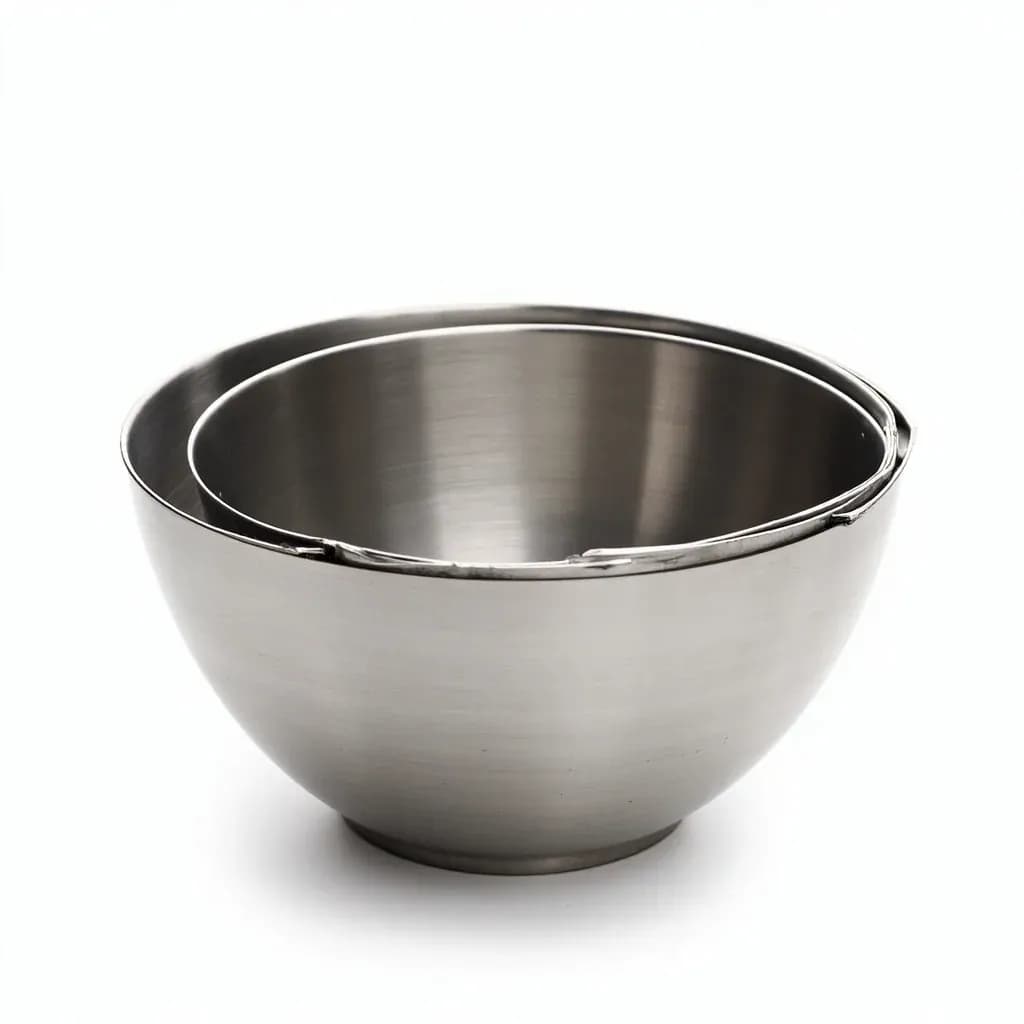
Mixing Bowl Set
A nesting set of graduated bowls for combining, whisking, and holding prepped ingredients.
A mixing bowl set is a series of graduated bowls, usually nesting for storage, used to combine batters, toss salads, marinate proteins, and organize mise en place. Cooks reach for different sizes throughout a recipe, from tiny bowls for spices to large ones for dough. Sets often mix materials like stainless steel, glass, and plastic for different tasks.
A mixing-bowl set is the workhorse cluster of a home kitchen — three to seven graduated bowls, usually nesting inside one another, that handle nearly every wet and dry combination task a cook performs. The nesting design matters: it keeps the bench and cabinet tidy, but the real value is having the right size at hand for the job, whether cracking two eggs into a small bowl, tossing a salad for four in a medium one, or kneading bread dough in a five-quart. A thoughtful set outlasts most other tools in the kitchen, so the material and sizing decisions made at purchase compound for years.
The choice of material shapes how the set behaves. Stainless steel is the professional default — light, non-reactive, freezer-tolerant, and safe to perch over a simmering pot for a bain-marie. Glass (Pyrex-style tempered glass, originally borosilicate when Corning introduced it in 1915) lets you monitor a marinade, go from fridge to microwave, and watch a sauce emulsify. Ceramic holds temperature longest, which is useful for proofing dough. Plastic is light and cheap but stains, scratches, and retains odors; copper is the traditional choice for egg-white foams because trace copper ions form a complex with conalbumin in the whites and stabilize the foam.
A five-piece set graduated from roughly one to five quarts covers almost every home recipe, and the middle bowl — about three quarts — does the most day-to-day work. Look for rolled or flared rims (easier to pour and grip), a flat or non-slip base for hand-mixing, and at least one bowl that takes a snug lid if you want the set to double as food storage.
Alternatives
Types & varieties
Workhorse of professional kitchens. Light, non-reactive, can sit over a double boiler, chills fast in the freezer for whipping cream. Can be noisy; lacks measurement markings unless printed on.
Pyrex-style. Lets you see contents, microwave- and often oven-safe (check manufacturer), good for marinating and overnight fridge storage. Heavier; chips at the rim if knocked.
Heaviest, often the most decorative; excellent heat retention for proofing dough or resting batter. Vulnerable to thermal shock — never move a cold bowl into a hot oven.
Lightweight and inexpensive; good for kids, picnics, and camping. Stains from turmeric and tomato, holds odors, and scratches over time.
Traditional for beating egg whites — copper ions stabilize the foam. Expensive, often tin-lined, and needs hand-polishing.
Stainless or plastic bowl with a silicone or rubber ring that grips the counter; ideal for whisking, hand-mixing, and use with a hand mixer.
Each bowl has a matching plastic lid, turning the set into a food-storage system — useful for marinating, holding prep, and refrigerating leftovers.
Material matters more than piece count
Most cooks buy a set once and live with it for a decade, so the material decision does more long-term work than the brand or the color. The honest ranking for a working kitchen is stainless first, glass second, ceramic third, plastic a distant fourth, and copper a specialty luxury. A mixed set — two stainless, two glass, one ceramic — is a strong compromise: stainless for everything hot or fast, glass for marinating and microwaving, ceramic for dough work. Plastic earns its place only in the kids' drawer, the picnic basket, or the camp box, where breakage risk outweighs staining and odor retention.
- Stainless for: double-boiler work, freezer-chilled cream whipping, vinaigrettes, anything that needs to go in and out of cold quickly.
- Glass for: marinating (you can see what's happening), tomato- and turmeric-based mixtures, microwave reheating, overnight fridge storage.
- Ceramic for: bread proofing, long rests of batter, serving salads at the table.
- Copper for: egg-white foams and meringues where maximum volume and stability matter — copper ions bind to conalbumin in the whites and reinforce the foam.
Sizing a set to the way you cook
A five-piece set graduated from one to five quarts is the right starting point for most households. Smaller than one quart is redundant — a measuring cup or small prep bowl covers the same ground — and larger than six quarts becomes awkward to lift and store. The three-quart bowl is the workhorse: pancake batter for four, a green salad, two cups of whipped cream, a pound of cookie dough all fit comfortably. The five-quart handles bread dough, a large batch of slaw, or a double recipe of meatballs. Choose the largest bowl with one eye on the cabinet and another on the sink — the most common mixing-bowl mistake is buying a set whose biggest piece is the one that fits least well in either place.
- 1 qt: cracking eggs, whisking a small vinaigrette, holding a few tablespoons of prep.
- 1.5–2 qt: whisking a dozen eggs, small salad, melting butter or chocolate over a double boiler.
- 3 qt: the daily driver — batters, doughs, salads, marinades for a pound of meat.
- 4–5 qt: bread dough, large salads, tossing pasta, holding a whole chicken while seasoning.
- 6+ qt: only needed for batch cooking, big-batch baking, or feeding a crowd.
Care, cleaning, and long-term storage
Stainless, glass, and BPA-free plastic sets are generally dishwasher-safe; copper and decorated ceramic should be hand-washed to preserve the finish. To keep a nesting set from grinding against itself, slip a paper towel or silicone liner between rims — this is the single most effective way to prevent fine scratches that eventually turn into stress cracks in glass. Lidded sets are notorious for mismatched covers in the cabinet, so label each lid with the matching bowl's volume in dry-erase marker, or store them all nested inside the largest bowl. A cracked or chipped glass bowl should be retired from food service: chips harbor bacteria, and a rim chip is almost always the start of a full break.
- Stainless and glass: dishwasher-safe, but hand-washing prolongs the mirror finish on stainless.
- Copper: hand-wash, dry immediately, polish with a dedicated copper cleaner or lemon-and-salt paste when it tarnishes.
- Ceramic: avoid sudden temperature changes; never put a chilled ceramic bowl into a hot oven.
- Plastic: replace once the surface goes cloudy or scratched — those scratches hold fat and odor.
- Glass with a rim chip: retire from food use, demote to a compost pail or utensil holder.
Common uses
Tips & pitfalls
- Pick the largest bowl that fits in your cabinet and your sink — a too-small bowl is the single most common cause of spills when whisking or running a hand mixer.
- Stabilize a wobbly bowl by setting it on a damp folded kitchen towel or a silicone trivet before you start whisking.
- Chill a stainless bowl in the freezer for 10–15 minutes before whipping cream; the cold surface cuts whipping time and helps the foam hold its shape.
- Use glass or ceramic — never plastic — for marinating tomato, turmeric, or curry-based mixtures to avoid permanent staining and odor retention.
- For egg whites and meringues, wipe the bowl with a cut lemon or a paper towel dipped in white vinegar, then dry; any trace of fat will deflate the foam. Copper and stainless are best, plastic is the worst choice.
- Avoid metal whisks in a coated or decorated ceramic bowl — the wire can score the glaze over time. Use a silicone whisk or a wooden spoon instead.
- Don't lift a heavy, full bowl by the rim with one hand; grip from underneath with both hands, or slide it to the counter edge before hoisting.
- If lids are mismatched, label each lid with the matching bowl's volume in dry-erase marker — lids migrate in the cabinet, but the volume does not.
Good to know
- Typical pieces per set
- 3 to 7, with 5-piece sets being most common
- Common size range
- Graduated from roughly 1 qt (≈1 L) up to 5–6 qt (≈5–6 L); some sets extend to 8 qt
- Most-used size
- 3 qt — handles most recipes for two to four people
- Standard materials
- Stainless steel, tempered glass, ceramic/stoneware, BPA-free plastic, copper, and silicone-collared hybrids
- Professional standard
- 18/8 or 18/10 stainless steel; lightweight and dent-resistant
- Glass bowl origin
- Pyrex (borosilicate, later tempered soda-lime) introduced by Corning in 1915
- Storage
- Nesting design — bowls stack inside one another; sets with lids stack flat or store inside the largest bowl
- Weight (5-piece stainless)
- Roughly 1.5–2.5 lb (700 g–1.1 kg) total
- Dishwasher-safe
- Most stainless, glass, and BPA-free plastic sets are; hand-washing extends life of copper and decorated ceramic
- Microwave-safe
- Glass and most plastic sets; never stainless or metal
Also called
nesting bowls · prep bowls
Related

Peeler
Swift blade for stripping skin off fruit and vegetables

Grater
Sharp-toothed surface for shredding cheese and vegetables

Microplane
Ultra-fine rasp for citrus zest, garlic, and hard cheese

Mixing Bowl
All-purpose bowl for combining, whisking, and tossing

Whisk
Looped wires that beat air into eggs, cream, and sauces

Spatula
Flat blade for flipping, lifting, and scraping

Slotted Spoon
Pierced spoon that lifts solids and drains the liquid behind

Wooden Spoon
Gentle, heat-friendly spoon for stirring anything