Prep Tools
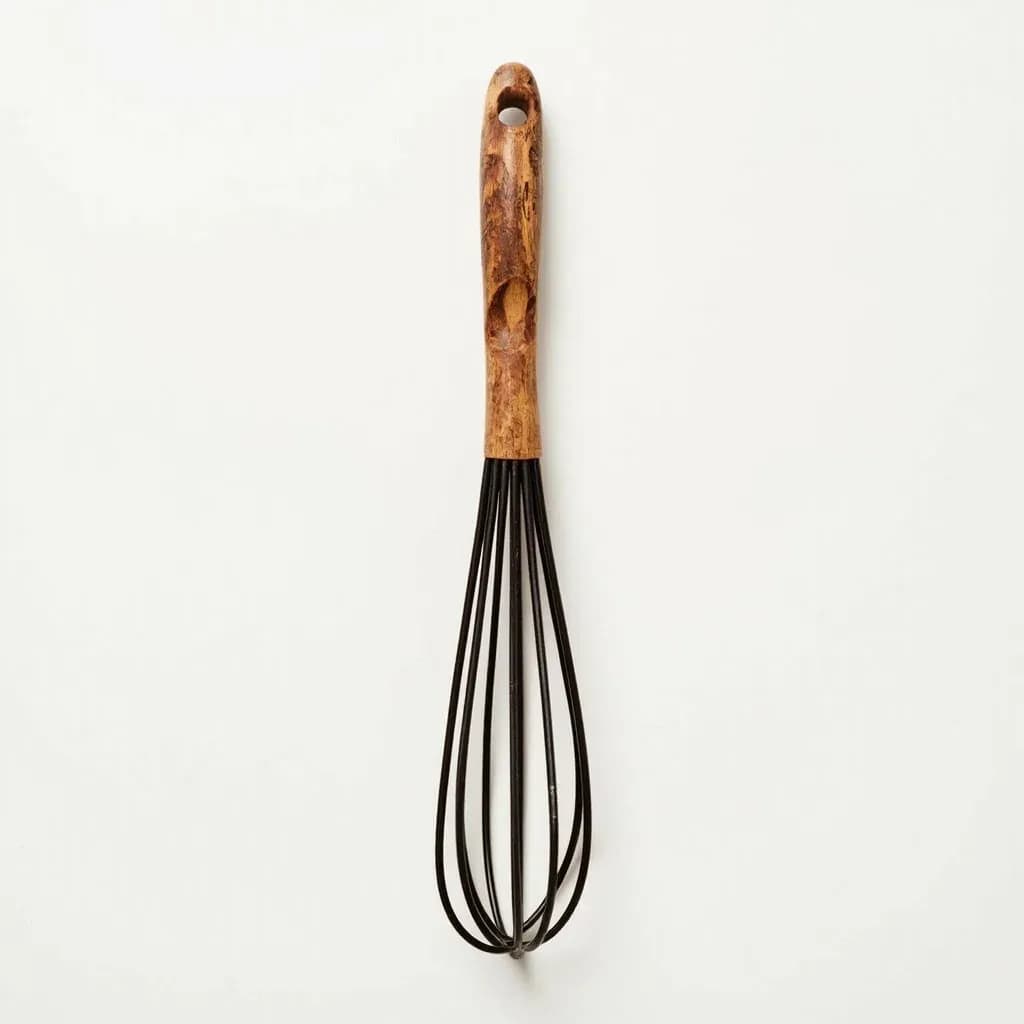
Molinillo Wooden Whisk
A carved Mexican wooden whisk twirled between the palms to froth hot chocolate and atole.
A molinillo is a traditional Mexican turned-wood whisk with loose carved rings around its head. It is spun by rolling the handle rapidly between the palms in a pot of hot chocolate or atole to create a thick, airy foam. The grooves and rings agitate the liquid to aerate it without splashing, a technique central to traditional Mexican drinking chocolate.
The molinillo is a hand-carved wooden whisk native to Mexico, used since pre-Hispanic times to aerate and froth hot chocolate and atole. Its head is shaped into a series of rings, prongs, or stacked wooden discs that catch the liquid as the tool spins, while the long handle sits between the cook's palms. The result is a thick, velvety foam that no metal whisk or spoon can easily replicate, and the tool has become inseparable from the ritual of chocolate caliente in the Mexican kitchen.
What makes the molinillo distinctive is the physics of its motion. Rather than being moved through the liquid like a Western whisk, it is held vertically and rolled between the palms so that only the carved head rotates. The spinning rings churn the surface, forcing air into the fats of the milk and cocoa butter, building a stable, long-lasting foam. The wooden construction is gentler on the pot than a metal coil and quieter than an immersion blender, and it carries a sensory warmth that has kept it on Mexican tables long after motorized frothers arrived.
Beyond function, the molinillo is a cultural object: traditionally turned from a single block of dense regional hardwood by village woodworkers, it is as much a part of the breakfast table as the tamales and pan dulce it accompanies. Hand-carved pieces from Oaxaca and Puebla are the most prized, sought after for the precision of their rings and the weight of their heads.
Alternatives
Types & varieties
Long, slender profile with closely spaced carved rings; often finished with a small turned finial at the tip. Hand-carved pieces from Oaxacan cooperatives are a well-known traditional source.
Stockier head with deeper grooves and a heavier feel; frequently painted in bright reds, yellows, or blues.
Free-moving wooden rings threaded on the head that clatter and slash the liquid as it spins, producing a particularly airy foam.
Lighter, more uniform carving in softer woods; functional for occasional use but less durable than hand-carved hardwood.
Anatomy of the tool
A well-made molinillo is a single turned and carved piece of wood with three working parts. The spinning head sits at the bottom, carved into rings or stacked discs that catch the liquid; in the middle is a long, smooth shaft that rests between the cook's palms; at the top is a small finial knob that keeps the rolling palms from sliding off the shaft. The proportions matter: a heavier head carries more momentum and pulls more air into the drink, while a too-light head stalls in the liquid and produces only modest foam.
Buying and caring for one
A solid molinillo should feel heavy for its size and have crisp, deeply cut rings rather than shallow decorative grooves. Avoid pieces with rough grain or visible glue joints—the tool should be a single piece of wood. Care is simple but worth following if you want the piece to last decades.
- Soak a new molinillo in cool water for 20–30 minutes before first use to swell the grain and reduce splintering; towel-dry well afterward.
- Rinse in warm water after each use; avoid dish soap on unfinished carved hardwood unless labeled food-safe.
- Towel-dry immediately and store in open air so the wood does not mildew in a closed drawer.
- Once or twice a year, rub a thin coat of food-grade mineral oil into the wood to prevent drying and cracking.
- Never put a molinillo in the dishwasher; the heat and detergent will check and split the wood.
How it compares to a milk frother
A handheld milk frother and an immersion blender will both aerate chocolate and atole, but they work differently. An immersion blender pulls air in aggressively and is fast, but it is easy to overdo, and the vortex it creates can splatter hot liquid. A molinillo circulates the entire body of liquid as it spins, gently dissolving discs of chocolate and evening out the texture while building a denser, more stable foam. It is also slower, quieter, and presents better at the table—a quality that has kept it in use for centuries.
Common uses
Tips & pitfalls
- Hold the molinillo vertically between your open palms and roll back and forth briskly; do not stir in a circle—the spinning head is what builds foam, not lateral motion.
- Use a deep, narrow pitcher or small pot so the head is fully submerged and the foam rises cleanly instead of sloshing out the sides.
- Warm the milk to just below a simmer (around 80 °C / 175 °F) before adding the chocolate; heat helps the cocoa butter and milk fat emulsify and trap air.
- For a thicker, longer-lasting cap of foam, use whole milk or a blend of milk and cream; skim milk gives a thin froth that disappears within a minute.
- Add the chocolate (or masa, for atole) before frothing so the spinning head helps dissolve it evenly instead of leaving gritty pockets.
- Keep the head from banging the bottom of the pot—impact dulls the carved rings and can split the wood along the grain.
- Do not run the molinillo dry in the air to "spin it up" first; the foam forms inside the liquid, and dry spinning wastes effort and may throw liquid from the pot.
- If the foam collapses quickly, the liquid was either too hot (above a simmer, which scalds the milk and breaks the foam) or too cool (below 60 °C / 140 °F, which traps less air); aim for that narrow band just under a simmer.
Good to know
- Origin
- Mesoamerica; documented among Aztec and Maya chocolate-drinking rituals and recorded by Spanish chroniclers after the conquest.
- Etymology
- Spanish diminutive of molino ("mill"), a nod to its milling-and-frothing action.
- Material
- Carved from a single piece of dense hardwood; traditional regional species vary, often painted or left natural.
- Typical length
- Roughly 20–30 cm (8–12 in) overall, with a head of about 8–15 cm.
- Head design
- Elongated or bulbous with carved rings, prongs, or loose threaded wooden rings that agitate the liquid as it spins.
- Primary function
- Aerating and frothing hot chocolate and atole by centrifugal force.
- Motion
- Held vertically and rolled rapidly between the open palms so only the head rotates.
- Cultural context
- Iconic to Mexican chocolate caliente and champurrado, traditionally served with tamales and pan dulce.
Also called
Wooden Whisk (Molinillo) · molinillo whisk · chocolate frother
Related

Peeler
Swift blade for stripping skin off fruit and vegetables

Grater
Sharp-toothed surface for shredding cheese and vegetables

Microplane
Ultra-fine rasp for citrus zest, garlic, and hard cheese

Mixing Bowl
All-purpose bowl for combining, whisking, and tossing

Whisk
Looped wires that beat air into eggs, cream, and sauces

Spatula
Flat blade for flipping, lifting, and scraping

Slotted Spoon
Pierced spoon that lifts solids and drains the liquid behind

Wooden Spoon
Gentle, heat-friendly spoon for stirring anything