Prep Tools
Spam Musubi Mold
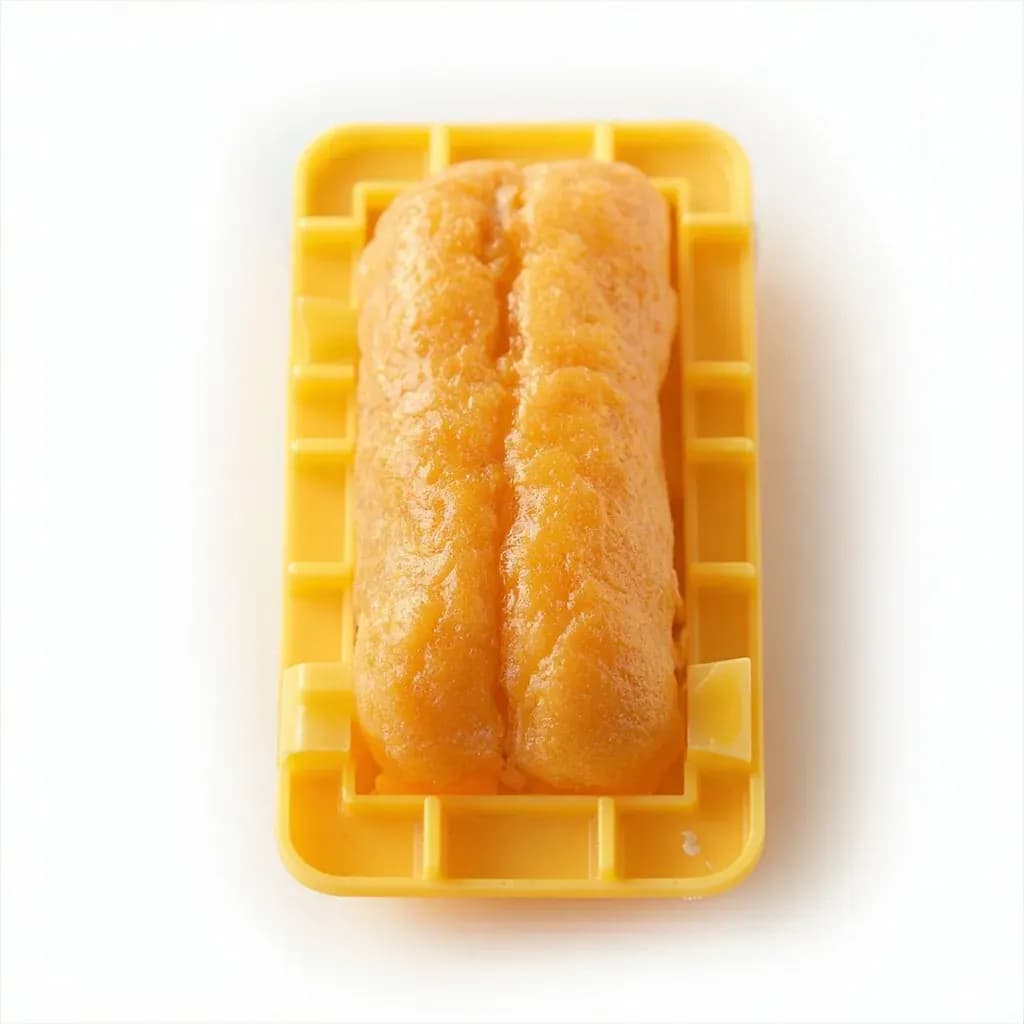
Rectangular press that shapes rice into the neat Spam-sized block for Hawaiian musubi.
An open-ended rectangular mold, usually plastic, used to press warm rice into a firm block the exact size of a slice of Spam. The cook layers rice in the mold, packs it with the included presser, then wraps the block and meat in a strip of nori. It guarantees the uniform, tidy shape that defines Hawaiian Spam musubi.
The Spam Musubi Mold is a small, handheld press that turns a scoop of cooked short-grain rice into a compact rectangular block sized to match a slice of Spam. Its single job is dimensional consistency: roughly 3 by 3 inches on the face and 1 to 1.5 inches tall, the exact footprint needed so the grilled Spam sits flush on the rice and the nori strip wraps cleanly around both. That tidy, layered cross-section is what visually defines a musubi, and the mold exists to guarantee it without the cook having to eyeball it.
Before the plastic mold existed, home cooks in Hawaii packed rice into an emptied Spam can and pushed it out by hand — a method that still works and is described under variants below. The dedicated press replaced that improvisation with a faster, repeatable result, and it spread through Hawaiian households, Japanese 100-yen shops, and Asian markets worldwide. Most are food-safe plastic (polypropylene), with silicone and occasional stainless versions available; many come as two- or three-piece kits that include a portioning paddle and a musubi-nori cutter.
The tool's real value shows up at scale. A cook making a plate of musubi for lunch, a school bento, or a fundraiser needs every block the same height and width so the Spam covers the top edge to edge and the nori strip (about 1 inch wide) wraps without buckling. The press delivers that with minimal skill — one or two attempts is enough for a beginner to produce uniform, release-clean blocks — which is why it has become standard equipment wherever Spam musubi is made at home.
Alternatives
Types & varieties
Open rectangular frame with a flat press that drops in from the top; the simplest and most common form, used with plastic wrap for release.
Adds a solid bottom plate so the formed musubi can be lifted cleanly and slid off without tipping.
Press has an attached handle or palm pad for even downward pressure; usually sold as part of a kit with a portioning paddle.
Flexible walls peel away from the rice block for easy release; edges are slightly less crisp than rigid plastic.
Bundle including mold, plastic portioning spoon, musubi-nori cutter strip, and sometimes a sleeve of musubi nori — a common gift or starter set.
Empty, cleaned Spam can used by hand; the original improvised mold and still a reliable substitute when no press is on hand.
Why the mold matters
A musubi is judged at a glance. If the rice block is taller on one side than the other, the Spam overhangs and the nori strip binds unevenly; if it is shorter than the Spam, the meat slides off when wrapped. The mold eliminates both failure modes by setting the block's height and width to a fixed dimension. That same consistency is what makes a tray of musubi look like a tray of musubi rather than a pile of improvised rice sandwiches.
- Fixed dimensions match a standard Spam slice so layering is automatic.
- Even compression keeps the rice block intact when the nori strip is wrapped around it.
- Repeatable output means a batch of a dozen looks uniform for a bento, plate lunch, or potluck.
Choosing rice and seasoning
The mold shapes the rice, but the rice itself determines whether the musubi holds together or falls apart. Short- or medium-grain Japanese-style rice is the standard because its starch content binds the grains under pressure. Long-grain rice lacks the stickiness and the block will crumble on release. Seasoning the rice — even lightly with sushi vinegar or a salt-sugar-vinegar mix — is what makes the block taste like musubi rather than plain white rice; the mold does not address flavor.
Working without a mold
The Spam can is the original mold and still works in a pinch. Stand an empty, washed Spam can upright on a small square of plastic wrap, leaving the original bottom intact, and pack in seasoned short-grain rice. Press the rice down firmly with your fingers or the bottom of a smaller can, then turn the can over and push the rice block out from the base. The footprint is slightly larger and the edges are rounder, but the technique is identical: press rice, top with Spam, wrap with nori.
Common uses
Tips & pitfalls
- Wet the inside of the mold and your hands with water or a lightly vinegared dip to keep rice from sticking — this is the single most common fix for crumbly releases.
- Line the mold with a small piece of plastic wrap for the cleanest, fastest release, especially with very sticky short-grain rice; lift the wrap and the block slides out.
- Use short- or medium-grain Japanese-style rice; long-grain rice will not hold the block shape and is a frequent cause of musubi that falls apart.
- Season the rice with sushi vinegar (or a light salt-sugar mix) so the block tastes like musubi, not plain white rice — the mold shapes but does not flavor.
- Fill the mold slightly over the rim, then press flush with the lid; over-pressing crushes the grains into a dense paste and ruins the texture.
- Dampen the portioning paddle so each scoop of rice slides off cleanly into the mold without dragging.
- Press the Spam slice gently into the rice block rather than hammering it down, so the rice keeps its shape under the nori strip.
- Wrap with a 1 in (2.5 cm) musubi-nori strip seam-side down so it does not uncurl; if you cannot find musubi nori, cut full sheets into 1 in strips with a sharp knife.
Good to know
- Tool type
- Handheld press for forming rectangular rice blocks
- Typical material
- Food-safe plastic (polypropylene); silicone and occasional stainless versions also sold
- Standard footprint
- Roughly 3 in × 3 in (7.5 cm × 7.5 cm), matching a slice of Spam
- Rice capacity
- Approximately 1/3 to 1/2 cup (80–110 g) of cooked short-grain rice per musubi
- Common configuration
- Two-piece (frame + press) or three-piece (base, frame, plunger/lid); kits often include a portioning paddle and nori cutter
- Companion nori
- Paired with thin 1 in (2.5 cm) "musubi nori" strips
- Cleaning
- Hand-wash; most plastic and silicone molds are top-rack dishwasher safe
- Cost range
- Inexpensive; widely available at Asian markets, Daiso-style stores, and online
Also called
Musubi Maker · Onigiri Mold · Spam Musubi Press
Related

Peeler
Swift blade for stripping skin off fruit and vegetables

Grater
Sharp-toothed surface for shredding cheese and vegetables

Microplane
Ultra-fine rasp for citrus zest, garlic, and hard cheese

Mixing Bowl
All-purpose bowl for combining, whisking, and tossing

Whisk
Looped wires that beat air into eggs, cream, and sauces

Spatula
Flat blade for flipping, lifting, and scraping

Slotted Spoon
Pierced spoon that lifts solids and drains the liquid behind

Wooden Spoon
Gentle, heat-friendly spoon for stirring anything