Prep Tools
Non-Skid Counter Mat
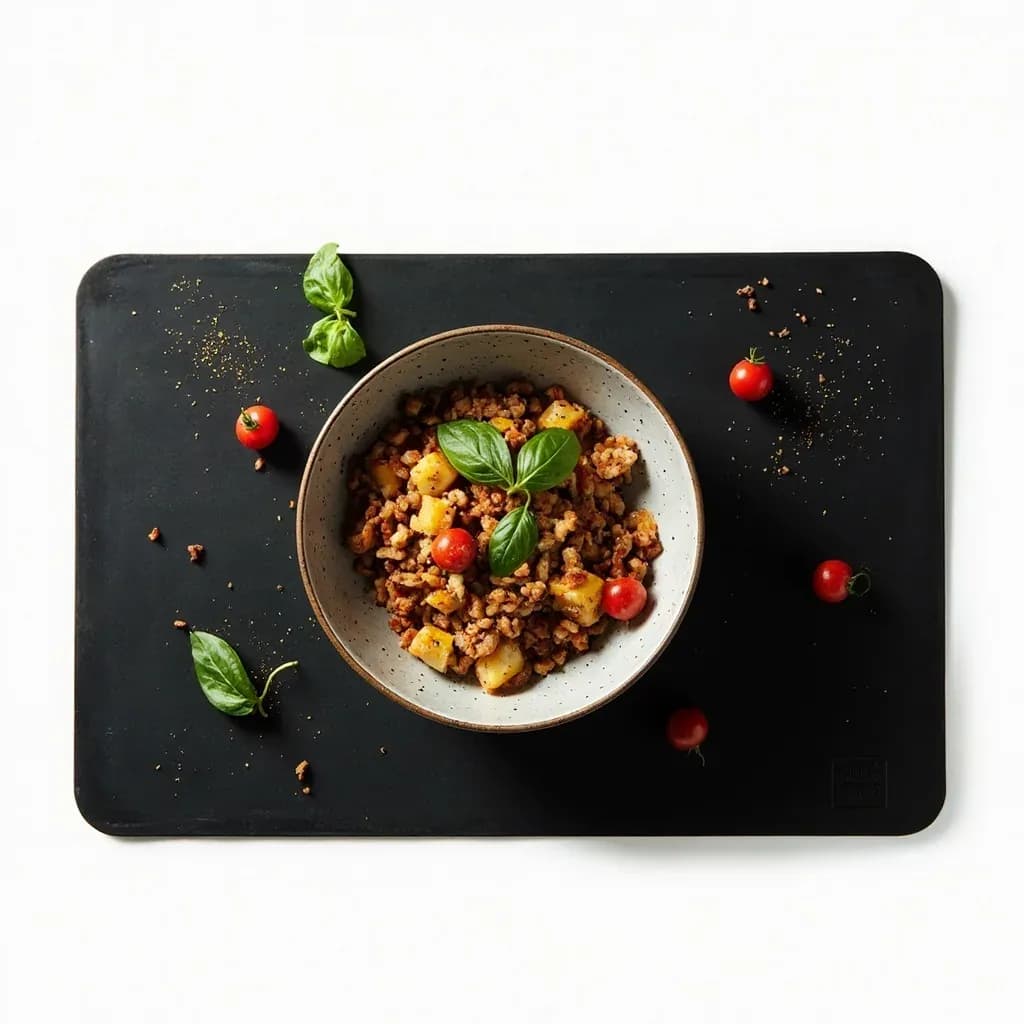
A grippy rubber or silicone mat that keeps bowls and boards from sliding while you work.
A non-skid counter mat is a thin grippy sheet placed under cutting boards, mixing bowls, or stand mixers to stop them shifting during use. It improves safety and control when chopping, whisking, or kneading. Many are silicone or rubber and double as trivets or drying mats.
A non-skid counter mat is a thin pad, most often food-grade silicone, natural rubber, or a microfiber-over-rubber laminate, that sits on the work surface to anchor bowls, boards, and small appliances. Its value is most obvious on the slick counters most home cooks actually have—polished granite, quartz, stainless steel, glass, and high-gloss laminate—where a damp cutting board or a heavy stand mixer will skate with the slightest provocation. The mat works by giving two opposing surfaces (the counter below and the bowl or board above) something with a high coefficient of static friction to bite into, so lateral force from whisking, chopping, or vibration is absorbed as shear stress inside the mat rather than as sliding motion.
What separates a useful mat from a useless one is the combination of grip on both faces, sensible thickness, and resistance to grease and water. Solid silicone sheets are heat-tolerant and wipe clean in seconds; dense rubber mesh grips tenaciously when wet; microfiber-topped versions are quieter under bowls and gentler on soft stone than hard plastic. The cheap PVC shelf liner sold by the yard will stop a bowl in the short term, but it tends to off-gas, harden, and leave a tacky residue; for any surface that touches food, stick to FDA-grade silicone or natural rubber.
A non-skid counter mat is not the same thing as a silicone baking mat (which is engineered as a heat-rated, food-contact surface for sheet pans) or as adhesive grip dots (which are bonded semi-permanently to the item itself). For general prep work—chopping, mixing, running a stand mixer—a dense silicone sheet or a rubber mesh pad is the right tool.
Alternatives
Types & varieties
Smooth, food-grade silicone (often the same material as silicone baking mats); doubles as a trivet, is heat-safe, and wipes clean easily.
Open-weave natural or synthetic rubber with excellent wet grip; dishwasher-friendly on the top rack; not rated for high heat.
Soft cloth top with a textured or rubberized backing; quieter under bowls than hard silicone, and gentler on stone counters.
Cheap, grippy when new, and sold by the yard; tends to off-gas, harden, and stick to surfaces over time—generally not recommended for direct food contact.
Sticky-backed pieces applied to the bottom of a board or bowl rather than the counter; a different solution to the same problem and semi-permanent.
How the grip actually works
A non-skid mat exploits the difference between static and kinetic friction. The rubber or silicone surface has a high coefficient of static friction against both the countertop and the bottom of the bowl or board, so when you push sideways with a whisk or a knife, that lateral force is dissipated as shear stress inside the mat instead of as sliding motion across the counter. The effect is most dramatic on the surfaces where every other object wants to skate: polished stone, stainless, glass, and high-gloss laminate. A thin film of water, oil, or flour between any of those interfaces collapses the grip instantly, which is why both surfaces must be clean and dry for the mat to do its job.
Choosing the right mat for the job
Match the mat to the task rather than buying one universal pad.
- For chopping and general prep on stone or laminate, choose a dense silicone sheet around 2 mm thick; it grips, wipes clean, and tolerates a hot pan set down briefly.
- For whisking and mixing in bowls, a rubber mesh mat grips best when wet and won't skate even under aggressive beating.
- For stand mixers, grinders, and other vibrating appliances, use the thickest mat you can find (about 3 mm) so the weight of the machine doesn't compress a thin mat and let it creep.
- For quieter work on soft or polished stone, pick a microfiber-topped mat; the soft cloth face dampens noise and is less likely to mar delicate surfaces than a hard pad.
- Avoid PVC for any food-contact surface; reserve it for lining drawers or shelves where the goal is just to keep jars from shifting.
Common uses
Tips & pitfalls
- Wipe both the mat and the bottom of the bowl or board before setting it down—grease, water, or crumbs dramatically reduce grip.
- If a rubber mat has lost its tack, wash it in hot soapy water, air-dry, and lightly dust with cornstarch to temporarily restore friction.
- Never put a hot pan directly on a PVC or standard rubber mat; use a heat-rated silicone mat or a trivet instead.
- Replace the mat as soon as it looks shiny, gummy, or cracked; degraded rubber can leave marks on light countertops and harbor mold in crevices.
- For heavy stand mixers, choose a thicker mat (about 3 mm) so the machine's weight doesn't compress the silicone and let it creep.
- Don't double up mats; a thin mat on a thick mat tends to slide as a unit. Use a single, properly sized pad instead.
- Avoid chopping directly on silicone sheets unless they're marketed as cutting mats—silicone dulls knife edges faster than wood or plastic boards.
Good to know
- Primary materials
- Food-grade silicone, natural rubber, or PVC with a high-friction surface; microfiber-over-rubber is a softer alternative.
- Heat resistance
- Food-grade silicone versions tolerate 400–500°F (205–260°C); rubber and PVC mats should be kept away from direct heat.
- Common sizes
- Rectangles around 12×15 in (30×38 cm) and 15×18 in (38×46 cm); also sold by the linear foot or in rolls for custom fitting.
- Typical thickness
- Roughly 1–3 mm; thin silicone sheets on the low end, denser rubber mats on the high end.
- Cleaning
- Most silicone and dense rubber mats are dishwasher-safe on the top rack; mesh rubber and microfiber mats are best hand-washed and air-dried.
- Food safety
- Choose FDA food-grade silicone or natural rubber; PVC versions are inexpensive but can degrade and have raised phthalate concerns.
- Service life
- Replace when the surface turns shiny, gummy, or cracked—usually 1–3 years of regular kitchen use.
- Storage
- Store flat or loosely rolled; sharp folds create permanent creases that become dead spots with no grip.
Also called
anti-slip mat · grip mat
Related

Peeler
Swift blade for stripping skin off fruit and vegetables

Grater
Sharp-toothed surface for shredding cheese and vegetables

Microplane
Ultra-fine rasp for citrus zest, garlic, and hard cheese

Mixing Bowl
All-purpose bowl for combining, whisking, and tossing

Whisk
Looped wires that beat air into eggs, cream, and sauces

Spatula
Flat blade for flipping, lifting, and scraping

Slotted Spoon
Pierced spoon that lifts solids and drains the liquid behind

Wooden Spoon
Gentle, heat-friendly spoon for stirring anything