Prep Tools
Ramen Noodle Cutter
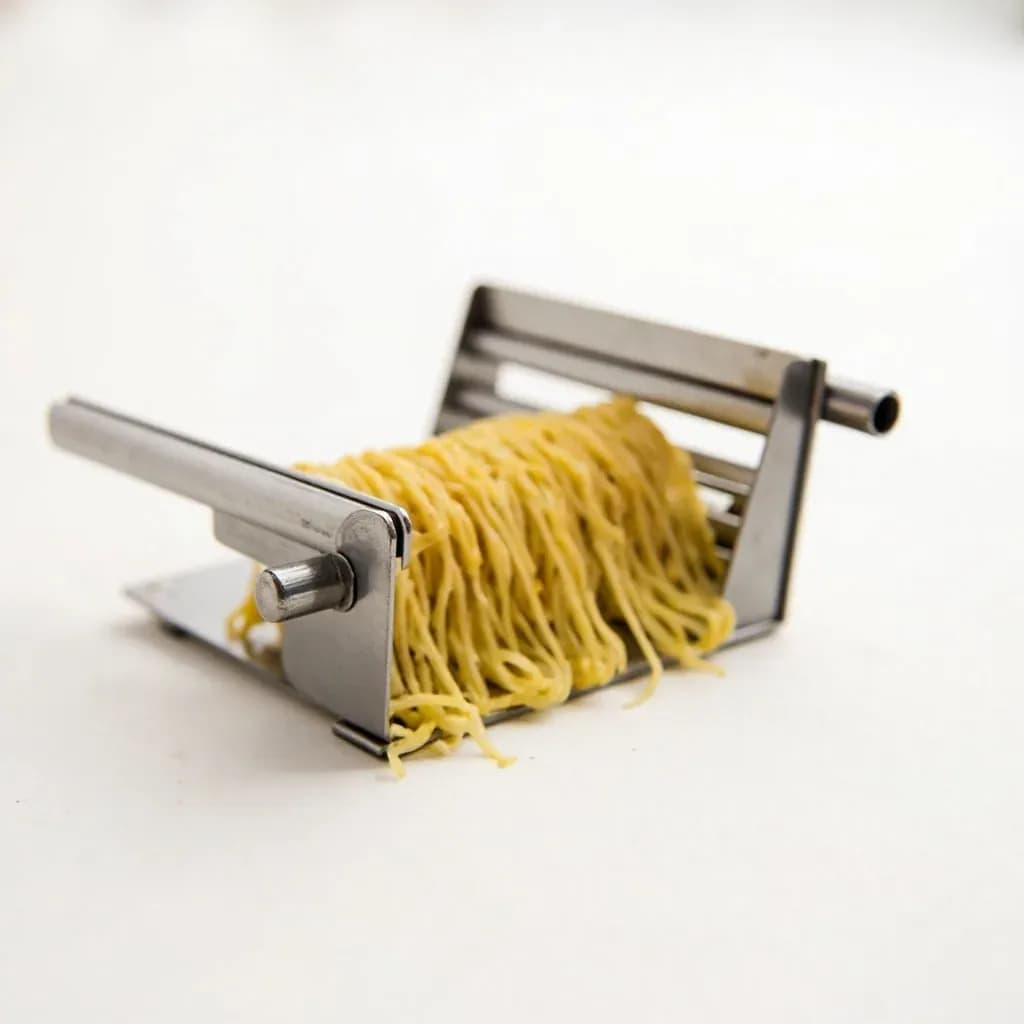
A grooved roller that slices rolled noodle dough into uniform ramen strands.
A ramen noodle cutter is a roller or machine attachment with evenly spaced grooves that slices a sheet of rolled dough into long, uniform noodle strands. The groove width determines noodle thickness, from thin Hakata strands to thick wavy ones. It is paired with a dough sheeter to produce consistent fresh ramen.
The ramen noodle cutter is, in practice, a pasta machine fitted with a set of interchangeable cutting gears. Two contra-rotating rollers mesh like fine gears, pinching a thin sheet of dough and shearing it into strands whose width is set by the tooth spacing of the cutting head. That tooth spacing is the single most important number in the whole process: it defines a shop's house style, from the feather-thin hosomen that swims in a clear shio broth to the chunky futomen that anchors a heavy tonkotsu.
The machine is built around a chrome-plated carbon-steel roller that thins the dough to a uniform sheet, plus a separate cutting head that snaps or swings into place. Home units — the Marcato Atlas and Imperia Titania are the standards — run 140 to 180 mm wide and clamp to a counter; Japanese commercial cutters from makers like Yamato (Nakano) are 300 to 500 mm wide and built for hours of continuous production. The wider the roller, the more uniform the sheet and the less rebatching the cook has to do.
Used well, the cutter does more than slice: it sets cooking time, broth absorption, and mouthfeel in a single motion. A 1.2 mm hosomen cooks in well under two minutes and slips through a light broth; a 3 mm futomen needs closer to three minutes and chews with real weight. The machine cannot rescue bad dough, though. Hydration in the 33–36% range, a proper rest, and a cornstarch or potato-starch dust are what let the gears cut cleanly instead of tearing the sheet.
Alternatives
Types & varieties
The home standard — Marcato Atlas, Imperia Titania, and similar — clamps to a board, rolls by hand, and swaps the cutting head in for strand work
Powered by a KitchenAid or equivalent; good for larger batches, though heavy, low-hydration dough can strain the mixer gearbox
Self-feeding motorized rollers, some with an integrated auto-cutter; convenient for repeat production but a step up in price
Wide-body units from makers such as Yamato (Nakano) built for ramen, udon, and soba shops; rollers 300–500 mm wide, built for continuous service
A single chassis where the cutting head sits on the same body as the thinning rollers, so one pass both finishes and slices the dough
Wider 6.5 and 12 mm cutting gears are sold alongside ramen gears; useful for Italian pasta work on the same machine but outside the ramen cutting range
The three ramen strand sizes
Ramen shops describe their noodles by strand size as much as by flour or broth, and the cutting gear is what sets that size. The three traditional cuts correspond to the gears most cutters ship with, and to the broths they were developed against.
- Hosomen (細麺), cut on a 1.2 mm gear: a very thin, straight strand that cooks in 60–90 seconds and is the classic match for light, clear shio and shoyu broths where the broth should lead.
- Standard or futsuumen (普通麺), cut on a 1.5–2 mm gear: the all-purpose shop noodle, around 90–120 seconds in the pot, balanced for miso and lighter tonkotsu bowls.
- Futomen (太麺), cut on a 3 mm gear: a thick, wavy strand with a chewy core, often with a wider bite from being folded into the sheet before cutting; pairs with heavy tonkotsu, gyokai, and richer tare.
Caring for the cutting gears
The cutting gears are the only part of the machine that does the actual work, and they are the part that wears out first. They cannot be sharpened, and they are unforgiving of a few common kitchen habits.
- Brush the rollers and gears dry between batches; any moisture left on chrome-plated steel flashes to rust within hours.
- Never wash the cutting head under running water or in a dishwasher — water displaces the bearing grease and corrodes the gear teeth.
- Lightly oil the rollers and gears with mineral or food-grade oil before long storage, then wipe the excess so it does not transfer to the dough.
- Replace the cutting gears, do not resharpen them. A frayed or split edge on the cut noodle means a chipped or worn gear, and a new set is the only real fix.
Common uses
Tips & pitfalls
- Rest the dough 30–60 minutes wrapped at room temperature, or 24 hours cold plus 30 minutes to temper; cold or under-rested dough tears the cutting gears and leaves ragged noodle edges.
- Dust the dough sheet with potato starch or cornstarch rather than wheat flour — wheat flour on the surface turns gummy in the pot and clouds a clear broth.
- Fold the sheet in thirds and run it through the roller two or three times at each thickness setting before stepping down; that build-up of layers is what gives ramen its signature chew.
- Finish the sheet at roughly 1.0–1.5 mm for thin ramen and 1.5–2 mm for standard before sending it to the cutter; too thick and the strands emerge doubled or uneven in width.
- Feed the sheet straight and slowly into the cutter, not at an angle; angling folds the dough over the gear teeth and jams the machine.
- Toss the cut strands with starch the moment they hit the basket — cut noodles hydrate fast and will stick to themselves in under a minute.
- Wipe the rollers with a dry brush between batches and never rinse the cutting head; a few drops of moisture inside the bearings will rust them out in a season.
- If the cutter leaves frayed or split edges, the cutting gears are dull or chipped — replace them, do not try to sharpen the teeth.
Good to know
- Type
- Hand-cranked, stand-mixer, or electric dough roller paired with interchangeable cutting gears that slice a dough sheet into uniform strands
- Primary materials
- Chrome-plated carbon steel for rollers and frames; hardened steel for cutting gears; stainless steel on commercial models
- Roller width
- 140–180 mm on home units (Marcato Atlas 150 mm, Imperia 150 mm); 300–500 mm on Japanese commercial ramen-shop cutters
- Strand widths
- Cutting gears commonly available in 1.2, 1.5, 2, 3, 4, 6.5, and 12 mm; ramen uses the 1.2–3 mm range
- Cutting mechanism
- Two contra-rotating grooved rollers (a driving and an idler gear) that pinch and shear the dough sheet
- Power options
- Hand-crank clamp-on, stand-mixer attachment, or electric countertop motor
- Cleaning
- Dry brush or barely damp cloth only; never submerge, never run under water, and never put in a dishwasher — water destroys the bearings and the gear geometry
- Storage
- Dry, with a drop of mineral or food-grade oil worked over the rollers before long storage to prevent oxidation
Also called
noodle cutting roller
Related

Peeler
Swift blade for stripping skin off fruit and vegetables

Grater
Sharp-toothed surface for shredding cheese and vegetables

Microplane
Ultra-fine rasp for citrus zest, garlic, and hard cheese

Mixing Bowl
All-purpose bowl for combining, whisking, and tossing

Whisk
Looped wires that beat air into eggs, cream, and sauces

Spatula
Flat blade for flipping, lifting, and scraping

Slotted Spoon
Pierced spoon that lifts solids and drains the liquid behind

Wooden Spoon
Gentle, heat-friendly spoon for stirring anything