Prep Tools
Noodle Press (Guksu Teul)
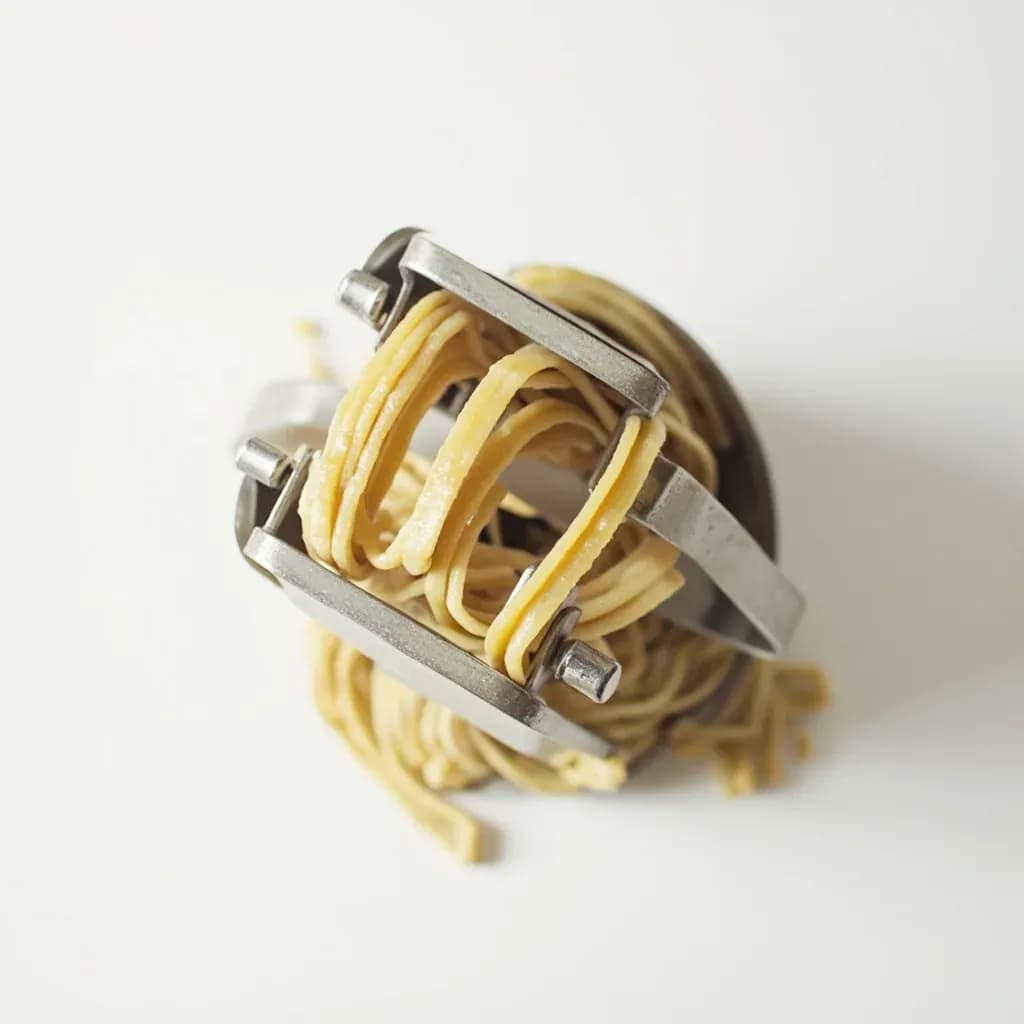
A lever or screw press that extrudes dough through a perforated plate into long fresh noodles.
A noodle press, such as the Korean guksu teul, forces stiff dough through a perforated die using a lever or screw plunger, extruding it directly into a pot of boiling water as long strands. It is used for chewy buckwheat and starch noodles like naengmyeon and some hand-pressed Chinese noodles. The pressure produces dense, springy noodles that are hard to make by rolling and cutting.
The noodle press is a Korean shaping tool (국수 틀, guksu teul) that turns hydrated wheat or buckwheat dough into uniform strands by forcing it through a perforated plate. A lever- or screw-driven plunger pushes dough down a heavy cylinder; the dough emerges from the base as continuous noodles that the cook catches on a floured tray or drops directly into boiling salted water. It replaces the long process of rolling, folding, and knife-cutting traditional noodles with a few minutes of steady pressure.
Most of a fresh noodle's character — its thickness, chew, and best dish — is decided by the plate, not the press itself. A 2 mm round hole yields classic somyeon, the thin wheat noodle for cold broths, japchae, and banchan; 4–6 mm gives the slightly thicker, more rustic strand of kalguksu; wider or shaped dies make flat, ribbon, or specialty buckwheat noodles. Interchangeable plates turn one press into a small noodle kitchen, provided the dough is correctly hydrated and rested.
The cook's real job with a guksu teul is dough management. The dough must be wet enough to flow through the holes without crumbling, rested long enough for gluten to relax (30–60 minutes is standard), and cut into chunks that fit the cylinder so pressure stays even. Get those right and the press does the rest; get them wrong and strands stick, tear, or back up into the plate — usually mid-service.
Alternatives
Types & varieties
Heavy 주철 body with a long wooden lever; the classic market-stall and home version, prized for inertia and even pressure.
Modern tabletop unit with a threaded plunger; gives very controlled, continuous pressure and is easier to clean.
Smaller cylinder that clamps to a sturdy work surface; operated by a short lever or plunger handle; a good fit for home cooks.
Shop-scale machine using water or air pressure; produces very long, uniform strands at high volume.
Round, square, or shaped holes in roughly 2–8 mm diameters; some sets include a star or hollow-tube die for somyeon and makguksu varieties.
Choosing the right plate
Plate selection is where the cook decides what kind of noodle comes out of the press. Round holes give cylindrical strands; square or slot-shaped holes make flatter, ribbon-like noodles. Diameter sets the texture: very fine holes (around 2 mm) make delicate somyeon that cooks in 60–90 seconds and shines in cold broth; mid-range holes (4–6 mm) produce the chewy, slightly irregular strand that defines kalguksu; larger holes yield a heartier, almost hand-cut feel suited to robust soups. For buckwheat work — makguksu — a slightly coarser plate helps weaker-gluten dough extrude without tearing.
- 2 mm round: classic somyeon, cold broth noodles, japchae
- 4–6 mm round: kalguksu and general-purpose wheat noodles
- Larger round holes: thick wheat noodles with a rustic, hand-cut feel
- Slot or square holes: flat noodle varieties
- Star or shaped dies: specialty decorative strands
Getting the dough right
A noodle press is unforgiving of badly mixed dough. The dough must be hydrated enough to flow through the plate holes under steady pressure but firm enough to hold together as it emerges — typically a hydrated, kneaded wheat dough sitting between a stiff pasta dough and a soft bread dough. Buckwheat blends, which develop less gluten, usually benefit from a touch more water and a binding flour such as wheat or sweet potato starch to hold together through the plate. After mixing, rest the dough 30–60 minutes so gluten relaxes and moisture equalizes — this single step is the difference between clean extrusion and a clogged plate.
- Too wet: strands fuse and stick on the tray or in the water
- Too dry: strands crumble, tear, or back up into the plate
- Rest 30–60 minutes after kneading for gluten relaxation
- Cut dough into cylinder-sized chunks so pressure stays even
- Lightly oil the plate to help the first centimeters release cleanly
Common uses
Tips & pitfalls
- Hydrate dough correctly: aim for a dough that holds together when pinched but is not tacky; too wet and strands fuse, too dry and they tear.
- Rest the dough 30–60 minutes after mixing so the gluten relaxes — the single biggest factor in clean extrusion.
- Cut the dough into chunks roughly the diameter of the cylinder, not one big mass, so pressure stays even across the batch.
- Lightly oil the perforated plate (neutral oil or perilla oil) before pressing; the first few centimeters of noodle release far more cleanly.
- Apply steady, continuous pressure — jerky strokes cause the strand to break and back up into the plate holes.
- Aim the press directly over boiling salted water or a floured tray; catching extruded strands by hand stretches and tears them.
- Between batches, run a skewer or thin chopstick through each plate hole to clear compacted dough; a clogged hole causes the strand to bulge or split.
- Wash the plate thoroughly and dry it on the stove or in a low oven immediately after use if it is cast iron; even a few minutes of damp air will flash-rust the plate.
- Do not press very stiff dumpling-style doughs — they will bind the plunger or buckle the plate. Loosen with a tablespoon of water at a time until the dough just barely clings.
- If strands curl on the tray, drape them over a floured wooden rod or chopsticks so they dry straight and don't tangle.
Good to know
- Korean name
- 국수 틀 (guksu teul), literally 'noodle frame' or 'noodle mold'
- Origin
- Korea; long-standing tool in home kitchens, market stalls, and noodle shops for pressing fresh wheat and buckwheat doughs
- Mechanism
- Lever- or screw-driven plunger forces dough through a perforated base plate (다지개), extruding uniform strands
- Typical plate hole diameter
- 2–4 mm for thin somyeon, 4–6 mm for kalguksu-style strands; plates are interchangeable on most models
- Typical dough capacity
- About 500 g–1 kg of hydrated dough per load
- Time per batch
- Roughly 1–3 minutes per load at steady pressure, depending on dough hydration
- Traditional materials
- Cast iron body with iron or brass perforated plate and a wooden lever handle
- Care
- Disassemble after each use, clear plate holes, dry immediately, and oil lightly if cast iron to prevent flash rust
Also called
Guksu Teul · Pasta Extruder Press · Noodle Extruder
Related

Peeler
Swift blade for stripping skin off fruit and vegetables

Grater
Sharp-toothed surface for shredding cheese and vegetables

Microplane
Ultra-fine rasp for citrus zest, garlic, and hard cheese

Mixing Bowl
All-purpose bowl for combining, whisking, and tossing

Whisk
Looped wires that beat air into eggs, cream, and sauces

Spatula
Flat blade for flipping, lifting, and scraping

Slotted Spoon
Pierced spoon that lifts solids and drains the liquid behind

Wooden Spoon
Gentle, heat-friendly spoon for stirring anything