Prep Tools
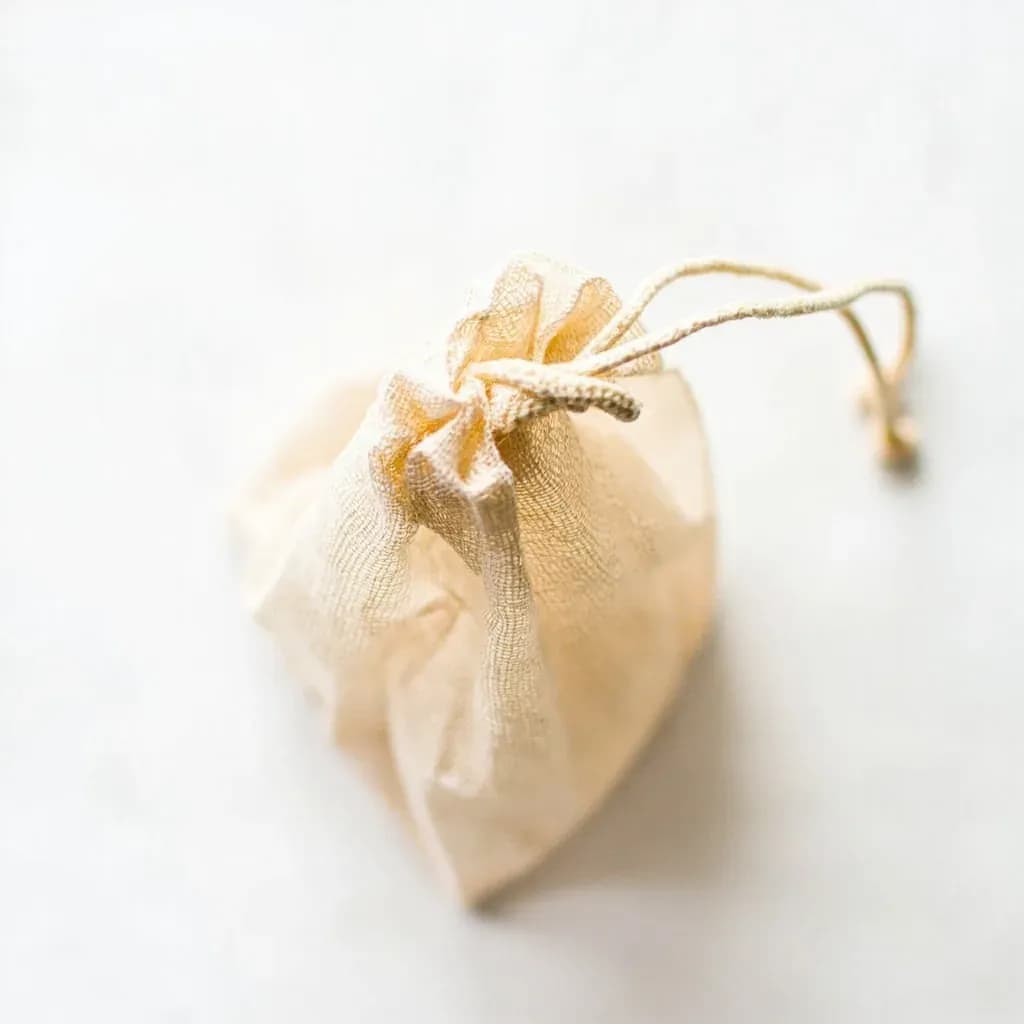
Nut Milk Bag
A fine mesh straining bag for squeezing pulp out of homemade nut milks and juices.
A nut milk bag is a reusable bag of tightly woven nylon or cotton mesh used to strain blended nuts, seeds, or produce. After blending soaked almonds, cashews, or oats with water, the slurry is poured into the bag and squeezed to separate smooth milk from the leftover pulp. It also works for clarifying broths, straining cold-brew coffee, and pressing cheese or sprouts.
A nut milk bag is a reusable, fine-weave fabric pouch engineered to do one job especially well: hold a wet slurry under hand pressure while letting only liquid escape. Its usefulness comes from pairing a tight mesh — typically a 50–200 micron food-safe nylon — with a strong, sewn seam and often a drawstring top, so a cook can squeeze the bag dry without bursting it. That combination is the difference between a clean glass of almond milk and a pulpy, gritty pour, and it is also what makes the same tool useful well beyond nut milk, from cold-brew coffee to labneh.
The bag earned its place in the home kitchen alongside the rise of plant-milk making in the 2000s, when cooks needed something sturdier and more reliable than cheesecloth. Cheesecloth tears when you grip it; a nut milk bag is built for the squeeze. Nylon is the practical default because it has a tight weave, resists stretching, and rinses clean in seconds, while cotton and hemp versions appeal to cooks avoiding synthetics at the cost of filtration fineness and lifespan. In practice, the bag is a low-tech workhorse — no moving parts, no electricity — whose value scales with how much scratch cooking you do.
Alternatives
Types & varieties
The everyday workhorse — fine nylon mesh, drawstring top, roughly 10×12 in. The right starting point for most home cooks.
Thicker nylon, reinforced seams, often 12×14 in or larger. Built for cafés and high-volume production where blowouts are not an option.
Natural-fiber weave that tolerates higher heat but lets more fine pulp through, yielding a slightly grittier milk.
For cooks avoiding synthetics. Coarser weave means slower filtration and a shorter working life.
Reinforced stitching at the stress points where soaked nut slurries tend to blow through the seam.
Tapered form that funnels liquid into a container; some versions sit in a stand or holder for hands-free draining.
Choosing the Right Bag
Match the bag to the job, not the other way around. For weekly home use with almonds, oats, or cashews, a standard 10×12 in nylon bag with a drawstring is the practical sweet spot — fine mesh, comfortable in the hand, and easy to rinse. If you make milk in big batches or run a small café, step up to a heavy-duty or double-stitched bag: the thicker fabric and reinforced seams survive hundreds of squeezes. Cotton and hemp make sense when heat tolerance matters more than a glassy-smooth finish — for example, when you want to strain a hot stock or infusion, or when you prefer to avoid plastic touching food. Avoid the very cheapest bags with single-row stitching; the seam is the failure point, not the mesh.
- Fine nylon mesh + reinforced seam = smoothest, longest-lasting results.
- Cotton or hemp for high-heat tasks, accepting a slightly grittier yield.
- Larger 12×14 in bags reduce the number of batches needed for big projects.
- A drawstring is worth having — it keeps the bag closed during the first, messiest squeeze.
Squeeze Technique and Common Mistakes
The way you squeeze matters as much as the bag itself. Start by pre-wetting the bag and squeezing out the water; a dry bag drinks up the first ounce or two of milk. Fill the bag only half to two-thirds full, gather the top loosely, and press from the top down with steady, even pressure. Twisting the bag concentrates force on the seams and is the most common cause of blowouts. Work over a wide bowl or a pitcher set in a rimmed tray; milks can splash. If a second pass is wanted for a smoother, more commercial-style finish, pour the strained liquid back through the same (rinsed) bag — this 'double-strain' removes the fine sediment that dulls flavor and texture.
- Pre-wet the bag to cut absorption loss.
- Fill only half to two-thirds full to prevent seam blowouts.
- Press from the top down; never twist.
- Rinse the bag between double-strain passes to keep the second filtration effective.
Common uses
Tips & pitfalls
- Reserve the trapped pulp — it slips into crackers, energy bites, granola, vegetable burgers, quick breads, and soups as a thickener or fiber boost.
- Rinse the bag immediately after use; dried pulp is far harder to remove and can permanently clog the mesh.
- Fill the bag only about half to two-thirds full. Overfilling is the single most common cause of seam blowouts.
- Squeeze from the top down with steady pressure — twisting concentrates force on the seams and causes tears.
- For a noticeably smoother milk, strain it a second time through the same rinsed bag.
- Hang or lay the bag flat until fully dry between uses; trapped moisture breeds mildew and odor.
- Sanitize occasionally: run nylon bags through a hot dishwasher cycle, or simmer cotton or hemp bags in water for 5–10 minutes (nylon is rated only to about 200°F, so boiling water can damage it).
- Replace the bag when the mesh stretches, develops holes, or stops catching fine pulp — usually after 6–18 months of weekly use.
Good to know
- Also called
- nut bag, nut milk strainer, milk bag, mesh strainer bag
- Material
- Fine-weave food-safe nylon; alternatives in polyester, cotton muslin, or hemp
- Typical size
- 9×10 in to 12×14 in (23×25 cm to 30×36 cm); commercial bags run larger
- Mesh grade
- Approximately 50–200 micron pore size — fine enough to catch pulp, open enough to drain fast
- Closure
- Most have a drawstring or stitched hem; some are open-topped
- Heat tolerance
- Nylon bags handle warm liquids to about 200°F (93°C); cotton tolerates more heat with a looser weave
- Capacity
- Holds roughly 1–2 quarts (1–2 L) of blended slurry per batch in standard sizes
- Care
- Hand-rinse immediately, then wash with warm soapy water or on the dishwasher top rack; hang to dry fully
- Reusability
- Designed for repeated use; lifespan typically 6–24 months with regular care
- Replaces
- A sturdier, reusable stand-in for cheesecloth in any squeeze-and-strain task
Also called
Straining Bag · Almond Milk Bag
Related

Peeler
Swift blade for stripping skin off fruit and vegetables

Grater
Sharp-toothed surface for shredding cheese and vegetables

Microplane
Ultra-fine rasp for citrus zest, garlic, and hard cheese

Mixing Bowl
All-purpose bowl for combining, whisking, and tossing

Whisk
Looped wires that beat air into eggs, cream, and sauces

Spatula
Flat blade for flipping, lifting, and scraping

Slotted Spoon
Pierced spoon that lifts solids and drains the liquid behind

Wooden Spoon
Gentle, heat-friendly spoon for stirring anything