Prep Tools
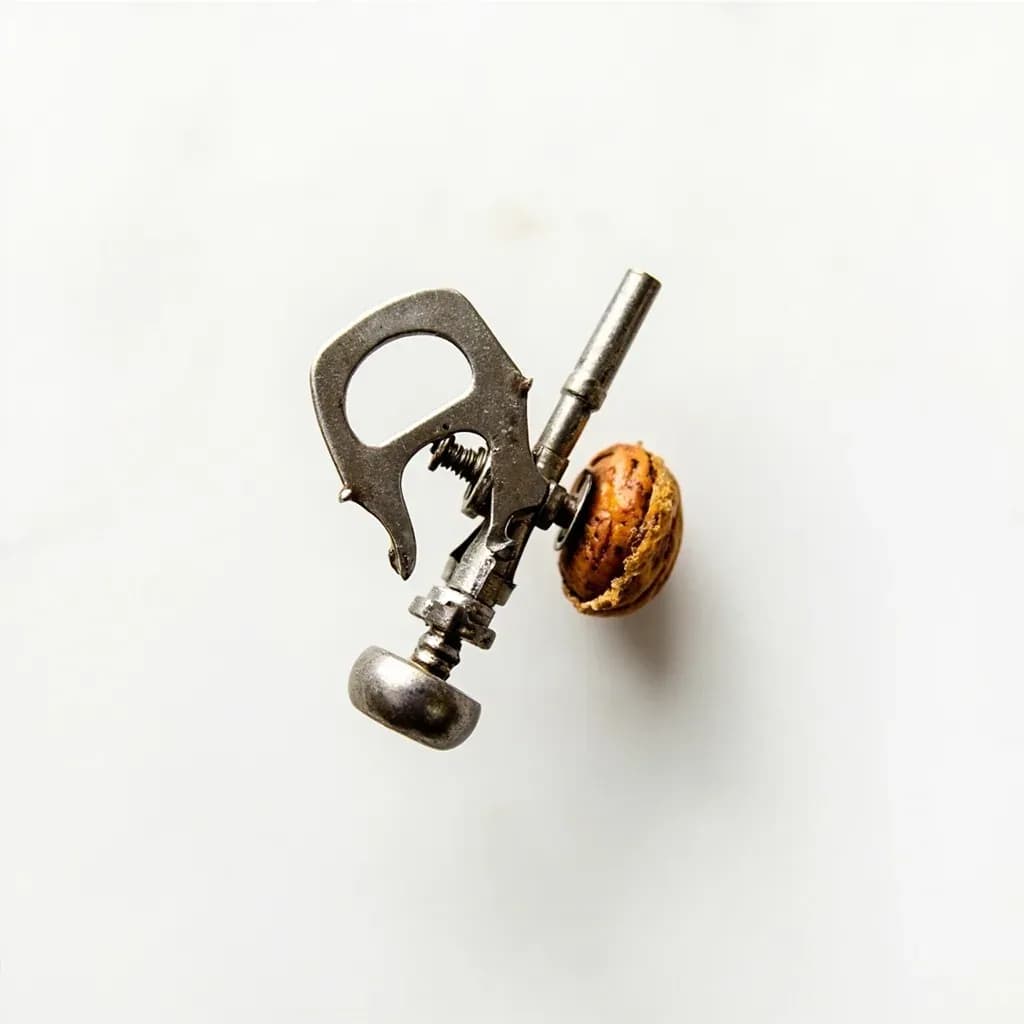
Nutcracker
A hinged hand tool that cracks the hard shells of walnuts, pecans, and other nuts.
A nutcracker is a hinged lever tool, usually metal, that applies squeezing force to crack open the shells of walnuts, pecans, hazelnuts, and similar nuts. Placing the nut in the ridged jaws and pressing the handles together splits the shell so the kernel can be picked out. Some models include a bowl to catch shells or a pick for extracting stubborn pieces.
A nutcracker is a hand-powered lever tool built to split the hard shells of tree nuts without pulverizing the kernel inside. At its core it is a simple machine: a hinge with two arms in which the long handles multiply the force of your hand and focus it onto a small jaw. That mechanical advantage — usually five to ten times the force you actually apply — is the entire reason nutcrackers exist, because nutshells are specifically evolved to resist direct squeezing.
The good ones balance two opposing goals: breaking the shell cleanly and keeping the kernel in as few pieces as possible. They do this by sizing the jaw to the nut, by giving the teeth enough bite to grip, and by being stiff enough that all the energy goes into splitting the shell rather than flexing the handles. A cheap or floppy cracker fails at this — the handle bends, the jaw slips sideways, and you get shell grit mixed into the meat.
Choosing the right cracker for the nut in front of you matters more than the brand. A small plier-style cracker is right for hazelnuts but wrong for black walnuts; a heavy cast-iron lever is overkill for almonds. The same tool, used well and aimed along the seam, is the difference between a bowl of clean nutmeat halves and a pile of rubble.
Alternatives
Types & varieties
The most common style: two hinged arms with a toothed jaw that closes as the handles are squeezed. The best general-purpose choice for walnuts and pecans.
Tabletop model with a threaded screw that drives a plunger down onto the nut. Slow but very controlled; common in older European kitchens.
Small, pliers-like tool with a single pivot. Handy for travel or small batches; less leverage than full-size lever models.
Larger, heavy unit held or fixed on the counter; uses a long handle for maximum leverage on tough shells like Brazil nuts.
Heavy, durable, often shaped as a pig, lobster, or acorn. Excellent leverage for hard shells; needs drying and a light oil coat to prevent rust.
Modern design with a return spring so the jaw opens automatically; reduces hand fatigue when cracking large batches.
Has a dial or shim that sets the maximum jaw opening, preventing over-crush of small nuts like hazelnuts and almonds.
Classic hardwood (often beech or walnut) cracker with a small metal tooth. Gentle on nutmeats but lower leverage; common in German and Austrian kitchens.
Carved wooden figure (soldier, king, miner) with a lever in the back. Functional but slow and low-leverage — better treated as a holiday object than a daily tool.
Cracking specific nuts
Different nuts want different crackers and slightly different handling. Match the tool to the nut, and you will get clean halves far more often than rubble.
- Walnuts (English): seam perpendicular to the jaw, one firm squeeze; a standard lever cracker is ideal.
- Black walnuts: very thick, irregular shells — use a tabletop lever or, frankly, a hammer on a wooden block; a hand cracker will tire you out.
- Pecans: lay the seam vertically in the jaw and squeeze; they split into clean halves with almost no practice.
- Hazelnuts (filberts): crack at the wider, blunt end, not the point; a small plier-style or adjustable cracker prevents pulverizing the small kernel.
- Brazil nuts: large and three-sided; need a tabletop lever or screw cracker — most handheld jaws cannot open wide enough.
- Macadamia nuts: extremely hard and round; the kernel shatters easily, so use the gentlest cracker that will still break the shell, and accept small fragments.
- Almonds: crack lightly with a small plier cracker; a heavy lever will crush the thin shell and the meat together into dust.
Care and storage
A nutcracker survives decades in a kitchen drawer if you keep two things out of it: moisture in the hinge and shell grit between the teeth.
- Wipe dry immediately after washing; trapped water is the main cause of rust on cast iron and plated steel.
- Uncoated cast iron benefits from a thin wipe of food-safe oil after drying.
- Pick shell fragments out of the jaw teeth and hinge periodically — built-up grit dulls the teeth and can contaminate the next batch with shell dust.
- Wooden-handled crackers should never be soaked; a quick rinse and towel-dry is enough.
- Store in a dry drawer; do not leave sitting in a damp sink or on a wet counter.
Common uses
Tips & pitfalls
- Aim the nut with its seam — the natural ridge running along the shell — perpendicular to the jaw, so the shell splits cleanly along its weakest line rather than crushing sideways.
- Squeeze in one firm, controlled motion rather than a slow build; slow pressure mashes the kernel into fragments while a single decisive squeeze splits the shell and leaves the meat intact.
- Dry, room-temperature nuts crack more cleanly than cold-from-the-fridge ones, and far more cleanly than very fresh, moist nuts, which deform instead of splitting.
- If shells are shattering into the kernel, the jaw is set too wide for the nut — wrap the nut in a thin kitchen towel before cracking to contain the fragments.
- Reserve the smallest, plier-style crackers for hazelnuts and almonds; a heavy lever on a small nut just pulverizes both shell and meat together.
- For black walnuts and other very hard, irregular shells, a vise or a hammer on a wooden block outperforms almost any hand cracker.
- Don't pry the shell open with a paring knife after cracking — you will usually lever the nutmeat in half; pick the shell apart with your fingers instead.
- Keep the jaw teeth and hinge clean; shell grit left in the mechanism dulls it and contaminates the next batch.
Good to know
- Primary function
- Cracks the hard shells of walnuts, pecans, hazelnuts, Brazil nuts, macadamia nuts, and similar tree nuts using focused leverage
- Main mechanism
- Lever action that multiplies hand force roughly 5–10x at the jaw
- Common materials
- Zinc alloy, chrome-plated carbon steel, stainless steel, cast iron, and hardwood handles
- Typical size
- Hand nutcrackers run 5–8 in (13–20 cm) long; tabletop lever models run 10–14 in (25–35 cm)
- Jaw capacity
- Roughly 1–1.5 in (2.5–4 cm) opening — fine for walnuts and pecans, too small for large Brazil nuts or black walnuts
- Historical origin
- Bronze and iron nutcrackers appear in Roman-era sites (c. 1st–4th century CE); the familiar hinged "alligator" style was patented and mass-produced in the 19th century
- Decorative tradition
- Carved wooden Nussknacker figures originated in the Erzgebirge region of Germany in the 17th century; the soldier style dates to the mid-1800s
- Care
- Hand-wash and dry immediately; uncoated cast iron needs a light oiling; wooden-handled versions should never be soaked
- Difficulty
- Beginner-friendly for soft-shelled nuts; hard shells such as black walnut and macadamia need a firm grip and sometimes a second squeeze
Also called
Nut Cracker · Shell Cracker
Related

Peeler
Swift blade for stripping skin off fruit and vegetables

Grater
Sharp-toothed surface for shredding cheese and vegetables

Microplane
Ultra-fine rasp for citrus zest, garlic, and hard cheese

Mixing Bowl
All-purpose bowl for combining, whisking, and tossing

Whisk
Looped wires that beat air into eggs, cream, and sauces

Spatula
Flat blade for flipping, lifting, and scraping

Slotted Spoon
Pierced spoon that lifts solids and drains the liquid behind

Wooden Spoon
Gentle, heat-friendly spoon for stirring anything