Prep Tools
Nutmeg Grinder
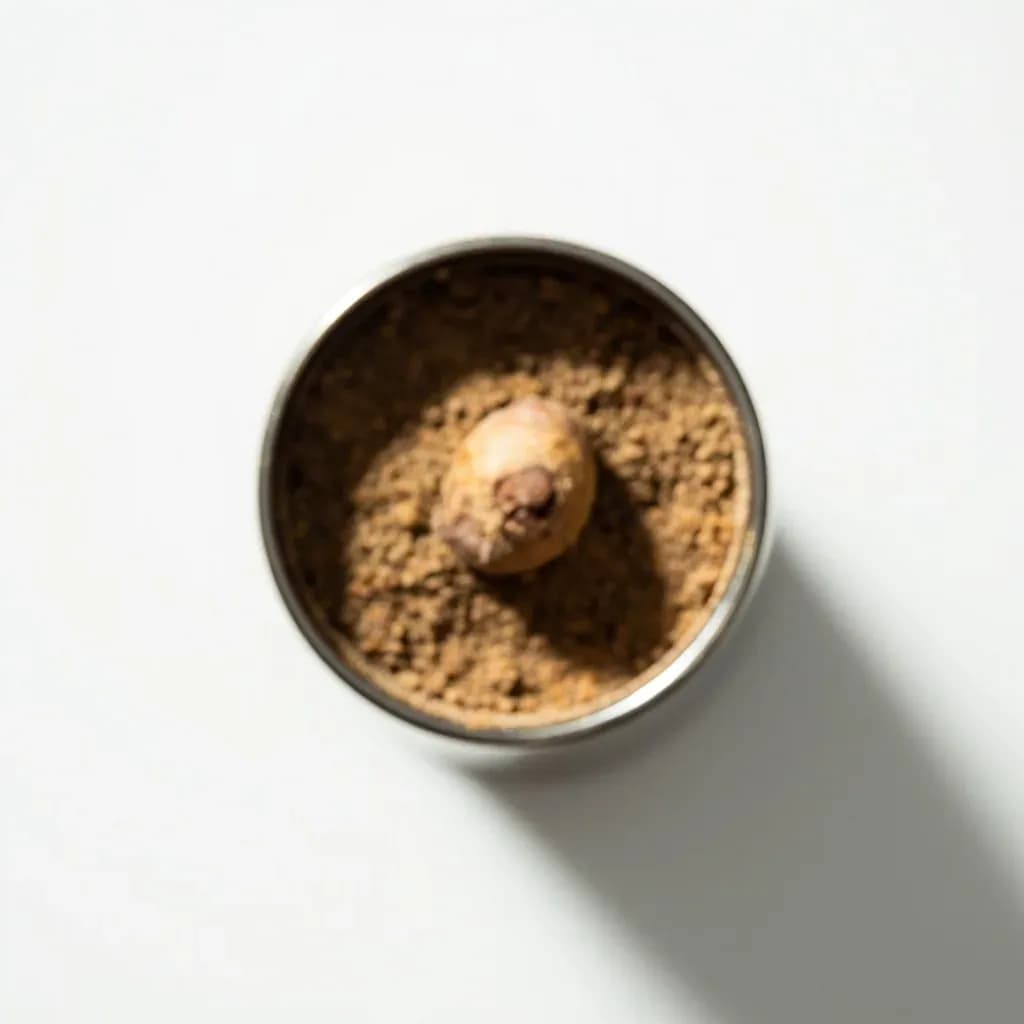
A small hand mill or grater for finely grinding whole nutmeg and other hard seeds.
A nutmeg grinder is a compact tool, either a spring-loaded crank mill or a fine rasp grater, that shaves whole nutmeg into fresh powder. Freshly ground nutmeg is far more aromatic than pre-ground, so cooks grate it directly over béchamel, custards, and spiced drinks. Similar small grinders are used for other hard items like walnuts, poppy seeds, or saffron.
A nutmeg grinder is a hand tool built specifically to rasp the dried seed of Myristica fragrans into a fine, fluffy powder. Unlike a pepper mill, which crushes brittle peppercorns between steel or ceramic burrs, a nutmeg grinder works by abrasion: a very fine stainless-steel rasp scrapes across the oily seed and shaves off microscopic curls that melt into a sauce or drink on contact. That mechanical detail matters — nutmeg is too brittle and fatty for a burr mill to handle well, and a standard kitchen grater produces coarse, splintery shavings that never fully dissolve. The tool exists, essentially, to make fresh grating effortless, and a dedicated grinder holds a seed or two inside so the spice is always a turn of the wrist away.
The single best reason to own one is freshness. Whole nutmeg keeps its aromatic oils for years in a cool, dark cupboard, but the moment the seed is ground the volatile compounds — pinene, sabinene, and the warm, slightly piney myristicin — begin to oxidize and fade. Within a few months in a jar, pre-ground nutmeg smells dusty and one-dimensional; freshly grated, it is sweet, floral, and almost effervescent, with a lift you can smell across the kitchen. That difference is most obvious in delicate preparations where the spice is not baked or simmered long: béchamel, custards, eggnog, and pasta sauces dressed at the table.
In practice, a nutmeg grinder is a small, single-purpose tool that does one thing very well. The most familiar form today is the hinged paddle popularized by Microplane, which folds around the seed like a pocketknife and stores a spare nutmeg inside; traditionalists still prefer the rotary box mill in beech or olive wood, and the flat metal rasp — the direct descendant of 18th- and 19th-century nutmeg graters — remains the simplest and most controllable option. None of them are expensive, none take up meaningful drawer space, and once a cook has grated nutmeg over a finished dish, they are difficult to give up.
Alternatives
Types & varieties
Two paddle-shaped halves hinged together with a sharp rasp on the inner face; folds closed to store whole nutmegs. The Microplane Nutmeg Grinder is the modern archetype of this style.
Box- or cylinder-shaped body with a side crank that drives a small auger across an internal grating surface. Operates like a pepper mill but with a finer rasp instead of burrs.
Bell- or dome-shaped body with a top crank and a wider base; visually distinct from cylindrical pepper mills. Made by Peugeot and Zassenhaus, among others.
A simple handheld metal rasp, often slightly curved or paddle-shaped, with no storage compartment. The traditional, no-frills form descended from 18th- and 19th-century nutmeg graters.
Many box-style graters include a fine 'nutmeg' hole; workable in a kitchen short on dedicated tools but slower and less consistent than a purpose-built grinder.
Choosing between styles
Each design has trade-offs that suit different cooks. The hinged paddle is fast, inexpensive, and tucks into a drawer; it is the right answer for most home kitchens. Rotary mills feel more substantial in the hand and dispense a controlled shower of nutmeg at the table, which is pleasant for finishing pasta or drinks in front of guests, but the internal auger and finer rasp are easier to clog and harder to clean. The flat rasp gives the most control — you can see exactly how much you are producing and grate directly over the pan — and has the fewest places for residue to hide, making it the easiest to keep clean long-term.
Working with mace and other hard spices
The same rasp that handles nutmeg will also work on mace, the dried lacy aril that wraps the seed inside the same fruit. Mace is even more fragrant than nutmeg and a traditional addition to charcuterie, creamy custards, and clarified butter. A dedicated grinder will also chew through small pieces of cinnamon stick, whole cloves, and star anise in a pinch — useful when you want a single tool to cover the harder whole spices — but softer seeds like coriander and cumin tend to smear and clog the fine teeth, so it is best to keep the grinder reserved for nutmeg and mace.
Common uses
Tips & pitfalls
- Buy whole nutmegs from a spice merchant rather than supermarket jars; freshness is the entire point of the tool.
- Use light pressure and let the sharp rasp do the work — pressing hard dulls teeth and yields uneven, oily clumps instead of a fine dust.
- Grate at the very end of cooking or table-side; heat and prolonged exposure dissipate nutmeg's most volatile, floral top notes.
- Store spare whole nutmegs in a sealed glass jar away from light; they keep for years and are dramatically more aromatic than pre-ground powder.
- Clean the rasp with a dry brush rather than water, especially on wood-bodied models; moisture swells wood and can loosen metal teeth.
- If the rasp clogs, tap it gently against the counter or run a piece of bread across the teeth to clear trapped fibers.
- Oil wood handles occasionally with a food-safe mineral oil to prevent drying and cracking.
- Reserve the grinder for nutmeg and mace; residues from softer or stronger spices such as coriander and cumin can cross-contaminate and clog the fine teeth.
- A pinch of freshly grated nutmeg is roughly equivalent to about 1/8 teaspoon of pre-ground by volume; when adapting a recipe written for jarred nutmeg, start with less than called for and adjust to taste.
Good to know
- Primary use
- Grating whole nutmeg seeds into a fine, fluffy powder
- Grating surface
- Sharp stainless-steel rasp, considerably finer than a standard kitchen grater
- Mechanism
- Rasp or abrasion rather than burr crushing — better suited than a pepper mill to nutmeg's oily, brittle texture
- Storage
- Hinged and rotary models typically hold 1–3 whole nutmegs in a small built-in compartment
- Source of nutmeg
- Dried seed of Myristica fragrans, native to the Banda Islands of Indonesia
- Whole vs. ground shelf life
- Whole nutmegs keep potency for years in a cool, dark place; pre-ground nutmeg loses aroma within a few months
- Common materials
- Stainless-steel rasp with beech, walnut, olive wood, or molded plastic body
- Typical weight of one nutmeg
- About 5–10 g per dried seed
- Cleaning method
- Tap out residue, then clear rasp teeth with a dry stiff-bristled brush such as a toothbrush
- Care
- Hand wash only and dry immediately; do not soak wood parts; treat wood handles occasionally with food-safe mineral oil
Also called
Saffron Grinder · Walnut Grinder (Diódaráló) · Nut Grinder · Poppy Seed Grinder (Mlýnek na Mák) · Spice Grinder
Related

Peeler
Swift blade for stripping skin off fruit and vegetables

Grater
Sharp-toothed surface for shredding cheese and vegetables

Microplane
Ultra-fine rasp for citrus zest, garlic, and hard cheese

Mixing Bowl
All-purpose bowl for combining, whisking, and tossing

Whisk
Looped wires that beat air into eggs, cream, and sauces

Spatula
Flat blade for flipping, lifting, and scraping

Slotted Spoon
Pierced spoon that lifts solids and drains the liquid behind

Wooden Spoon
Gentle, heat-friendly spoon for stirring anything