Prep Tools
Oil Mister / Atomizer
A pump or pressurized sprayer that coats food with a fine, even mist of oil.
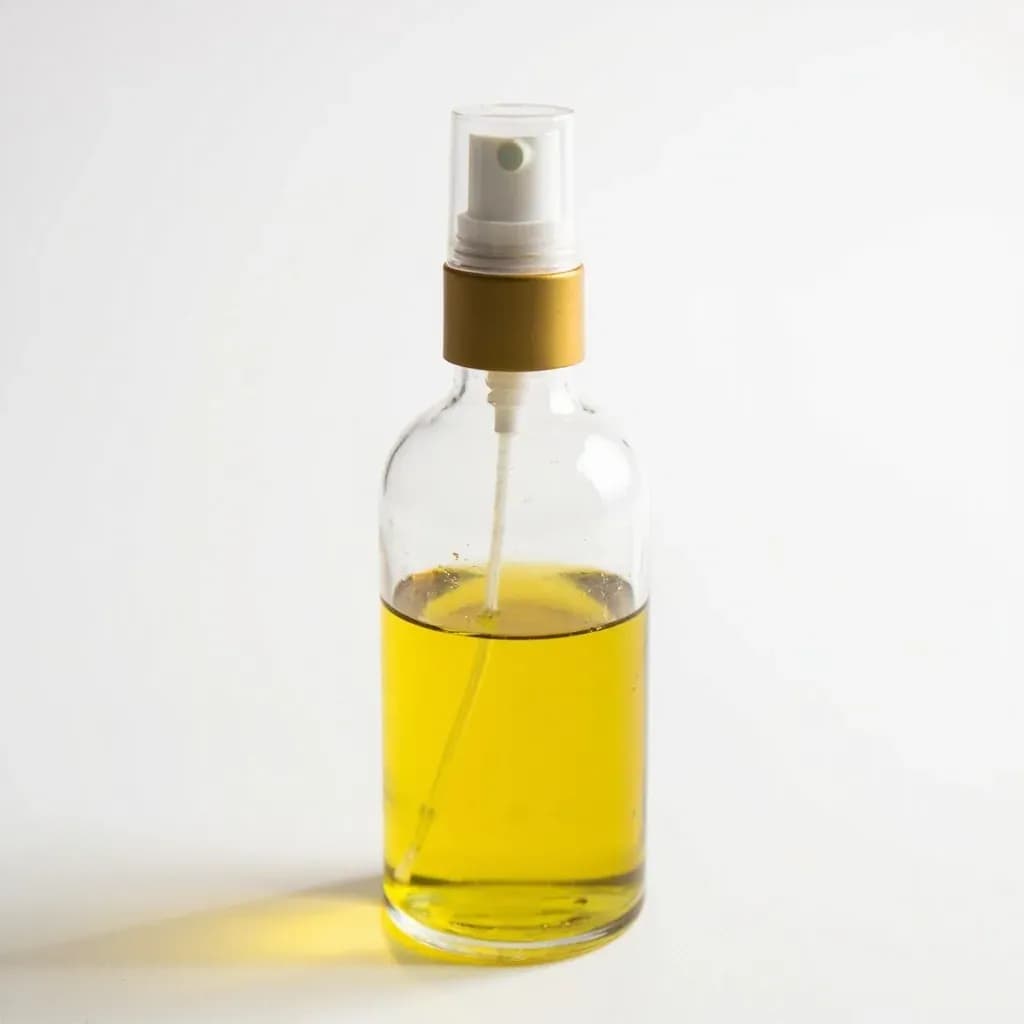
An oil mister is a refillable bottle with a pump or pressurized atomizer that disperses cooking oil as a fine spray. Cooks use it to coat pans, grates, salads, and roasting vegetables with a thin, even layer while using far less oil than pouring. Filled with water it can also mist dough or steam-prone bakes; aerosol-free models let you control exactly which oil you use.
An oil mister — also called an oil atomizer or oil sprayer — is a handheld dispenser that breaks liquid cooking oil into a fine, airborne mist rather than pouring or brushing it. The result is a whisper-thin, uniform film of fat across a pan, a sheet of dough, or a salad, delivered in a quick burst from a few inches away. The classic form is a refillable bottle with a hand-pump cap that pressurizes the headspace and releases oil through a fine nozzle when you press a lever.
The appeal is precision. Because the droplets are genuinely small, you can coat an entire sheet pan with a fraction of the oil a brush would lay down — a couple of short bursts instead of a full brushload. That matters for air-fryer baskets, low-fat roasting, salads where you want oil to cling to leaves without pooling in the bowl, and any cooking where you want even browning without greasiness. The trade-off is volume: a mister gives you coverage, not protection, so it is not the right tool for a hard sear or for shielding delicate fish from a screaming-hot pan.
Behavior varies by mechanism, and it varies sharply. Pump-action refillable models build pressure mechanically and dispense only the oil you put in, which is why they are the home-kitchen standard. Pressurized butane-cartridge sprayers produce a finer, more consistent aerosol but introduce propellant and flammability concerns. Both fail in the same way: thick oil, particulates, or insufficient pumping turns the promised mist into a sputtering stream — and managing that quirk is the one practical skill a cook has to learn.
Alternatives
Types & varieties
Aluminum or stainless body with a hand pump; build pressure by pumping the cap, then press a lever to spray. Reusable indefinitely, oil-only, and the classic home-kitchen design.
Uses a small butane or N₂O propellant cartridge to dispense an extremely fine aerosol mist. Gives the finest atomization but adds flammability and recurring cartridge cost.
Glass reservoir with pump top; favored for aesthetics and for swapping the bottle between oil, vinegar, and lemon juice.
Battery- or hand-driven trigger bottles that mist oil; not a true atomizer but functionally similar and common in commercial kitchens.
Commercial PAM-type sprays; not refillable but produce a very consistent fine mist. The mass-market reference point.
Larger stainless units used in pro kitchens for high-volume, low-fat application on sheet pans and grills.
Choosing the right oil
The single most important decision with an oil mister is what goes inside it. Atomization depends on viscosity, and a nozzle sized for a thin refined oil will clog almost immediately on anything heavier. Reach for neutral, well-filtered oils — canola, vegetable, grapeseed, sunflower, refined avocado, or a light olive oil. Avoid extra-virgin olive oil that has visible sediment, herb- or chili-infused oils, garlic oil, and unrefined nut oils; the suspended bits and the higher viscosity are the fastest route to a blocked tip. If you want to finish with a flavored oil, do it after cooking from a separate bottle.
- Refined, neutral oils mist cleanly and rarely clog
- Sediment in unfiltered EVOO is the most common cause of sputtering
- Infused oils belong in a dropper or cruet, not a mister
- Cold oil is too viscous — store the mister at room temperature
Why misters clog, and how to fix it
Almost every complaint about oil misters comes down to one of three causes: thick or particulate-laden oil, insufficient pumping, or a nozzle that has dried out between uses. Diagnose in that order. A properly primed, well-oiled mister should produce a cone of fine droplets that settles onto the food as a barely visible sheen; if you see wet spots or a stream, the device is telling you something is wrong.
- Sputtering or a stream = under-pumped; pump the cap until you feel firm resistance before spraying
- No spray at all = clogged nozzle; pump warm water or a splash of white vinegar through, then re-prime with oil
- A pin or toothpick in the nozzle tip clears dried oil film
- Run a cleaning cycle (water, then oil) whenever you switch oil types
- If the pump has lost its seal, the head will not hold pressure — replace the rubber gasket rather than the whole unit
Common uses
Tips & pitfalls
- Use only thin, well-filtered oil; sediment and herbs are the number-one cause of clogged nozzles.
- Pump the cap until you feel firm resistance — under-pumping is the main reason a mister sputters instead of misting.
- Hold the mister 6–10 inches from the food; closer than that and you will get wet droplets, not a mist.
- Two or three short bursts cover a full sheet pan — far less than you would brush on. A mister's whole point is restraint.
- Do not fill past the indicated max line; you need air headspace to build pressure.
- Never spray a pressurized/butane model toward an open flame, gas burner, or hot coals — the propellant is flammable.
- Do not put butter, ghee, or coconut oil straight into a mister; they solidify and clog. Melt first and spray while still fully liquid.
- Label the bottle if you switch between oils, and rinse thoroughly between very different ones — leftover olive oil will taint a neutral-oil batch.
Good to know
- Tool type
- Handheld oil dispenser that atomizes liquid cooking oil into a fine mist
- Two main mechanisms
- Manual pump-action (reusable, refillable) and pressurized/butane-cartridge (aerosol-style)
- Typical capacity
- Pump models usually 6–16 fl oz (180–475 mL); pressurized refills vary
- Common body materials
- Aluminum, stainless steel, plastic, or glass with a plastic pump head and nozzle
- Best oils
- Thin, refined oils: canola, vegetable, grapeseed, sunflower, light olive oil, or avocado oil
- Worst oils
- Thick or particulate-laden oils: extra-virgin olive oil with sediment, herb-infused oils, garlic oil, unrefined nut oils
- Spray distance
- Roughly 6–10 inches (15–25 cm) from the target for even coverage
- Open-flame safety
- Pressurized/butane models must never be sprayed toward an open flame or hot burner; pump models are safer but should still be kept away from direct flame
- Clearing a clog
- Pump warm water or a little white vinegar through the nozzle, then re-prime with oil; a thin pin clears the tip
Also called
Oil Mister Sprayer · Oil Atomizer/Mister · Water/Dew Mister · Oil Sprayer
Related

Peeler
Swift blade for stripping skin off fruit and vegetables

Grater
Sharp-toothed surface for shredding cheese and vegetables

Microplane
Ultra-fine rasp for citrus zest, garlic, and hard cheese

Mixing Bowl
All-purpose bowl for combining, whisking, and tossing

Whisk
Looped wires that beat air into eggs, cream, and sauces

Spatula
Flat blade for flipping, lifting, and scraping

Slotted Spoon
Pierced spoon that lifts solids and drains the liquid behind

Wooden Spoon
Gentle, heat-friendly spoon for stirring anything