Prep Tools
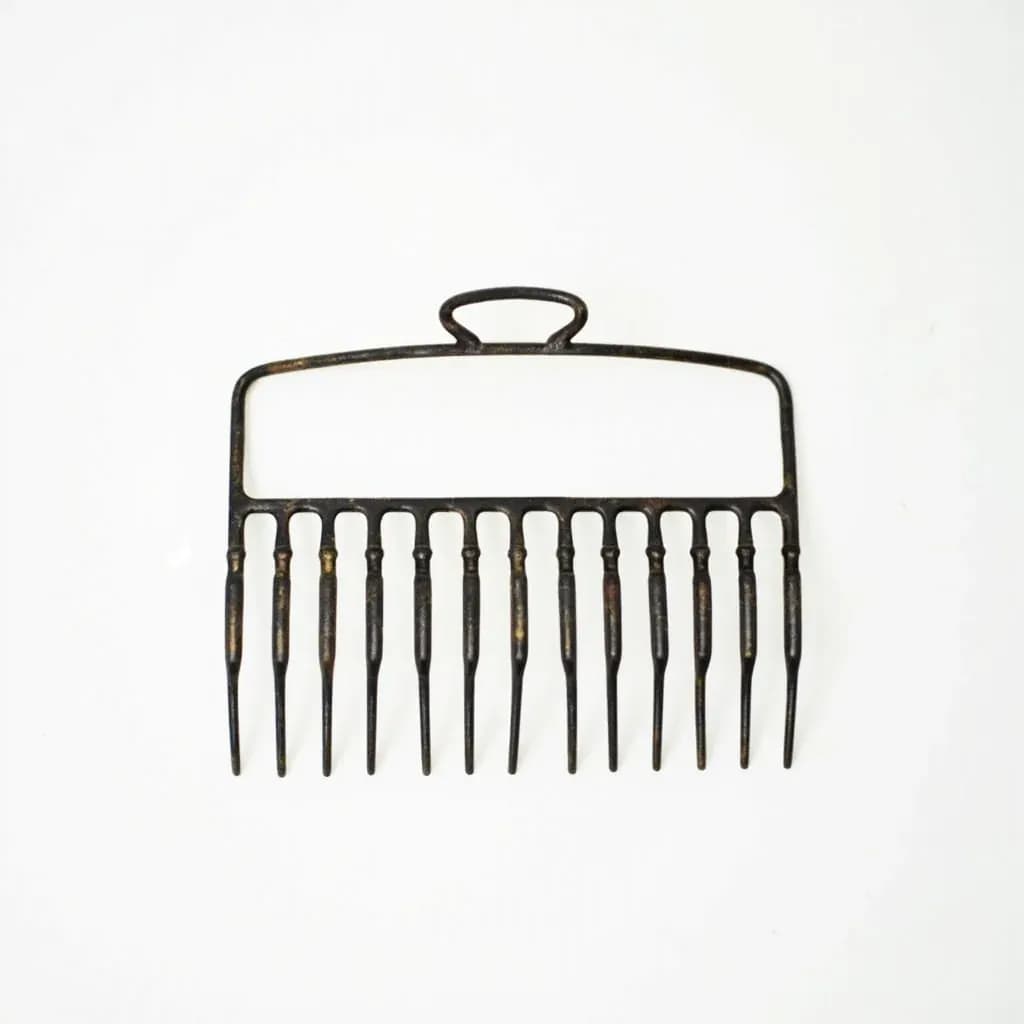
Hand-Held Olive Rake (Comb)
A toothed comb that strips olives or berries from branches without bruising the fruit.
A hand-held olive rake is a comb-like tool whose splayed tines are drawn through olive branches to strip the fruit into a net or basket below. It harvests faster than hand picking while sparing the leaves and limbs. The same toothed design is sold as a berry picker for blueberries and lingonberries.
The hand-held olive rake — also called an olive comb or, in Italian, a pettine per olive — is a short-handled harvesting tool built around a row of flexible tines, usually eight to fourteen, that slide along an olive branch and catch the fruit's pedicels just hard enough to snap the stems free without tearing the bark or stripping the leaves. It matters because olive trees carry the next season's crop on one-year-old wood: a tool that thrashes the branch will cost the grower next year's harvest along with this year's olives. The comb is the low-tech solution to that problem, and the reason it has survived the spread of electric shaker wands and trunk-wrapping harvesters in industrial groves.
In practice the tool behaves like a soft pitchfork drawn through hair. You gather a bundle of branchlets in one hand, hook the tines behind the fruit, and pull toward you; the flexible fingers flex around the wood, the olives drop into the net below, and the leaves mostly stay put. Modern versions use food-grade plastic tines roughly ten to fifteen centimeters long, mounted on a wooden or plastic handle, because plastic is cheap, easy to wash, and won't absorb olive oil the way older horn or hardwood combs did. The rake lives in the orchard and the curing shed, not on the kitchen counter — the entry exists here because the choices made at harvest (ripeness, bruising, cleanliness) directly shape the table olive or oil that ends up on the cook's bench.
Alternatives
Types & varieties
Short-handled model held at chest height; the classic small-farmer tool, used while standing under the tree.
Comb head mounted on an extended wooden or aluminum pole (1.5–3 m) for upper branches without a ladder.
Tines on both faces of the head, so the comb works on either a pull or a push stroke.
Older pre-plastic version; gentler on bark but less durable, harder to sanitize, and absorbs oil over time.
Modern injection-molded food-grade plastic; the most widely sold style today, and the easiest to wash.
Battery or PTO-powered abbacchiatore or shaker combs from Campagnola, Pellenc, Zanon, Lisam — far faster but a different class of tool.
Choosing tine spacing
Tine spacing is the specification that actually matters when you buy one of these, and it is tuned to the cultivar being harvested. Tight spacing suits small-fruited oil varieties like Leccino and Frantoio, where the pedicels are short and the olives dense on the branch. Wider spacing suits large table olives such as Gordal and Sevillano, whose longer stems and bigger fruit would clog a tight comb and crush the olives underneath. A comb matched to the wrong cultivar is the single most common reason beginners leave half the crop on the tree or arrive at the net with olive mash instead of whole fruit.
Working with a net
The comb is only half the system. The other half is what you catch on: an olive net (rete in Italian), a tarpaulin, or a ring of ground cloth spread under the canopy before you start pulling. Combing straight onto bare ground is the fastest way to bruise fruit, pick up leaf litter and stones, and end up with dirty olives that have to be washed before any curing or milling decision can be made. The net also lets you bunch the harvest into crates at the end of each row rather than chasing loose fruit across the orchard.
Common uses
Tips & pitfalls
- Lay a net or tarp under the canopy first — combing directly onto the ground bruises fruit and picks up dirt and leaf litter.
- Pull the comb toward you along the branch, not across it, so the tines slide with the grain of the wood and don't snap the fruiting shoots.
- Target the one-year-old bearing wood; avoid stripping the current season's growth, which carries next year's buds.
- Unload the comb every few pulls — a handful of olives held in the tines crushes the fruit underneath and jams the tool.
- Harvest in the morning after dew has dried; wet olives slip through the tines and rot faster in storage.
- Wear nitrile or leather gloves; olive sap and the comb edges will wear skin raw inside an hour.
- For green table olives such as Sevillano and Manzanilla, pick firm; overripe fruit is much harder to comb cleanly and bruises on contact.
- Sanitize the comb between trees or groves with a dilute food-safe sanitizer if olive fly or other pests are a concern.
- Don't substitute a leaf rake, dog comb, or plastic fork — the tine spacing and flexibility are tuned to olive pedicels, and you will either strip the leaves or snap the twigs.
- For tall trees, a long-reach comb is safer than climbing; pair it with a ladder only on level ground.
Good to know
- Also called
- Olive comb, olive harvester comb, pettine per olive (Italian), rastrillo de aceitunas (Spanish)
- Typical material
- Food-grade plastic tines with a wooden or plastic handle; older versions use wood or horn
- Tine length
- Roughly 10–15 cm (4–6 in) flexible fingers
- Tine count
- Usually 8–14 tines per comb; some models are double-sided
- Region of use
- Mediterranean basin — Italy, Spain, Greece, Portugal, Croatia, North Africa — plus California, Australia, and parts of South America
- Harvest season
- October through January in the Northern Hemisphere, varying with cultivar and end use (green table vs. oil-ripe black)
- Labor efficiency
- Manual combing is far slower than pneumatic or electric harvesters but cheaper, quieter, and gentler
- Fruit damage
- Significantly less bruising than beating branches with sticks; some skin abrasion still possible on overripe fruit
Also called
Berry Picking Rake · Olive Comb · Harvest Comb
Related

Peeler
Swift blade for stripping skin off fruit and vegetables

Grater
Sharp-toothed surface for shredding cheese and vegetables

Microplane
Ultra-fine rasp for citrus zest, garlic, and hard cheese

Mixing Bowl
All-purpose bowl for combining, whisking, and tossing

Whisk
Looped wires that beat air into eggs, cream, and sauces

Spatula
Flat blade for flipping, lifting, and scraping

Slotted Spoon
Pierced spoon that lifts solids and drains the liquid behind

Wooden Spoon
Gentle, heat-friendly spoon for stirring anything