Prep Tools
Order Ticket Rail / Wheel
A rail or rotating wheel that holds and sequences kitchen order tickets on the line.
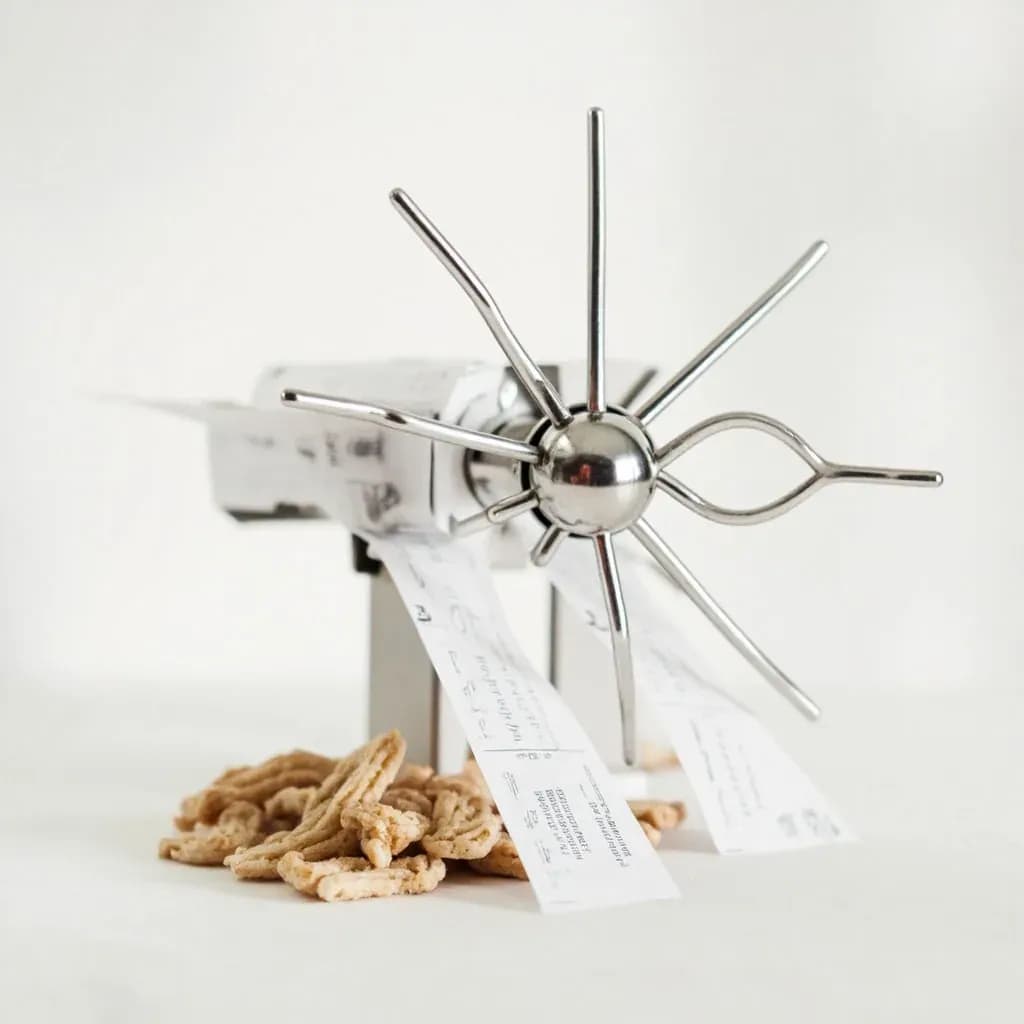
An order ticket rail or wheel is a metal strip or spinning carousel mounted at the pass where servers clip incoming order tickets for the kitchen. It keeps tickets in firing order so the line cooks and expediter can manage timing across multiple tables. The classic spinning version is the iconic diner ticket wheel.
The order ticket rail is the line cook's queue made physical: a horizontal bar fitted with spring clips, mounted under an over-shelf, holding paper order tickets in the exact sequence they were called. The cook reads the oldest unstarted ticket, fires it, and the line moves forward in time with the dining room. It is one of the oldest and least-changed tools in a professional kitchen because it solves a problem that has barely changed — keeping a sequence of orders visible, in order, to several people at once.
The rotating wheel variant, often just called "the wheel," is a circular drum of clips that the cook spins to bring the next ticket into view. It is favored at stations that work a steady stream of short, single-item orders — pizza ovens, broilers, grills — where the cook wants the work to come to him rather than reach across a hot line. The rest of the rail family is straight bars in different mountings: under-shelf, wall-bracketed, freestanding on a pedestal, or hung from the hood frame in open and exhibition kitchens.
In practice, a ticket rail is a coordination device as much as a holder. It tells the expediter what has been fired, what is cooking, and what is ready to plate; it lets the sous chef glance up and read the shape of the entire night; and it provides a tactile, spatial map of order flow that a flat screen cannot quite replicate. Many contemporary kitchens now run a hybrid — Kitchen Display Systems (KDS) for timing, modifiers, and analytics, with a small physical rail at the pass for plate marking and as a paper backup when screens go down.
Alternatives
Types & varieties
Horizontal bar mounted beneath an over-shelf; the default in full-service restaurants
Vertical or horizontal drum on a stand or under a hood; the cook spins it to bring the next ticket into view; favored at high-volume grills and pizza stations
Bracketed to a wall or tile column where no over-shelf exists, such as prep tables or pastry benches
Freestanding unit on a heavy base, used on islands and pass-throughs
Hung from the hood frame or ceiling strut; common in open kitchens and exhibition lines where sightlines matter
Two or three parallel bars stacked vertically to separate courses (apps/mains/desserts) or stations (hot/cold/grill)
Uses rare-earth magnets or notched pegs in place of clips; holds thicker cards, prep lists, or KDS backup tickets
Long rail at the pass used by the expo to stage finished plates against incoming tickets and mark courses as they go out
The rotating wheel, in detail
The wheel is essentially a circular Lazy Susan of tickets, and it earns its keep at stations that cook a relentless, uniform stream — a broiler turning out steaks, a pizza oven working a queue of pies, a fryer cranking out baskets. The cook stands in one place and gives the drum a quarter- or half-turn with a free hand; the next ticket rolls into reading position without him stepping away from the heat. The catch is mechanical: a wheel that sits still for long stretches welds its clips shut with grease and flour, and a heavy ticket can bend a clip or stop the drum mid-spin. A cook who keeps the wheel turning lightly, even between tickets, keeps the mechanism honest.
- Best for one-cook stations with short, repetitive tickets
- Mount so the ticket face lands at eye line, not above it
- Spin the wheel a half-turn every few tickets even when not pulling one
- Watch for bent clips — a stuck wheel is almost always a clip problem, not a bearing problem
Running a rail alongside a KDS
Kitchen Display Systems solved the legibility and timing problems of paper tickets but lost the at-a-glance spatial awareness that a physical rail provides. A cook can read the entire night's shape from a glance down a rail; a screen shows one ticket at a time, scrolled in a list. Most kitchens that have made the jump run both: KDS screens at each station for timing, modifier tracking, and 86 calls; a small physical rail at the pass where the expo marks plates, parks VIP orders, and tucks paper tickets during a system outage. The rail is the redundancy plan and the human-readable map; the screen is the data layer.
- Keep at least a short pass-side rail even after installing KDS screens — it is your outage backup and your expo's plate-marking surface
- Use colored clips on the pass rail to flag allergies, VIPs, and large parties that need hand-off attention
- Treat the rail as the visual ground truth during a screen crash: tickets go on the rail first, then into the system when it returns
Common uses
Tips & pitfalls
- Color-code clips by course or station — one color for apps, another for mains, a third for dietary restrictions — and you will stop calling out modifiers by voice every ticket.
- Move the completed ticket to a designated 'done' clip, a back rail, or a bin; leaving finished tickets mixed with active ones is the single most common cause of duplicated or dropped plates.
- Mount the rail at the cook's eye line, not above it — tall cooks will not look up, and a rail above the sightline becomes invisible during a rush.
- If you run a wheel, give it a half-turn every few tickets even when you are not pulling one; the friction of a stationary wheel is what bends clips and jams the mechanism.
- Use a separate rail for each station (hot, cold, grill, fryer) so cooks are not reaching across the same bar; modular multi-rail frames make this cheap and tidy.
- Clip the ticket at the top edge, not the middle, so the order text hangs readable — pinching the body of the ticket covers modifiers and table numbers.
- Do not overload a single clip; if an order spans more than one ticket (modifiers on a duplicate), fan them so the most recent edit sits on top.
- Wipe the clips weekly; grease and flour build up and tickets slide off at the worst possible moment.
- Keep a 'parking' clip or short side-rail for held or VIP tickets so they are not buried under the rush.
- Retire any rail with bent tubing or loose clips — tickets falling on the floor is a food-safety and timing problem, not a minor one.
Good to know
- Also called
- Order rail, ticket rail, the wheel, expediter rail, kitchen rail, sous chef rail
- Primary function
- Sequences and displays paper order tickets in the order they were called so the line can work them oldest-first
- Common material
- Stainless steel tubing or extruded aluminum; lower-cost or older versions use chrome-plated steel wire
- Typical length
- 24–72 in (60–180 cm); 36 in and 48 in are the most common; modular rails join end-to-end
- Clips
- Spring-loaded alligator or pinch clips, usually sold separately; 8–24 per rail depending on length
- Mounting options
- Under-shelf (screw or clamp), wall bracket, overhead-suspended from the hood frame, or freestanding on a counter pedestal
- Origin
- Evolved in mid-20th-century American kitchens from clothespins-on-a-string setups; the rotating wheel is associated with 1950s–60s New York and Chicago steakhouse and grill lines
- Companion hardware
- Thermal receipt printers, station printers, call buttons, and (in newer builds) KDS screens
- Ticket medium
- Originally handwritten chits on a spike; now almost universally thermal-printer roll tickets or carbon-copy guest checks
- Cleaning
- Wipe-down with food-safe sanitizer; clips are removable for dishwashing; do not soak the rail
- Price range
- Roughly $40–$300 for a basic rail or wheel; stainless modular systems with clips run $150–$500+
Also called
ticket wheel · order rail · wheel of pain
Related

Peeler
Swift blade for stripping skin off fruit and vegetables

Grater
Sharp-toothed surface for shredding cheese and vegetables

Microplane
Ultra-fine rasp for citrus zest, garlic, and hard cheese

Mixing Bowl
All-purpose bowl for combining, whisking, and tossing

Whisk
Looped wires that beat air into eggs, cream, and sauces

Spatula
Flat blade for flipping, lifting, and scraping

Slotted Spoon
Pierced spoon that lifts solids and drains the liquid behind

Wooden Spoon
Gentle, heat-friendly spoon for stirring anything