Prep Tools
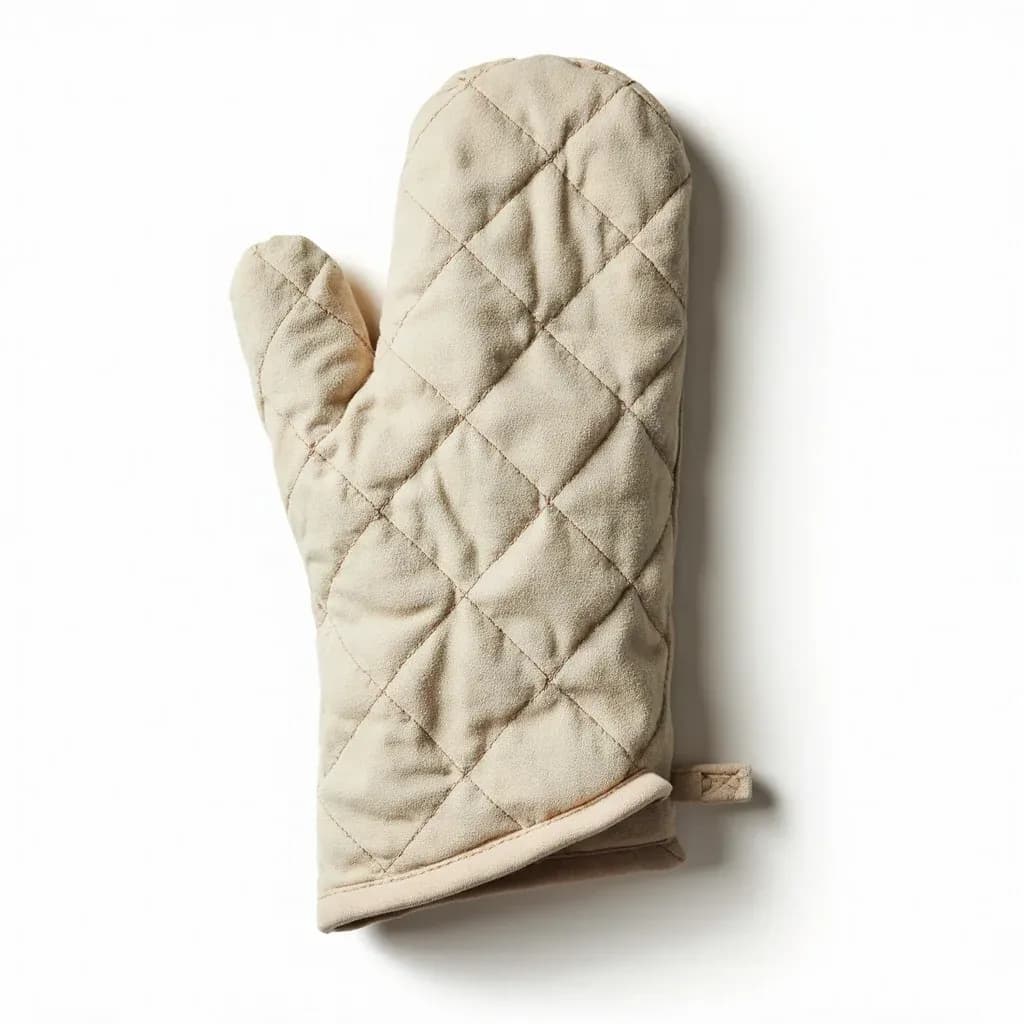
Oven Mitt
An insulated glove that protects the hand and wrist when handling hot pans and trays.
An oven mitt is a thickly padded glove, often quilted cotton or silicone, that shields the hand and forearm from heat when removing pans from the oven or lifting hot pots. It gives a fuller, safer grip than a folded towel, especially for heavy roasting trays. Silicone versions add a non-slip, water-resistant surface.
An oven mitt is an insulated hand covering built to bridge the seconds-long gap between a hot pan and the counter, stovetop, or trivet. Unlike a potholder — a flat square meant to grab a handle or lift a lid — a mitt wraps the hand and, depending on style, part of the forearm, freeing the cook to lift, tilt, and rotate heavy or awkward loads: a screaming sheet pan, a deep Dutch oven full of braise, a turkey roaster sloshing with drippings. The job looks trivial until it goes wrong; a wet cotton mitt conducts heat almost as well as bare skin, and a slick fabric mitt on an enameled handle is a recipe for a dropped pan and a foot burn.
The two dominant designs solve the problem differently. Quilted cotton mitts layer fabric with polyester batting to trap still air, the same principle as a winter coat; they are soft, dexterous, and inexpensive, but they lose most of their protective value when damp and offer only modest grip on slick metal. Silicone mitts — either fully molded or as a silicone shell over fabric — shed water, grip slick surfaces with a textured pattern, and tolerate higher temperatures, at the cost of a stiffer hand and a slightly clumsy feel for fine work. Commercial kitchens add a third option: aramid-fiber (Nomex or Kevlar-blend) mitts that handle sustained contact far better than anything sold for the home cook.
The right mitt for a task is dictated less by maximum temperature than by whether the heat is wet or dry, how heavy the load is, and how long contact will last. A brief grab of a dry sheet pan at 425°F is one job; lowering a hot canning jar into a boiling-water bath is another; rotating a grill grate over glowing coals is a third. Match the mitt to the moment and it becomes nearly invisible; mismatch it and the lesson arrives in a hurry.
Alternatives
Types & varieties
Traditional, soft, and flexible; the everyday choice for dry oven work. Weakest when wet and the least grippy on slick metal.
Waterproof shell with a textured, high-friction surface; higher heat tolerance and safe when damp. Stiffer hand, slightly clumsy for fine tasks.
A large flat mitt insulated on both sides with a pocket for two hands; built for roasting pans and full sheet trays where balance matters more than dexterity.
Extended 12–18 in past the wrist; the right pick for broilers, smokers, charcoal grills, and reaching deep into a wall oven.
Nomex or Kevlar-blend used in restaurant kitchens; the highest heat tolerance and the best choice for sustained contact, at the cost of thickness and price.
Gauntlet-style leather, often with a cuff; made for grills, fireplaces, chimneys, and handling coals.
Small square or half-hand shape used for jar lids, skillet handles, and quick grabs where a full mitt is overkill.
Reading the heat rating
A mitt stamped "500°F" tells you the fabric or silicone can survive brief contact with a surface at that temperature — it does not promise protection from a longer grip, a hotter surface, or a wet mitt. In practice the oven air around a roast is rarely the danger; the danger is the metal pan itself, which is usually within 50°F of the air, and the radiant heat pouring off a broiler element or a closed grill lid. Treat the rating as a ceiling for the moment of contact, not a continuous-use temperature, and give the mitt a few seconds between grabs whenever you can.
- Brief contact only — let go and reset the grip rather than holding on through a long carry.
- Wet fabric collapses the rating: assume a damp cotton mitt is no mitt at all.
- Silicone beats cotton whenever water, oil, or sugar syrup enters the equation.
- Grip matters as much as heat tolerance; a slick fabric mitt on a polished handle will drop the pan before the temperature becomes an issue.
Common uses
Tips & pitfalls
- Never pick up a wet or damp fabric mitt — moisture transmits heat straight through the batting and turns the mitt into a steam compress against the skin.
- Skip the cotton mitt for boiling-water tasks (pasta, blanching, water-bath canning); a silicone mitt or long tongs are far safer.
- Don't store mitts at the edge of the cooktop or right next to a burner — an unthinking reach toward a flaming mitt is one of the most common causes of kitchen fires.
- Replace a mitt when the batting feels matted, the outer fabric is thinning, or there are scorch marks; insulation degrades with age and laundering long before the mitt looks worn out.
- For a heavy roast, use a double mitt with two hands rather than a single mitt — the center of a loaded turkey pan is the hottest point and the load tips easily.
- Reach for silicone whenever the surface is slick — sheet pans, enameled cast iron, stainless saucier handles — the textured grip prevents the sideways slide that drops the pan.
- A doubled-up dry cotton kitchen towel is the classic stand-in at the stovetop, but it slips on metal, offers no wrist protection, and is dangerous when wet; treat it as a backup, never a true substitute.
- Long-cuff and gauntlet mitts pay for themselves the first time you pull a sheet pan from under a live broiler or reach across a charcoal grill.
Good to know
- Primary materials
- Quilted cotton with polyester/cotton batting; silicone (molded or coated over fabric); aramid fibers (Nomex or Kevlar-blend) in commercial mitts; terry cloth; leather for grilling.
- Heat tolerance (home models)
- Standard cotton mitts are rated for brief contact around 400°F (204°C); silicone mitts commonly rated 450–500°F (232–260°C); commercial aramid mitts run higher. Ratings apply to brief contact, not prolonged exposure.
- Length
- Standard cuff ends at the wrist (about 8–10 in / 20–25 cm); long-cuff or gauntlet styles run 12–18 in (30–46 cm) for broilers, grills, and deep ovens.
- Wet-heat behavior
- Fabric mitts lose most insulating power when wet because water conducts heat; silicone mitts remain safe when damp and are preferred for steam and boiling-water work.
- Care
- Quilted cotton mitts are usually machine-washable, tumble-dry low; silicone mitts are typically dishwasher-safe; dry fabric mitts thoroughly to prevent mildew in the batting.
- First patent
- U.S. Patent 27,545 (1861) by Francis Poillon for a 'sloven or glove' for handling heated utensils — among the earliest documented mitt designs.
- Lifespan cue
- Replace when batting is compressed, fabric is thinning, or scorch marks appear.
Also called
oven-mitts · Oven Glove · Pot Holder Glove
Related

Peeler
Swift blade for stripping skin off fruit and vegetables

Grater
Sharp-toothed surface for shredding cheese and vegetables

Microplane
Ultra-fine rasp for citrus zest, garlic, and hard cheese

Mixing Bowl
All-purpose bowl for combining, whisking, and tossing

Whisk
Looped wires that beat air into eggs, cream, and sauces

Spatula
Flat blade for flipping, lifting, and scraping

Slotted Spoon
Pierced spoon that lifts solids and drains the liquid behind

Wooden Spoon
Gentle, heat-friendly spoon for stirring anything