Prep Tools
Papaya Shredder (Mit Soi Malakor)
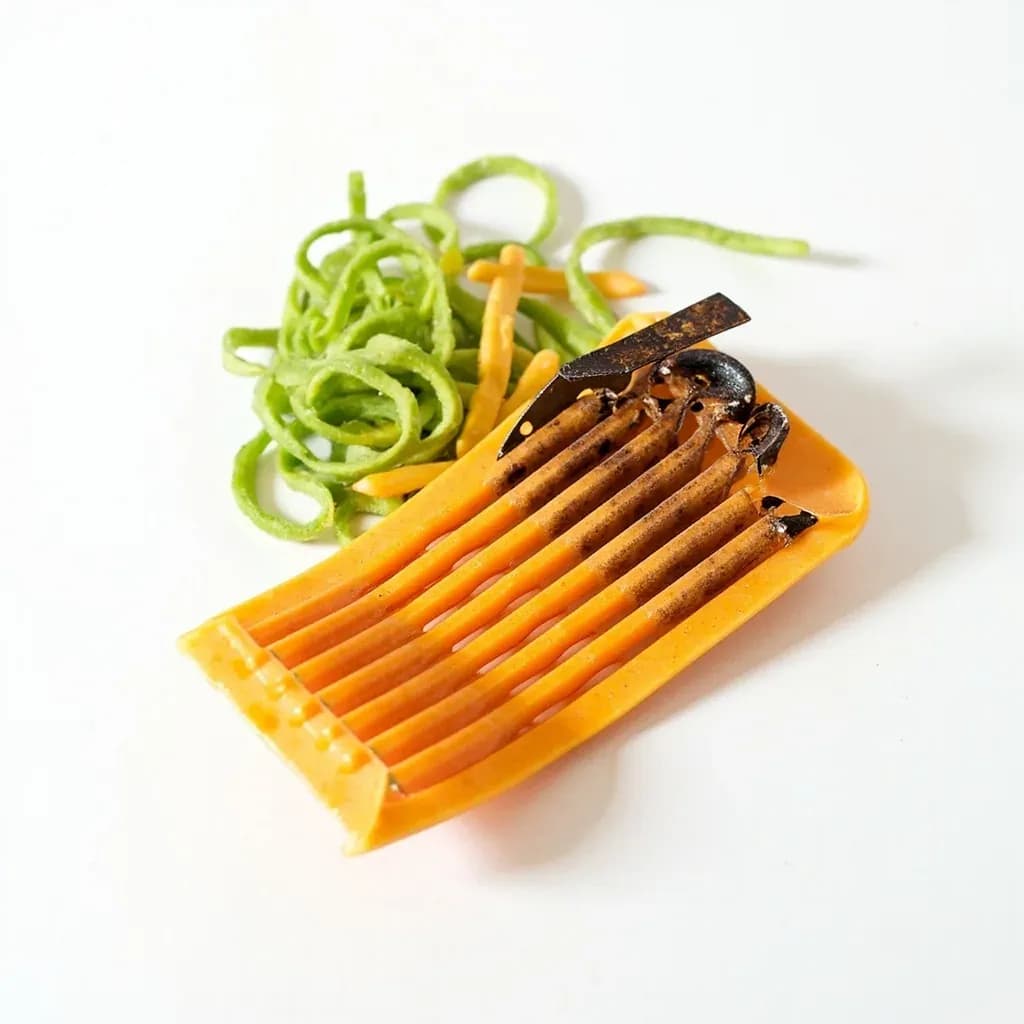
A serrated hand grater that cuts green papaya into long fine threads for Thai som tam salad.
A papaya shredder is a slim metal or plastic blade studded with tiny serrated teeth, used to scrape firm green papaya or carrot into long thin strands. It is a staple for Thai green papaya salad (som tam), where the ragged shredded texture grips the dressing better than a smooth julienne. Cooks hold the peeled fruit in one hand and draw the blade down its length, then slice off the shredded layer.
The Mit Soi Malakor — literally 'papaya-shredding knife' in Thai — is a hand tool purpose-built for one job: turning a peeled, unripe papaya into the long, fine, crisp threads that form the structural backbone of som tam, Thailand's celebrated green papaya salad. At first glance it looks like a small flat grater, but its defining feature is a row of parallel serrated slots cut into a rectangular blade, with the sharp edges facing inward toward the user. You draw the firm green papaya across these slits in a single pulling stroke, and the blade shaves off long, even ribbons rather than the short, irregular pieces a box grater produces.
The cut matters because som tam dressing — lime, fish sauce, palm sugar, chili — needs something to cling to. Short grated pieces absorb liquid too quickly and collapse into a limp pile; the long threads from a mit soi malakor stay crisp, hold dressing in their folds, and give the salad its characteristic fluffy, almost nest-like texture. Most Thai cooks consider the shred quality visually and texturally distinct from any substitute, which is why this specialist tool has survived in markets and restaurant kitchens even as Western mandolines and julienne peelers have become widespread.
In practice the tool is simple and forgiving. The motion is closer to using a carpenter's plane than a grater: a single smooth draw, firm downward pressure, and a clean stop. The real challenges are choosing a fully green, rock-hard papaya (any softness and the flesh mashes instead of cutting), keeping the angle consistent, and clearing pulp from the serrated slots between strokes so the slits keep cutting cleanly rather than tearing the fibers.
Alternatives
Types & varieties
Most common in Thai market stalls; hardwood handle riveted to a stainless or tin blade, favored for grip and balance.
Lighter, cheaper version sold in supermarkets; identical blade geometry but a less durable handle.
Wider blade (around 6–7 cm) for shredding larger produce faster; common in restaurant kitchens and catering.
Smaller, often plastic-bodied version sold to tourists; useful for single-serving portions but slower than full-size tools.
Features both fine and coarser serrations on opposite faces of the blade for different shred thicknesses.
Working with Green Papaya
The shredder will only do its job if the produce is right, and the produce must be very specific. A ripe or even slightly softening papaya has too much moisture and broken-down pectin; the blade slides through it and the flesh smears. You want a papaya that is fully green, heavy for its size, and so firm that pressing a fingernail into the skin leaves no mark. In Thai markets the long, football-shaped green papaya picked young and still hard as wood is the classic choice, sold by ripeness stage rather than by variety name. Once home, keep it at room temperature and shred within a day or two; refrigeration does not help unripe papaya and can cause surface pitting and uneven ripening.
Preparation is quick. Peel the skin with a vegetable peeler or paring knife, then slice off one long side to create a flat face so the papaya sits stably on the board instead of rolling under pressure. Hold the shredder at roughly a 20–30 degree angle to the papaya and pull toward you in one smooth stroke — sawing tears the fibers and produces ragged shreds. Rotate the fruit as you work to expose a fresh face, and stop when the seedy core is reached. Between strokes, clear pulp from the slots with your thumb or a bamboo skewer; a clogged slit rips the next shred instead of cutting it.
After shredding, soak the threads briefly in a bowl of cold water, swish, and drain. This washes away the white papaya latex that otherwise clouds the dressing and turns the shreds dull, and it firms up the cells so the salad stays crisp for longer.
Common uses
Tips & pitfalls
- Choose a fully green, rock-hard papaya; even slight softness will cause the flesh to mash and clog the slits rather than shred cleanly.
- Peel the papaya and cut a flat side so it sits stably on the board before drawing it across the blade — a rolling fruit is a dangerous one.
- Hold the tool at roughly 20–30 degrees and pull toward you in a single smooth stroke; sawing back and forth tears the fibers and produces ragged shreds.
- Apply firm downward pressure through the tool rather than into it — the serrations do the cutting, your job is to keep the angle and the stroke even.
- Clear pulp from the serrated slots between strokes with your thumb or a bamboo skewer; clogged slits rip shreds instead of shaving them.
- Soak the shredded papaya briefly in cold water and drain well to wash away latex and keep the threads pale and crisp.
- Do not use the tool on soft produce — banana, ripe mango, or tomato will mash into the slits and ruin both the food and the blade.
- Avoid the dishwasher for wooden-handle models; hand wash, dry immediately, and lightly oil carbon-steel blades to prevent rust.
Good to know
- Thai name
- Mit Soi Malakor (มีดซอยมะละกอ), literally 'papaya-shredding knife'
- Origin
- Thailand; used throughout Southeast Asia for green papaya and green mango salads
- Primary use
- Shredding unripe green papaya into long, fine, uniform threads for som tam
- Material
- Stainless steel blade with wooden or plastic handle; budget versions use stamped tin-plate
- Blade design
- Flat rectangular blade with parallel rows of inward-facing serrated slits; produce is drawn across the blade to shave off ribbons
- Typical size
- Blade 12–15 cm long, 4–5 cm wide; tool roughly 20–25 cm overall
- Skill level
- Beginner-friendly; the main challenge is keeping consistent pressure and angle
- Cleaning
- Hand wash and dry immediately; serrated slots trap fibers and pulp and need a brush or bamboo skewer to clear
Also called
papaya-grater · papaya peeler shredder · som tam shredder · mit soi malakor
Related

Peeler
Swift blade for stripping skin off fruit and vegetables

Grater
Sharp-toothed surface for shredding cheese and vegetables

Microplane
Ultra-fine rasp for citrus zest, garlic, and hard cheese

Mixing Bowl
All-purpose bowl for combining, whisking, and tossing

Whisk
Looped wires that beat air into eggs, cream, and sauces

Spatula
Flat blade for flipping, lifting, and scraping

Slotted Spoon
Pierced spoon that lifts solids and drains the liquid behind

Wooden Spoon
Gentle, heat-friendly spoon for stirring anything