Prep Tools
Passatelli Press
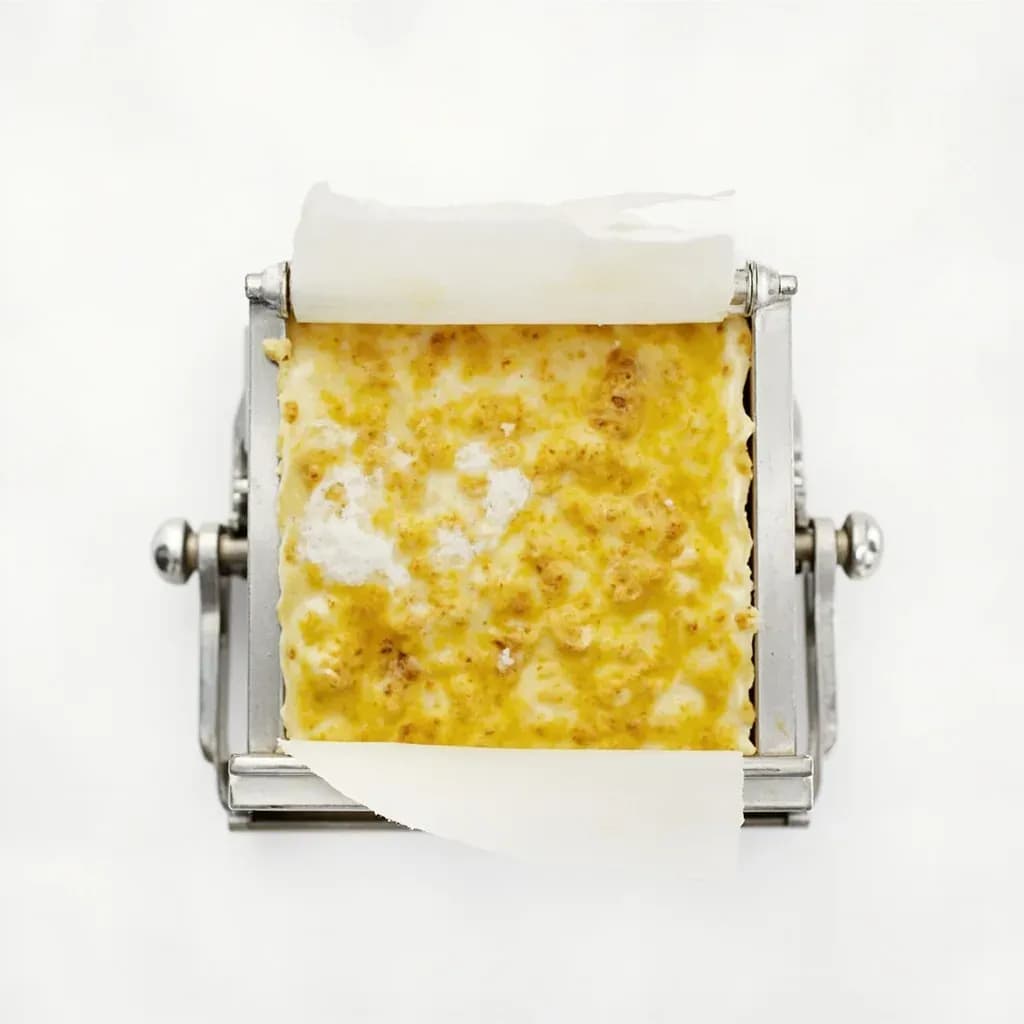
A perforated plate-and-plunger press that extrudes Emilian breadcrumb dough into short passatelli noodles.
A passatelli press is a hinged tool with a thick perforated disc through which a dough of breadcrumbs, eggs, and Parmesan is forced into stubby cylindrical strands. The cook clamps a ball of stiff dough inside and squeezes the handles to push it through the wide holes, cutting the extruded ropes straight into simmering broth. It is a regional Italian tool from Emilia-Romagna, prized for the rough, coarse texture it gives the noodles.
The passatelli press — ferro per passatelli in Italian, passatelliera in Emilian dialect — is a small hand-operated tool purpose-built for one of Emilia-Romagna's most distinctive dishes: passatelli in brodo. Unlike a pasta extruder that pushes semolina dough through a die under screw pressure, a passatelli press compresses a soft, dense mixture of fine breadcrumbs, egg, grated Parmigiano-Reggiano, and often a little bone marrow or pancetta through a coarse perforated disc, typically 3 to 5 millimeters in diameter. The result is a short, fat, pillowy strand that poaches directly into simmering broth and absorbs it as it cooks.
The disc must be coarse because the dough is closer in texture to a soft dumpling mixture than to extruded durum-wheat pasta, and the strands need enough body to hold their shape the moment they leave the plate. Most presses hold a single portion — roughly 80 to 150 grams per load — and a heavy-bottomed wide pot is far more practical than a tall stockpot, because you need clear access to the surface of the broth to position the tool and the finished passatelli need room to float. The dish is built around the tool, and choosing the wrong hole size, the wrong pressure, or the wrong dough consistency will change the final texture more than any other variable.
In practice, a passatelli press is to the Emilian cook what a spaetzle maker is to the Swabian or a ricer is to the French: a single-purpose implement that does one job with great precision. Antique brass and tin-plated models are still functional and prized as kitchenalia; modern stainless versions are sturdier and easier to clean. There is no convincing substitute for it in the traditional kitchen, and the one thing a cook must never do is reach for a fine pasta-extruder die in its place.
Alternatives
Types & varieties
The classic form: a single perforated disc set in a metal ring, a cylinder to hold the dough, and a wooden or metal plunger pushed by hand. The most common type in Italian home kitchens.
A two-handled variant that squeezes dough through a perforated plate using leverage rather than direct thumb pressure. Easier on the hands and well suited to larger batches.
A rotating or screw-fed drum with a perforated face, sometimes mounted on a table clamp. More of a restaurant or large-family tool than a home one.
Heirloom pieces with a hand-turned brass body and wooden plunger, still functional and collected as Emilian kitchenalia.
The dough it was built for
Passatelli dough has almost nothing in common with extruded durum-wheat pasta. It is built from fine dry breadcrumbs, eggs, and grated Parmigiano-Reggiano, plus small enrichments: a knob of softened bone marrow (midollo) in the Modenese style, a spoonful of rendered pancetta in some Bolognese versions, occasionally a whisper of lemon zest or nutmeg. The mixture comes together into a soft, slightly sticky mass about the consistency of firm mashed potato, and it is usually rested for 30 minutes to an hour so the breadcrumbs fully absorb the egg.
That texture is the entire reason for the tool's design. A standard pasta-extruder die (under about 1.5 mm) would crush this dough into paste rather than pushing it through as coherent strands, and even a typical spaetzle maker is too fine. The passatelli press's 3–5 mm perforations and plunger action let the dough emerge in short, fat strands that hold their shape the instant they hit hot liquid. The strands then swell slightly and turn tender as they absorb broth during the brief poaching, giving passatelli their characteristic soft-yet-bouncy bite.
Working at the pot
The right pot matters almost as much as the right press. Use a wide, heavy-bottomed pan — a Dutch oven or low-sided braiser — with the brodo at a steady bare simmer, not a rolling boil. Hold the press a few centimeters above the surface so the strands drop cleanly into the liquid without splashing or clumping. As each strand emerges from the disc, snip it with kitchen shears or break it against the rim of a wooden spoon at roughly 3–4 cm; this is the canonical length and what allows the pieces to cook evenly in about 2–3 minutes.
Work in two or three small batches rather than crowding the pot. Passatelli swell as they absorb broth, and too many at once will cool the liquid below a simmer, leaving the centers chalky. They are ready the moment they float to the surface and feel springy when nudged with a spoon. Serve immediately in warmed shallow bowls with a generous ladle of the same broth and a dusting of additional Parmigiano — and, in the Modenese tradition, often a small piece of the capon leg that flavored the brodo alongside.
Common uses
Tips & pitfalls
- Press the dough directly into already-simmering broth — cold liquid makes the strands stick to the disc and tear as they emerge.
- Dough consistency is everything: it should be soft but hold its shape when squeezed, like firm mashed potato. Too wet and the strands collapse in the broth; too dry and they crumble on the way out.
- Lightly grease the disc with butter or a wipe of neutral oil before the first pass to keep the dough from clinging.
- Use gentle, even pressure. Forcing too hard extrudes dense, gummy strands instead of the light, airy texture passatelli should have.
- Cut the strands to roughly 3–4 cm (kitchen shears or the edge of a wooden spoon work) as they emerge so they fall freely into the broth rather than piling up on the disc.
- Passatelli are done as soon as they float and feel bouncy; overcooking turns them gluey because of the breadcrumb content.
- Do not substitute a standard pasta-extruder die for a passatelli plate — pasta dies are far too fine and will clog or crush the dough.
- Hand-wash and thoroughly dry older tin-plated or brass presses. A dishwasher cycle will strip the plating, after which the dough will stick badly.
- If the disc clogs mid-batch, briefly dunk it in the hot broth and continue. Do not clear the holes with a knife, which can deform the openings.
Good to know
- Origin
- Emilia-Romagna, Italy — primarily the provinces of Bologna, Modena, and Parma
- Also called
- Ferro per passatelli, passatella, or passatelliera
- Tool family
- Perforated-plate press, related in design to a potato ricer (schiacciapatate) and to spaetzle makers
- Typical materials
- Tin-plated steel, brass, or stainless steel for the perforated disc; turned wood or cast metal for the plunger handle
- Hole size
- Roughly 3–5 mm diameter — much larger than standard pasta-extruder dies, because the breadcrumb dough is dense and thick
- Working capacity
- Holds roughly one portion of dough (about 80–150 g) per load, depending on model
- What it extrudes
- Passatelli — short, soft, breadcrumb-and-Parmigiano 'noodles' about the thickness of a pencil
- Care
- Older tin-plated or brass models should be hand-washed and dried immediately; modern stainless versions are dishwasher-safe
Also called
passatelli maker · ferro per passatelli · passatelli iron
Related

Peeler
Swift blade for stripping skin off fruit and vegetables

Grater
Sharp-toothed surface for shredding cheese and vegetables

Microplane
Ultra-fine rasp for citrus zest, garlic, and hard cheese

Mixing Bowl
All-purpose bowl for combining, whisking, and tossing

Whisk
Looped wires that beat air into eggs, cream, and sauces

Spatula
Flat blade for flipping, lifting, and scraping

Slotted Spoon
Pierced spoon that lifts solids and drains the liquid behind

Wooden Spoon
Gentle, heat-friendly spoon for stirring anything