Prep Tools
Spaghetti Server / Pasta Tongs
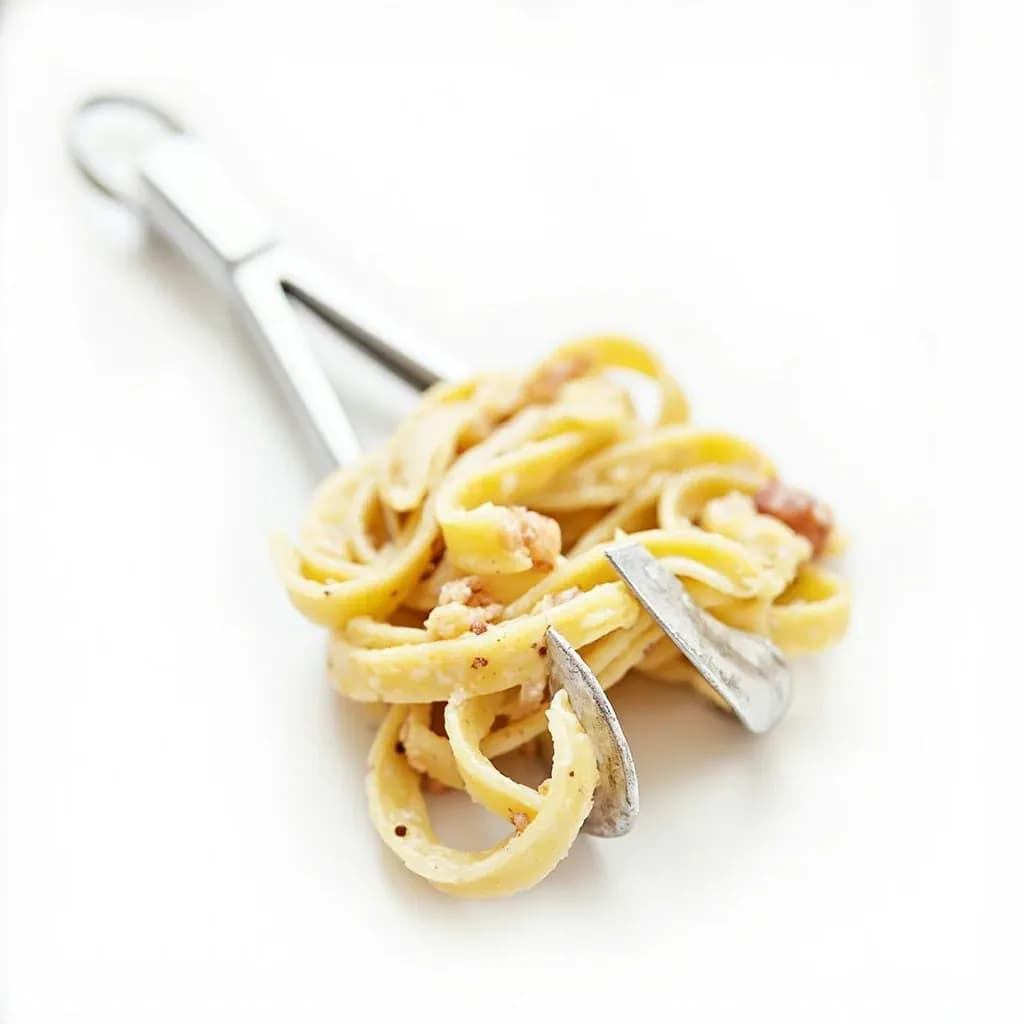
Clawed tongs or fork that grips long pasta strands to portion and toss spaghetti.
A serving tool with toothed claws or prongs designed to grab and lift slippery long pasta like spaghetti and linguine. It grips the strands to portion plates, toss noodles with sauce, and lift pasta from the pot without it sliding away. The teeth catch the strands where smooth tongs would let them slip.
A pasta server is the single tool that solves the specific problem long pasta creates: the strands are slippery, they tangle the moment you stop stirring, and a soup spoon or wooden spoon will break them on the way out of the pot. Whether it takes the form of a one-piece stamped claw, scissor-action tongs, or a measuring spoon with a hole in the bowl, the job is the same — to grab a bundle of spaghetti, linguine, or tagliatelle, lift it without breaking the strands, and deliver it into a pan of sauce with a splash of the starchy cooking water still clinging on.
The material matters more than the silhouette. Bare stainless grips the best but will slowly score a non-stick or ceramic pan; silicone- or nylon-tipped versions trade a little bite for pan safety. Wood and bamboo are the gentlest of all and have a traditional Italian look, but they crack if you leave them sitting in hot water and they don't belong in the dishwasher. The portion-hole design is the most quietly useful variant — a circular hole in the bowl sized to hold about 100 g (3.5 oz) of dry long pasta, which is a single standard serving, so you can skip the dry-measuring cup entirely.
More than any other piece of pasta gear, a good server lets you do the move that defines modern Italian-American pasta cookery: lift straight from the boiling pot to the sauce pan, no colander in between. That step preserves the cloudy, starchy cooking water that emulsifies butter or oil into a clinging sauce, which is the difference between a glossy, coat-the-strands finish and a watery puddle at the bottom of the bowl.
Alternatives
Types & varieties
A single stamped or cast piece with curved tines; you press the pasta against the side of the pot to grip. The classic Italian-American design.
Two arms hinged like scissors or pliers, one or both with teeth. Best for actively twirling and tossing in a pan.
Thumb lever or internal gear opens the claw without a second hand, leaving the other free to steady the pot. Examples include Tovolo, OXO, and KitchenAid versions.
A large spoon or fork with a circular hole in the bowl; the hole meters a single serving of dry spaghetti (about 100 g).
Long, slim three- or four-tine fork with a slim handle — the simplest form; lifts and twirls but grips slippery strands the least.
Metal tongs with heat-resistant silicone ends; protects non-stick and ceramic coatings while still giving firm grip.
Gentlest on cookware and traditional in look; should not be soaked and is not dishwasher safe.
Pot-to-pan transfer: skipping the colander
The defining technique the pasta server enables is lifting strands straight from the boiling water to the waiting sauce pan. It feels awkward the first time you try it, because pasta wants to slip back into the pot the instant you raise the server. The fix is to grab a smaller bundle than you think you need — a wet, heavy clump is what causes the slip — and to twist the server against the inside wall of the pot as you lift, so the strands coil onto the tines rather than dangling loose.
- Reserve a mug of pasta water before you start lifting; you will want a splash to loosen the sauce once the pasta is in the pan.
- Scoop the pasta at a slight angle so the bundle lies across the tines, not hanging straight down.
- Twist the server toward you as you raise it so the strands wind into a loose rope — they will not fall back into the pot.
- Drop the bundle into the sauce pan and toss with the same tongs; the residual water on the strands is what emulsifies the sauce.
The portion-hole trick
The hole in a portioning spaghetti spoon is not decorative. It is sized so that one filled hole of dry, straight strands equals roughly 100 g, which is the standard serving in most Italian portions and a generous main-course portion in North America. For two people, fill the hole twice; for four, four times. This is faster than weighing dry pasta and more reliable than eyeballing a bundle.
- Push the dry strands through the hole end-first so they pack evenly; don't try to scoop them sideways.
- Most reliable with long, straight dried pasta such as spaghetti — the hole is designed around its diameter and length.
- If you're cooking for a mixed group, a portion-hole server lets you scale by single servings without dirtying a scale or measuring cup.
Common uses
Tips & pitfalls
- Use a portion-hole server to skip the dry-pasta measuring step: one filled hole is one standard 100 g portion.
- Transfer pasta from pot directly to the sauce pan — don't drain into a colander; you want the starchy cooking water to emulsify the sauce.
- Twist the server with the pasta held against the pan wall to build a tight nest on the plate rather than a loose heap.
- Pick silicone- or nylon-tipped tongs for non-stick or ceramic pans; bare stainless will eventually score the coating.
- For very long strands like vermicelli and capellini, lift a smaller bundle — the weight of waterlogged pasta on one server will flip the strands back into the pot.
- Don't cut long pasta to fit the pot; the extra cut ends release starch and the strands turn gummy.
- Don't leave wood or bamboo servers sitting in hot water; the grain lifts and the tool will crack within a season.
- If strands keep slipping off the tines, the pasta is undercooked — properly al dente strands grip much better than soft, overcooked ones.
Good to know
- Also called
- Pasta server, spaghetti claw, spaghetti fork, pasta spoon, spaghettiklaue
- Primary material
- Stainless steel; also available in heat-resistant nylon, silicone, wood, and bamboo
- Typical length
- 18–22 cm (7–9 in) overall
- Portion-hole standard
- The measuring hole in a portioning server holds roughly 100 g (3.5 oz) of dried long pasta — one standard serving
- Heat tolerance
- Stainless handles boiling contact; silicone tips are rated to roughly 200–230 °C (400–450 °F); standard nylon begins to soften near 170–200 °C (340–390 °F)
- Dishwasher safe
- Stainless steel and most silicone-tipped versions are dishwasher safe; wood and bamboo are not
- Origin
- Italy, late 19th to early 20th century, as long-strand pasta shifted from festival food to daily staple
- Pan safety
- Safe on stainless, enameled cast iron, and non-stick only when the tips are nylon, silicone, or wood
Also called
Spaghetti Server · Pasta Fork · Spaghetti Tongs
Related

Peeler
Swift blade for stripping skin off fruit and vegetables

Grater
Sharp-toothed surface for shredding cheese and vegetables

Microplane
Ultra-fine rasp for citrus zest, garlic, and hard cheese

Mixing Bowl
All-purpose bowl for combining, whisking, and tossing

Whisk
Looped wires that beat air into eggs, cream, and sauces

Spatula
Flat blade for flipping, lifting, and scraping

Slotted Spoon
Pierced spoon that lifts solids and drains the liquid behind

Wooden Spoon
Gentle, heat-friendly spoon for stirring anything