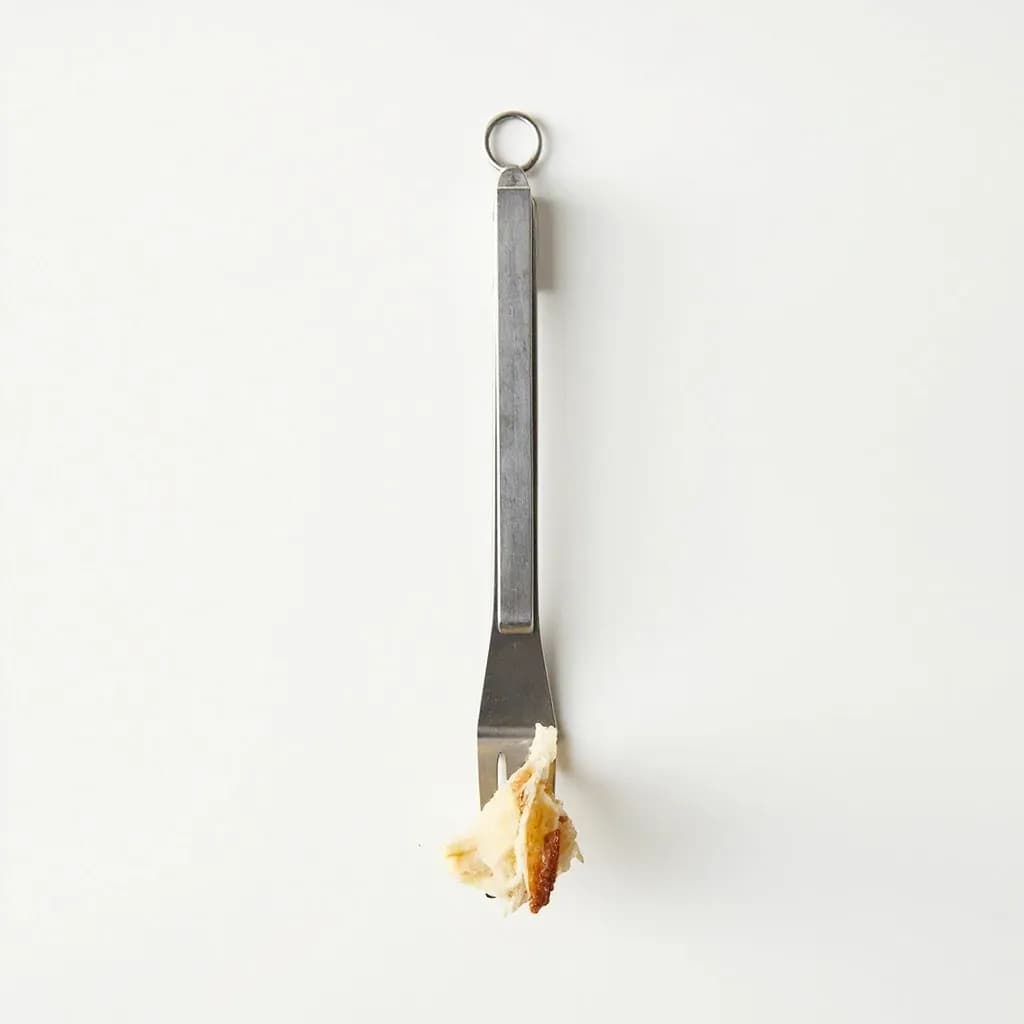
Prep Tools
Pastry Tweezers
Long precision tweezers for placing garnishes and delicate elements when plating.
Pastry tweezers are long, fine-tipped tweezers used by chefs to place herbs, microgreens, edible flowers, and tiny garnishes with precision when plating. The extra length keeps fingers clear of the plate and allows controlled, surgical placement. They are a staple of fine-dining and pastry presentation.
Pastry tweezers are the long, slim precision pincers used at the final stage of plating, when a chef needs to set down a microgreen, a chocolate shard, or a single roe without the hand entering the frame. They are essentially jewelry- and laboratory-style tweezers adopted by fine-dining and kaiseki pastry stations over the last few decades, prized because fingers—however nimble—leave smudges, transfer heat (enough to melt chocolate or soften spun sugar), and can't reliably place items smaller than a pea. The length (usually 20–30 cm) keeps the chef's hand off the plate, while the fine tips allow placement accurate to the millimeter.
Most pro versions are made from 18/10 or 18/8 stainless steel, with tips that can be straight, angled, offset, or curved depending on the task. They are not a general-purpose tool: tweezers are reserved for the last "two feet" of plating, where a small adjustment is the difference between a composed plate and a careless one. In a serious pastry or garde-manger station, a chef typically keeps at least three pairs at the pass—straight, angled, and either a finger-ring or offset pair—each tuned to a different job.
The skill is in the grip. Held like a pencil, with a steady point of contact on the plate's rim or bench, tweezers let you lay down a tuile, dot a sauce, or retrieve a fallen crumb without leaving a fingerprint or smearing a glaze. They are the quietest, least glamorous tool at the pass, and one of the hardest to fake without.
Alternatives
Types & varieties
Best for direct overhead placement; the most common style in pastry and chocolate work.
Tips bent 15–45° so the hand stays clear of the plate; favored for final garnish placement.
Bend near the middle of the shaft; keeps knuckles off the plate rim during low-angle work.
Gentle arc for working around domes, quenelles, and tall vertical presentations.
Two loops instead of a pinch grip; common in Japanese kitchens for nigiri and sashimi, also used in pastry.
Broader, blunt tips for handling larger or softer items without piercing them.
Micro-serration for gripping slippery items like fish roe, candied peel, or oiled herbs.
Grip and body mechanics
The most common mistake with pastry tweezers is gripping them between thumb and index in a tight, scissor-like pinch. That hold tires the hand within a plate or two and coarsens the touch. The pencil grip—with the tweezers resting along the index finger and controlled by thumb and middle finger—gives the same fine motor control a draftsman uses for ink work. The other key is a steady point of contact: rest the pinky or the side of the hand on the plate rim, the bench, or a nearby tin, turning hand and tool into a tripod and removing the wobble that comes from a free-floating arm.
Tweezers vs. chopsticks vs. small tongs
In a pastry station, all three overlap but are not interchangeable. Choosing the right one for the task is half the job.
- Chopsticks: best for repetitive pickup-and-set work (dredging, glazing, turning small items in sugar); they tolerate heavier use without tip damage.
- Small tongs: best for warm components or anything needing a firm grip across a wider surface—a quenelle, a folded tuile, a filled choux.
- Tweezers: win for single-item precision placement where the hand must stay clear of the plate and the component is small, dry, or fragile.
Common uses
Tips & pitfalls
- Hold like a pencil, not like scissors—the pinch grip gives finer control and delays hand fatigue across a long service.
- Rest the side of the hand or a fingertip on the plate's rim or bench for steadiness when placing very small items; a floating arm drifts.
- Keep a damp cloth and a dry cloth at the pass and wipe the tips between each plate to prevent cross-contamination and sauce bleed onto the next garnish.
- Don't use plating tweezers for cooked proteins, sheet pans, or anything heavy—the tips bend, lose alignment, and the tool is finished for plating.
- Store tips-up in a cup or on a magnetic strip so the tips don't get nicked in a drawer; a nick is the first thing to mar a chocolate shard.
- If the tips no longer meet flush, retire the tool for plating and demote it to kitchen utility use—misaligned tweezers crush, rather than grip, delicate garnishes.
- Practice picking up a single grain of salt or sesame seed before trusting the tweezers on a finished plate; the exercise trains the tip-closing reflex.
- In pastry, run two pairs at the pass: one designated wet (chocolate, glaze, sauce dots) and one dry (tuiles, sugar work, herbs) to avoid sticky residue ruining alignment.
- Avoid magnetic or silicone-tip tweezers for chocolate work unless rated for it—chocolate residue builds fast in those surfaces and throws the tips out of alignment.
Good to know
- Tool type
- Long-handled precision tweezers for plating and pastry work
- Typical length
- 8–12 inches (20–30 cm); finger-ring ("sushi-style") versions run 5–7 inches
- Material
- Stainless steel (often 18/10 or 18/8); some models have non-stick or textured tips
- Tip styles
- Straight, angled (15–45°), curved, offset; tips may be pointed, flat, or finely serrated
- Also called
- Plating tweezers, garnish tweezers, precision tweezers, sushi tweezers (for finger-ring style)
- Dishwasher safe
- Most stainless versions are; hand-washing extends tip alignment
- Origin / rise in kitchens
- Adapted from jewelry and laboratory tweezers; became standard in fine-dining and kaiseki pastry in the late 20th century
- Price range
- Roughly $10–$60 for pro-grade stainless; Japanese-made models can exceed $80
Also called
Mnakech · plating tweezers · chef tweezers
Related

Peeler
Swift blade for stripping skin off fruit and vegetables

Grater
Sharp-toothed surface for shredding cheese and vegetables

Microplane
Ultra-fine rasp for citrus zest, garlic, and hard cheese

Mixing Bowl
All-purpose bowl for combining, whisking, and tossing

Whisk
Looped wires that beat air into eggs, cream, and sauces

Spatula
Flat blade for flipping, lifting, and scraping

Slotted Spoon
Pierced spoon that lifts solids and drains the liquid behind

Wooden Spoon
Gentle, heat-friendly spoon for stirring anything