Prep Tools
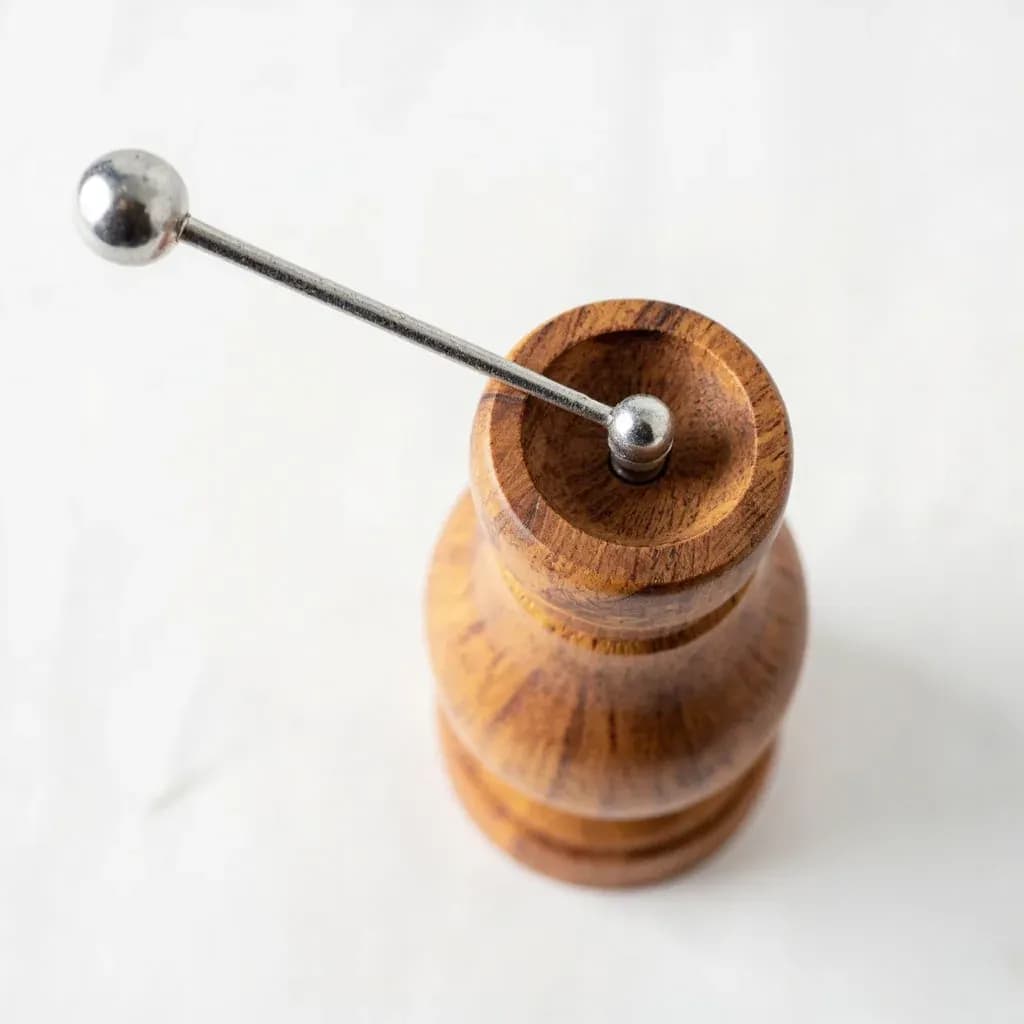
Pepper Mill
A hand grinder that cracks whole peppercorns fresh, with an adjustable coarseness setting.
A pepper mill is a handheld grinder with an internal burr that crushes whole peppercorns into fresh pepper as you twist or crank it. Grinding to order keeps the aromatic oils intact for far more flavor than pre-ground pepper. Most have an adjustable nut to set the grind from fine dust to coarse crackle, and the same mechanism works for salt or other dry spices.
A pepper mill is a hand- or motor-driven grinder that cracks whole peppercorns at the moment of use, and the difference between it and a jar of pre-ground pepper is the single largest flavor upgrade available for very little money. Peppercorn aroma comes from volatile essential oils and piperine that begin to oxidize the moment the seed is broken; within weeks of grinding, those top notes fade to a dull, dusty heat. A mill keeps the seed intact until the instant the pepper hits the food, so the bright, floral, almost citrusy aromatics reach the plate intact. The improvement is most obvious on simple preparations — sliced tomatoes, avocado, a perfectly seared steak, a soft-boiled egg — where pepper is a principal seasoning rather than a background note.
Inside the mill, two grooved plates (the burrs) shear the peppercorn rather than smashing it, which is why burr mills produce clean, even fragments while cheap blade-style grinders turn pepper into a mix of dust and oily shards. The gap between the burrs is set by a small knob or screw at the top or base of the mill; tighten it for a fine powder, loosen it for a coarse crack, and stop somewhere in the middle for the everyday grind that works for most cooking. Most home mills are 15–20 cm tall and hold a few dozen grams of peppercorns; tall 30–45 cm restaurant mills hold several hundred grams and suit big households or open kitchens.
The two buying decisions that actually matter are burr material and adjustment style. Hardened steel burrs are the standard for pepper alone and stay sharp for years; ceramic burrs resist corrosion from salt and are the better choice if the same mill will also see sea salt. A continuous-screw adjustment gives the most precise control, while a click-stop system (Peugeot's u'Select, for example) snaps to a handful of preset grinds and is faster to repeat dish after dish.
Alternatives
Types & varieties
The classic table model with a hand-turned top crank; gives direct control over grind speed and is the most common type in home kitchens
One-button operation; useful for arthritis or high-volume prep; runs on AA batteries and typically has a smaller burr
Grinds a preset amount when flipped upside down; common at restaurant tables but limited in capacity
Single body with two separate chambers and burr sets, pepper on one side and salt on the other; requires ceramic burrs to resist salt corrosion
Twin mills joined by a central post, so one refill covers both condiments
Tall 30–45 cm mill with a large hopper; the standard in restaurants and open kitchens where a single refill should last a service
Compact 10–12 cm mill, often with a protective cap, sized for a lunch bag or picnic
Transparent body that shows the peppercorn level and any blend inside, useful when filling with colored or specialty peppercorns
Adjustment ring with a defined number of preset grinds (e.g., Peugeot u'Select's six levels) rather than a continuous screw; designed for repeatable results across a service
Choosing a mill
For most home cooks, a 15–20 cm manual mill with a wood body and hardened-steel burrs covers everything from a fine grind for cream sauce to a coarse crack for steak. Bigger is not better: a tall restaurant mill is awkward at the table and unnecessary unless you genuinely cook for a crowd. The clearest upgrade is moving from a blade-style grinder (the cheap shakers that double as mills) to a true burr mill, because the burr shear produces a consistent grind without the oily fines that make food taste muddy. If you also want a salt mill, pick a model with ceramic burrs or buy a separate mill, since steel burrs will eventually corrode from salt exposure.
- Wood body + steel burrs is the default for pepper-only mills
- Ceramic burrs are the right choice for combined salt-and-pepper mills
- Continuous-screw adjustment gives the most precise control; click-stop is faster to repeat
- Acrylic body is useful if you fill with blends of pink, white, and black peppercorns
Care and maintenance
A pepper mill is nearly indestructible if it is kept dry, but humidity is its enemy. Steam from the stovetop and damp storage will rust steel burrs, clump the peppercorns, and leave the crank feeling gritty. Wood bodies should never be washed; wipe them with a dry cloth and oil occasionally with a light food-grade mineral oil if the finish dries out. When the grind starts to feel inconsistent, the burrs are usually clogged with old oil and dust rather than worn. A quick reset empties the mill, runs a small handful of dry rice through to absorb residue, then brushes the burrs clean before refilling.
- Never wash a wood-bodied mill; brush and wipe only
- Keep the mill away from stovetop steam and humid storage
- If the crank feels gritty, empty the mill and run dry rice through to absorb oil
- Replace a mill with chipped or visibly worn burrs rather than living with inconsistent grind
Common uses
Tips & pitfalls
- Buy whole peppercorns and refill the mill; pre-ground pepper loses its top notes within weeks as piperine and essential oils oxidize
- Choose a burr grinder over a blade mill for a clean, even grind without oily fines that muddy the flavor
- Set the grind slightly coarser than you think you need, since burrs often grind finer as they warm up during use
- Twist the adjustment knob with the mill empty before refilling to clear old grounds and reset the burrs
- Test the grind into the palm: coarse should look like granulated sugar, fine should look like table salt
- Keep the mill away from the stove and steam; humidity clumps peppercorns and rusts steel burrs
- If the crank feels gritty, the burrs are likely clogged with oil rather than worn; empty, run dry rice through, and brush clean
- For combined salt-and-pepper mills, choose ceramic burrs so the salt does not corrode the mechanism
- Store peppercorns in an airtight container in a cool, dark place and buy in small quantities for the freshest flavor
- For table service, choose a mill that holds at least one full meal's worth of pepper so guests are not cranking mid-dinner
Good to know
- Also called
- Pepper grinder, peppercorn mill
- Primary function
- Cracks whole peppercorns at the moment of use, preserving the volatile oils and piperine that pre-ground pepper loses within weeks
- Mechanism
- Burr grinder (two grooved plates that shear the seed) is standard; cheap blade mills produce inconsistent, oily dust
- Burr materials
- Hardened steel (most common, stays sharp); ceramic (corrosion-proof, also suitable for salt)
- Body materials
- Beech, oak, walnut, or maple wood; stainless steel; clear acrylic; occasionally glass
- Adjustability
- Knob or screw at top or base sets the burr gap, from fine powder to coarse crack; some mills use a click-stop system with 6 preset levels
- Standard sizes
- Table mills 15–20 cm, 30–90 g capacity; tall restaurant mills 30–45 cm, 200–500 g capacity
- Oldest commercial makers
- Peugeot, France, began making pepper mills in 1842; Zassenhaus, Germany, from 1867
- Power options
- Manual hand-crank (most common); gravity/auto mills that grind when inverted; battery-electric mills
- Origin
- Hand mills for spices appeared in European kitchens from the 17th century; the familiar crank-top pepper mill became widespread in the 19th century
- Cleaning
- Disassemble and brush the burrs; never wash a wood body; ceramic burrs can be rinsed and dried
Also called
Moulin à Poivre · peppercorn grinder · salt and pepper mill
Related

Peeler
Swift blade for stripping skin off fruit and vegetables

Grater
Sharp-toothed surface for shredding cheese and vegetables

Microplane
Ultra-fine rasp for citrus zest, garlic, and hard cheese

Mixing Bowl
All-purpose bowl for combining, whisking, and tossing

Whisk
Looped wires that beat air into eggs, cream, and sauces

Spatula
Flat blade for flipping, lifting, and scraping

Slotted Spoon
Pierced spoon that lifts solids and drains the liquid behind

Wooden Spoon
Gentle, heat-friendly spoon for stirring anything