Prep Tools
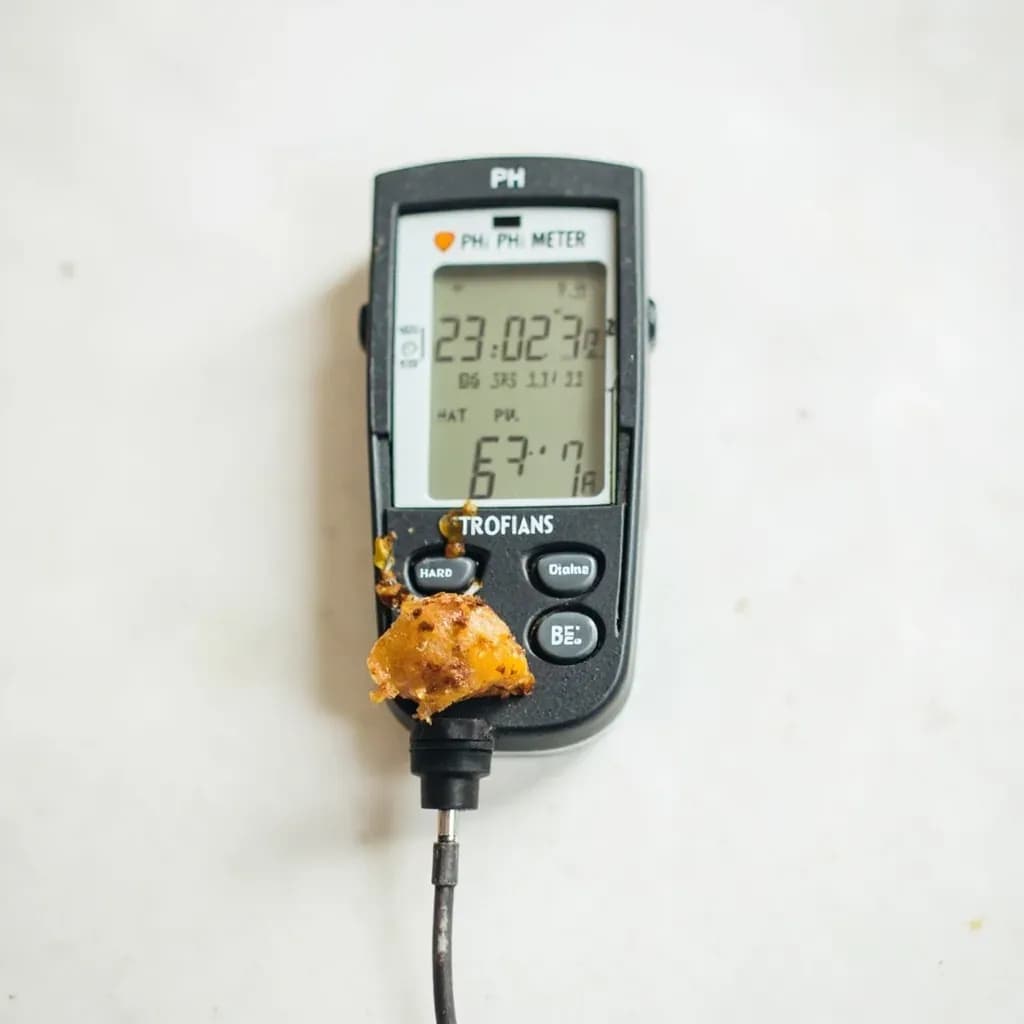
pH Meter
A digital probe that measures acidity, key for safe fermentation and preserving.
A pH meter is an electronic instrument with a glass probe that measures the acidity or alkalinity of a liquid or food on the pH scale. In the kitchen it is used to verify that ferments, pickles, cheeses, and canned goods reach a safe acidic level that inhibits harmful bacteria. The probe is calibrated with buffer solutions and dipped into the sample for an instant digital reading.
A pH meter is the cook's instrument of choice for turning the abstract notion of "acidity" into a number you can act on. At its core it is a glass-bulb electrode that generates a tiny voltage proportional to the hydrogen-ion activity in a liquid, paired with a reference electrode and a body that converts that voltage to the familiar 0–14 pH scale. In a home kitchen the meter does work that neither the tongue nor litmus paper can do reliably: it tells you, to a tenth of a pH unit or better, whether a ferment has truly finished, whether a pickling brine is safe for water-bath canning, and whether a sourdough starter has produced enough lactic and acetic acid to leaven and flavor bread predictably.
The single most important number to internalize is pH 4.6. Below that line, Clostridium botulinum cannot grow in a sealed jar — which is why USDA and National Center for Home Food Preservation (NCHFP) guidelines allow high-acid foods (pickles, fruit preserves, hot sauces, salsas) to be safely processed in a boiling-water-bath canner. Above 4.6, the same food must be pressure-canned or rejected. Litmus strips, with their ±0.5 unit error, can read "4" on a sample that is actually 4.7; only a calibrated electronic meter closes that margin. The same precision lets a fermenter watch a batch of sauerkraut or kombucha slide from pH 6 down through 4.0 to a safe, shelf-stable finish, reproducing results batch after batch instead of relying on guesswork and folklore.
For all its lab-coat reputation, a kitchen pH meter is a humble tool: a $40–80 pen-style unit with a replaceable probe, two bottles of buffer solution, and a small vial of storage fluid. Its accuracy lives or dies in probe care — keeping the bulb hydrated, calibrating with fresh buffers, and replacing the probe every year or two. Treated well, it is the difference between hoping a ferment is safe and knowing it is.
Alternatives
Types & varieties
Compact, all-in-one probe-and-body; the everyday choice for home cooks, brewers, and bakers.
Larger, mains-powered, higher accuracy, often with a separate replaceable electrode; favored in production kitchens and small commercial operations.
Probe sits inside a fermenter (kombucha, sauerkraut, sourdough crock) and logs pH over days or weeks; often Bluetooth-linked to a phone or tablet.
Pairs with a phone app to graph pH drift, set alarms, and store calibration history; popular with kombucha and hot-sauce fermenters who want trend data.
Standard reference design; fine for pickles, dairy, sourdough, and most everyday ferments.
Reference junction is isolated from the sample; resists clogging from proteins, sulfides, and silver — the right choice for beer, wine, cured meats, and kombucha.
User tops up KCl through a fill hole; longer-lived and more accurate, but requires periodic maintenance.
Maintenance-free; shorter service life, common in pen-style meters aimed at casual users.
Flat-tip probe designed for semi-solids like cheese, meat, and dough; useful in charcuterie and direct-acid cheesemaking.
The 4.6 threshold and why it matters
Every food-safety decision in a home canner eventually comes down to pH 4.6. The USDA Complete Guide to Home Canning and the National Center for Home Food Preservation both anchor their high-acid/low-acid distinction on this number: foods with a finished equilibrium pH at or below 4.6 are hostile to Clostridium botulinum and can be safely processed in a boiling-water-bath canner, while foods above 4.6 require the higher temperatures of a pressure canner to destroy spores. A recipe that looks safe on paper — a chunky salsa, a low-sugar fruit preserve, a fermented hot sauce that stalled early — can quietly sit above 4.6 and become a botulism risk in the pantry. A calibrated pH meter, used on the cooled finished product, is the only practical home tool that can verify the threshold has been met. Litmus strips, pH paper, and indicator solution lack the precision to distinguish 4.5 from 4.7, which is the difference between safe and unsafe.
- Test the finished, cooled product, not a freshly poured hot sample — pH rises slightly as dissolved CO2 escapes and temperatures normalize.
- Average readings across multiple jars from the same batch; a single jar can vary by 0.1–0.2 units from its neighbors.
- For chunky foods, blend a representative sample with an equal weight of distilled water to a uniform slurry before testing.
Reading pH in a kitchen context
A pH number is only useful in context: what stage of fermentation you are in, what temperature the sample is at, and what the food is supposed to taste and behave like at that point. The ranges below are what a home cook is most likely to need.
- Sauerkraut, kimchi, other lacto-ferments: start near pH 6, finish at 3.4–3.6 for safe, shelf-stable storage.
- Kombucha: primary fermentation finishes around pH 2.5–3.0; secondary (flavoring, carbonation) often rebounds to 3.0–3.5.
- Sourdough starter, ripe and active: pH 3.5–4.0; finished dough typically 4.0–4.5 depending on flour and fermentation time.
- Pickling brines and finished pickles: must measure 4.6 or below for water-bath canning safety.
- Yogurt and kefir at the eat-by point: roughly 4.0–4.4; too high means fermentation stalled, too low means over-acid and possibly syneresis.
- Cheesemaking direct-acid targets depend on style — ricotta curds set near 5.8–6.0, paneer near 5.0–5.2, quick (30-minute) mozzarella stretches around 5.0–5.3.
- Brewing mash: 5.2–5.6 for best extract and enzyme activity; the lower end of the range improves body and color in pale beers.
Common uses
Tips & pitfalls
- Calibrate with fresh buffer solution every time you break out the meter, or at minimum weekly; never reuse buffer solution that has been poured into a beaker, and never pour used buffer back into the stock bottle.
- Rinse the probe in distilled water between samples, then briefly in the next sample itself, to avoid cross-contamination and carryover of acid or salt.
- Store the probe in electrode storage solution or pH 4 buffer, never in distilled or tap water — distilled water leaches the reference electrolyte out of the probe and shortens its life dramatically.
- Soak a new or dried-out probe in storage solution for several hours, ideally overnight, before first calibration; readings from a dry probe will drift wildly and are not trustworthy.
- For thick foods like dough, cheese, meat, and whole pickles, do not jab the bulb in — squeeze out a small amount of liquid and test that expressed juice, or blend a 1:1 slurry with distilled water and measure the slurry.
- Use a double-junction probe (or a manufacturer-rated food-grade spear probe) for high-protein, high-sulfide, or alcoholic samples; standard single-junction probes clog at the reference junction and read low within weeks.
- Do not measure a liquid that is being actively heated or cooled; let samples equilibrate to room temperature, or use a meter with Automatic Temperature Compensation (ATC) and stir gently while reading.
- Treat the glass bulb as the fragile sensor it is: no scraping, no dropping, no dry wiping with a paper towel — blot gently. Replace the probe if it will not calibrate to within ±0.1 across all three buffers, or if it reads slowly and drifts downward.
- Keep a small bottle of electrode cleaning solution (or 0.1 M HCl) on hand to dissolve the mineral crust and protein film that builds up on the bulb over time.
Good to know
- Measurement range
- 0–14 pH (7 is neutral; below 7 is acidic, above 7 is alkaline).
- Critical food-safety threshold
- pH 4.6 — below this, foods can be safely preserved in a water-bath canner; above, pressure canning is required.
- Typical accuracy
- ±0.01 pH for quality benchtop meters, ±0.1 pH for budget pen-style meters; either is sufficient for kitchen work.
- Calibration points
- Two-point (pH 4 and 7) is standard for most kitchen use; three-point (4, 7, 10) is useful for broader range, including alkaline solutions such as lye baths for bagels and pretzels.
- Probe storage
- Keep the glass bulb moist in electrode storage solution (typically 3 M KCl) or pH 4 buffer; never store dry or in distilled or tap water long-term.
- Probe lifespan
- 1–3 years with regular home use; much shorter if stored dry, used in hot liquids, or cleaned aggressively.
- Temperature compensation
- Automatic Temperature Compensation (ATC) is standard on quality meters; pH readings shift with sample temperature, so ATC or manual entry is essential for accuracy.
- Reference design
- Single-junction probes suit general use; double-junction probes resist fouling from proteins, sulfides, and silver ions, and are preferred for beer, wine, cured meats, and kombucha.
Also called
Digital pH Meter · pH Tester
Related

Peeler
Swift blade for stripping skin off fruit and vegetables

Grater
Sharp-toothed surface for shredding cheese and vegetables

Microplane
Ultra-fine rasp for citrus zest, garlic, and hard cheese

Mixing Bowl
All-purpose bowl for combining, whisking, and tossing

Whisk
Looped wires that beat air into eggs, cream, and sauces

Spatula
Flat blade for flipping, lifting, and scraping

Slotted Spoon
Pierced spoon that lifts solids and drains the liquid behind

Wooden Spoon
Gentle, heat-friendly spoon for stirring anything