Prep Tools
pH Test Strips
Color-changing paper strips that estimate acidity to monitor fermentation, pickling, and food safety.
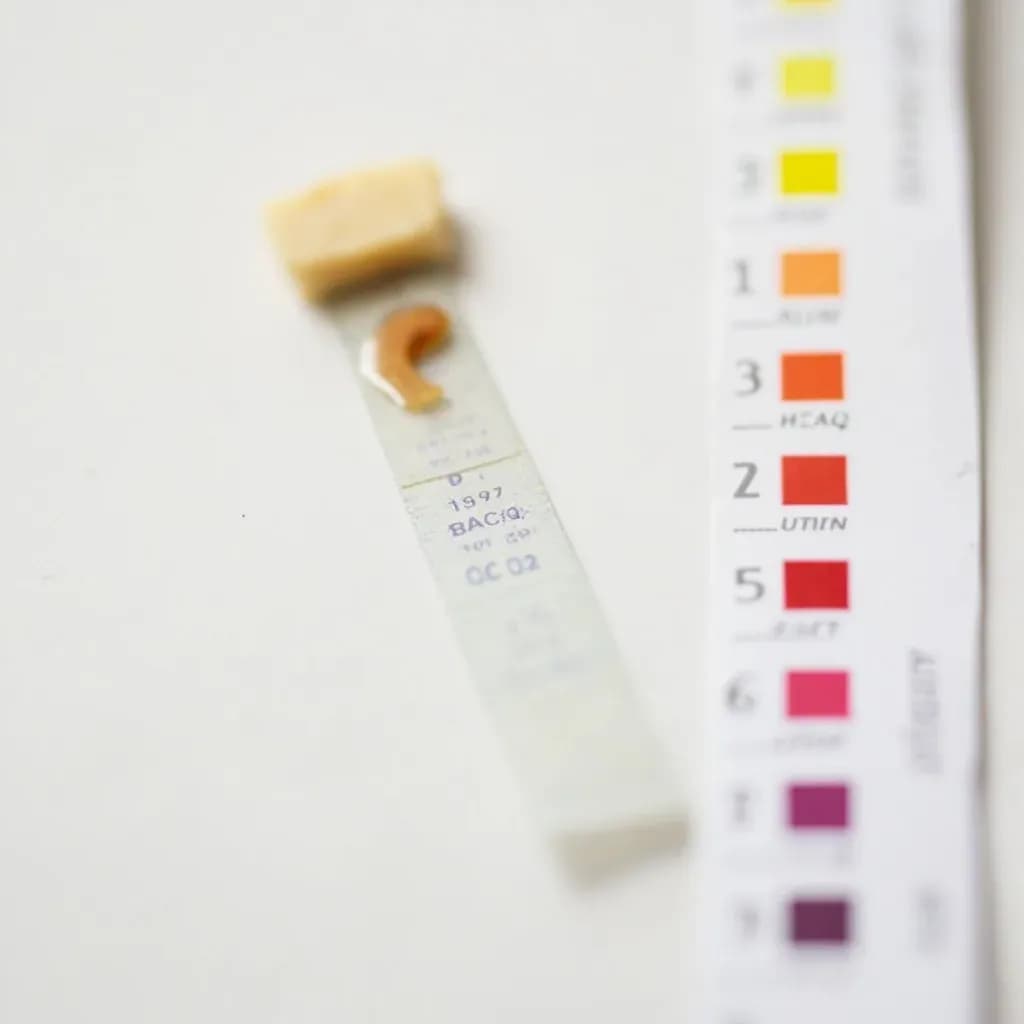
pH test strips are paper strips treated with indicators that change color when dipped in a liquid, matched against a chart to read approximate acidity. Fermenters, picklers, and cheesemakers use them to confirm a batch has acidified into a safe range or reached a target pH. They are quick and inexpensive, though less precise than a calibrated digital pH meter.
pH test strips are short paper or plastic ribbons printed with one or more indicator pads—weak organic dyes that change color when they meet hydrogen ions in a solution. Dip the pad into a sample, wait the few seconds the package specifies, and match the resulting hue to a printed chart that translates color into a number on the 0–14 pH scale. Lower numbers are more acidic, 7 is neutral, and higher numbers are alkaline. The chemistry is the same one that turns red cabbage blue in a baking-soda solution, just packaged into a single throwaway tool.
In a working kitchen, the strip is almost always doing one of two jobs: confirming that a food is acidic enough to be safe on the shelf, or watching acidity drop as a fermentation matures. The pivotal number is 4.6, the threshold below which the USDA National Center for Home Food Preservation considers an acidified food safe for room-temperature storage, because Clostridium botulinum cannot grow below that point. Pickled vegetables, shelf-stable hot sauces, and lacto-ferments all need to cross and stay beneath that line. For fermenters, watching pH fall from roughly 5.5 down through 3.0–4.0 over days or weeks is one of the cleanest signals that a culture is healthy and that the food is ready to eat, bottle, or move to cold storage.
A strip is a sanity check, not a laboratory instrument. The color steps are wide—usually 0.2 to 0.5 pH units apart—and lighting, sample temperature, dye age, and the user's color perception all shift the result. Treat every reading as a rough estimate, pair it with sensory cues (the sharp tang of finished sauerkraut, the bright bite of finished hot sauce), and back the strip up with a calibrated digital pH meter for any recipe you intend to can and keep on a pantry shelf.
Alternatives
Types & varieties
Two-tone, only distinguishes acidic from alkaline; not useful for precise kitchen work
Covers the full scale, but color jumps blur the small differences that matter in ferments and pickling
Finer color increments in the range where most ferments live; the right tool for kraut, kimchi, and kombucha
Indicator dyes are bound to a plastic carrier so they will not leach into pale or clear brines
Added dropwise to a small sample; useful for cloudy liquids like milk or opaque brines where a paper pad reads poorly
Reading a strip correctly
Most strip errors are not the strip's fault; they come from how the test is run. A few habits will tighten your readings considerably.
- Pull the strip out of the liquid quickly. Letting it sit too long can wash dye off the pad or let the color develop past the true reading.
- Compare to the color chart within the time window printed on the package, usually 10–30 seconds. Indicator reactions keep shifting after that point.
- Hold the strip next to the chart in natural daylight, not under warm tungsten or fluorescent bulbs, which push colors toward yellow and red.
- Cool any hot sample to room temperature first; high temperature changes how the dyes respond and can skew the reading.
- Use a clean spoon or cup to draw the sample so fingers, sweat, and skin oils do not contaminate the indicator pad.
Common uses
Tips & pitfalls
- Choose a narrow-range strip in the 3.0–6.0 band for fermentation work; a 1–14 universal strip blurs exactly the differences you are trying to see.
- Confirm that the batch is below pH 4.6 before water-bath canning any acidified vegetable, salsa, or chutney that will sit on a shelf at room temperature.
- Use plastic non-bleed strips for pale or clear liquids you intend to consume, so indicator dyes do not leach into the food.
- Reseal the package tightly between uses and store it somewhere cool and dry; humidity is the fastest killer of unused strips.
- Sanity-check a suspect bottle against a known reference—fresh lemon juice is roughly pH 2 and a teaspoon of baking soda stirred into a cup of water is roughly pH 8—before trusting the strip on real food.
- For any recipe you intend to can for long shelf storage, back the strip reading with a calibrated digital pH meter, and two-point calibrate the meter itself with fresh buffer solutions.
Good to know
- pH scale
- 0 (strongly acidic) to 14 (strongly alkaline), with 7 neutral
- Safety threshold for acidified foods
- 4.6 or below (USDA National Center for Home Food Preservation)
- Typical finish range for common ferments
- pH 3.0–4.0 (sauerkraut ~3.4–3.6, kombucha ~2.5–3.5)
- Resolution of visual strips
- About 0.2–0.5 pH units between adjacent color steps
- Common kitchen ranges
- 1–14 universal, 3.0–6.0 fermentation, 4.5–9.0 general/baking
- Format
- Short paper or plastic strips carrying one or more indicator pads
- Shelf life, unopened
- 1–2 years; humidity shortens it dramatically
- Cost
- Roughly $5–$20 for 100 strips from kitchen or lab suppliers
Also called
pH strips · litmus strips · acidity test strips
Related

Peeler
Swift blade for stripping skin off fruit and vegetables

Grater
Sharp-toothed surface for shredding cheese and vegetables

Microplane
Ultra-fine rasp for citrus zest, garlic, and hard cheese

Mixing Bowl
All-purpose bowl for combining, whisking, and tossing

Whisk
Looped wires that beat air into eggs, cream, and sauces

Spatula
Flat blade for flipping, lifting, and scraping

Slotted Spoon
Pierced spoon that lifts solids and drains the liquid behind

Wooden Spoon
Gentle, heat-friendly spoon for stirring anything