Prep Tools
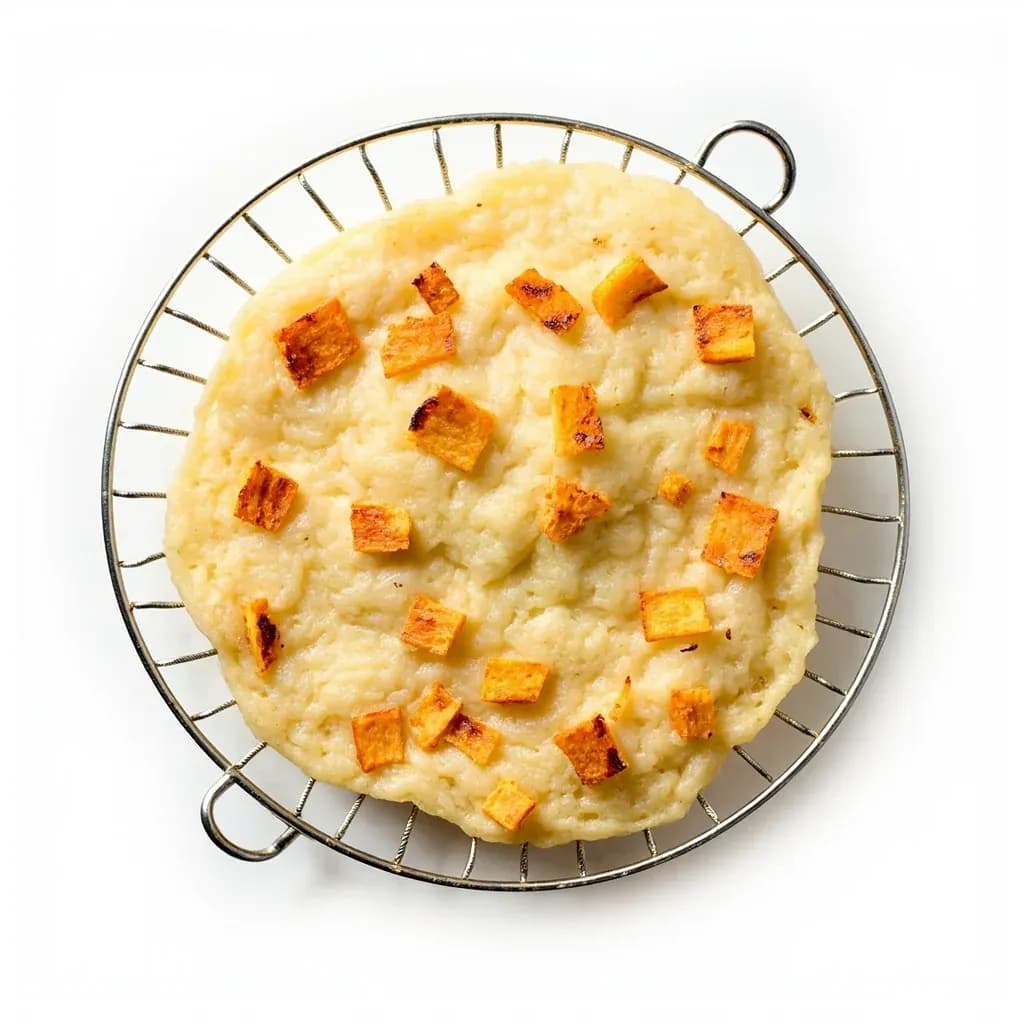
Wire Roasting Grate (for Phulka)
A small wire rack set over a flame to puff Indian phulka rotis directly on fire.
A phulka grate is a simple wire mesh or wire-frame rack placed over a gas burner so flatbreads can be roasted directly over an open flame. After a roti is partly cooked on a tawa, it is laid on the grate where the direct heat makes it balloon into a puffed phulka. The raised wire keeps the bread off the burner head and allows flame contact across its surface.
A wire roasting grate for phulka is a small stainless-steel mesh stand, typically 6 to 8 inches across, supported on short legs roughly 1 to 2 inches above a gas burner grate. Its job is to expose a partially cooked flatbread to direct, open flame so that residual moisture inside the dough flash-converts to steam and inflates the bread into a taut, balloon-like puff. That puff is the defining quality of a well-made phulka — it separates the dough's layers, makes the bread tender, and signals that the cook's hydration, kneading, and rolling have all been done correctly.
The tool is a modern, hands-free descendant of the older Indian technique of holding a chapati over a flame with iron tongs (a chimta) or balancing it directly on the burner with bare fingers. Both older methods work, but they require quick reflexes and a tolerance for singed knuckles. The wire grate removes that skill barrier: you lay the bread on the mesh, leave it for a few seconds, and the bread puffs itself. Because the flame passes through the openings of the mesh, heating is fast and even across the entire underside, and the grid of wires leaves faint sear marks that signal char without burning.
It is worth being clear about what the tool is not. It is not a tawa substitute, not a grilling rack for meat or vegetables, and not designed for electric coil, ceramic, or induction cooktops. It is a single-purpose, gas-only implement sized for a single flatbread — and in an Indian kitchen that single purpose, repeated three or four times a day, earns it a permanent place beside the burner.
Alternatives
Types & varieties
The most common form; flat square frame with fine wire mesh and short legs, sits stably on a gas burner grate.
Circular version, often preferred for round rotis; sometimes supplied with folding handles for storage.
Handles fold flat against the mesh so the grate stores in a kitchen drawer without snagging.
Heavier traditional option that conducts heat well but must be dried thoroughly after washing to prevent rust.
Tighter weave suited to small breads, papad, and makki di roti, where a coarser mesh would let thinner items drop through.
Two meshes on one frame: a coarse side for chapati and phulka, a fine side for papad or small items.
Why a flatbread puffs
The puff is a piece of straightforward kitchen physics. A well-kneaded, rested chapati dough is roughly 50–60 percent water by weight. When the rolled disc is cooked briefly on a tawa, the surface dries and sets, but the interior remains moist. The moment that disc touches the wire grate over a live flame, the surface heats rapidly and the trapped moisture turns to steam. Because the bread's outer skin has already set on the tawa, the steam has nowhere to escape laterally — it can only push outward, inflating the bread like a balloon. A good puff means the skin was strong enough to hold and the dough was hydrated enough to generate steam. A flat, stubborn chapati is usually a sign of under-kneaded dough, over-floured rolling, or a tawa that ran too hot and dried the surface before the interior could steam.
- Phulka dough should be soft, well-kneaded, and rested at least 20–30 minutes so the gluten relaxes and the moisture distributes evenly.
- On the tawa, cook only until small bubbles appear and the underside shows light brown spots — not longer, or the surface dries out and will not puff.
- Transfer the bread to the grate with the partially cooked (tawa) side facing down so the still-moist upper surface receives the most direct flame.
- If a bread refuses to puff after 10–15 seconds, prick a tiny pinhole to vent the dry inner layer, then return it to the flame.
Choosing and caring for the grate
For most home kitchens, a square or round stainless-steel mesh in the 7-inch range is the most useful size: large enough for a standard chapati, small enough to sit over a single gas burner without tipping. Stainless is rust-resistant, tolerates the dishwasher, and holds its shape over years of daily use. Chrome-plated iron heats a touch faster and was the traditional choice, but it oxidizes if stored wet and benefits from being dried on the burner after washing. Mesh gauge matters more than people expect: a coarse weave lets thinner breads sag and small papad fall through, while a very fine weave blocks radiant heat and slows the puff. The double-sided models solve this by offering both weaves on one frame.
- Stainless steel is the most forgiving material for daily use; choose it unless you specifically want the faster heat-up of chrome-plated iron.
- Pick a mesh gauge appropriate to your bread — fine for papad and makki di roti, medium-coarse for everyday chapati and phulka.
- Wash while still warm (not hot) with a stiff nylon brush and soapy water; a steel scrubber can roughen the surface and cause food to stick.
- Dry chrome-plated iron immediately and thoroughly, ideally by setting it on a low burner for a minute after washing.
- Store flat or hanging; do not stack heavy pots on top, which can warp the welded legs and unbalance the grate over the flame.
Common uses
Tips & pitfalls
- Use a medium flame rather than high — high heat scorches the surface before the steam can inflate the bread.
- Preheat the empty grate for 30–60 seconds so the bread puffs immediately on contact rather than sitting and drying out.
- Place the partially cooked side (the side just done on the tawa) face-down on the mesh for the best lift and puff.
- Do not press down on the bread with a spatula; let the trapped steam do the work or you will deflate the puff.
- Flip once the underside shows light golden char spots, then cook the second side for only a few seconds — overcooking hardens the bread.
- Use the mesh itself to lift and turn the bread: the grid grips the surface lightly and saves you from grabbing it with tongs or fingers.
- Avoid electric coil, ceramic glass, and induction — the tool is designed for a live gas flame, where radiant heat passes up through the mesh.
- If the bread refuses to puff, prick a tiny hole with a pin to release the dry inner layer, then return it to the flame and it will usually inflate.
Good to know
- Origin
- Indian subcontinent; a modern adaptation of the tong-held direct-flame method
- Also known as
- Phulka jali, roti jali, phulka stand, phulka rack, phulka holder
- Primary material
- Stainless steel wire (most common); chrome-plated iron in older or traditional versions
- Typical size
- 6–8 inches (15–20 cm) across the mesh surface
- Common shapes
- Square or round; both widely sold
- Heat source
- Open flame from a gas burner only
- Elevation above flame
- Roughly 1–2 inches (2.5–5 cm), set by short welded legs or a frame
- Skill level
- Beginner-friendly; far more forgiving than holding bread with tongs
- Dishwasher safe
- Most stainless steel models are; hand-washing is recommended to extend life
- Compatible cooktops
- Gas only; not effective on electric coil, ceramic, or induction
- Average cost (India retail)
- Roughly ₹100–₹400 for standard stainless models (varies by brand and size)
Also called
Roti Grill · Phulka Jali · Roasting Net
Related

Peeler
Swift blade for stripping skin off fruit and vegetables

Grater
Sharp-toothed surface for shredding cheese and vegetables

Microplane
Ultra-fine rasp for citrus zest, garlic, and hard cheese

Mixing Bowl
All-purpose bowl for combining, whisking, and tossing

Whisk
Looped wires that beat air into eggs, cream, and sauces

Spatula
Flat blade for flipping, lifting, and scraping

Slotted Spoon
Pierced spoon that lifts solids and drains the liquid behind

Wooden Spoon
Gentle, heat-friendly spoon for stirring anything