Prep Tools
Plantain Press (Tostonera)
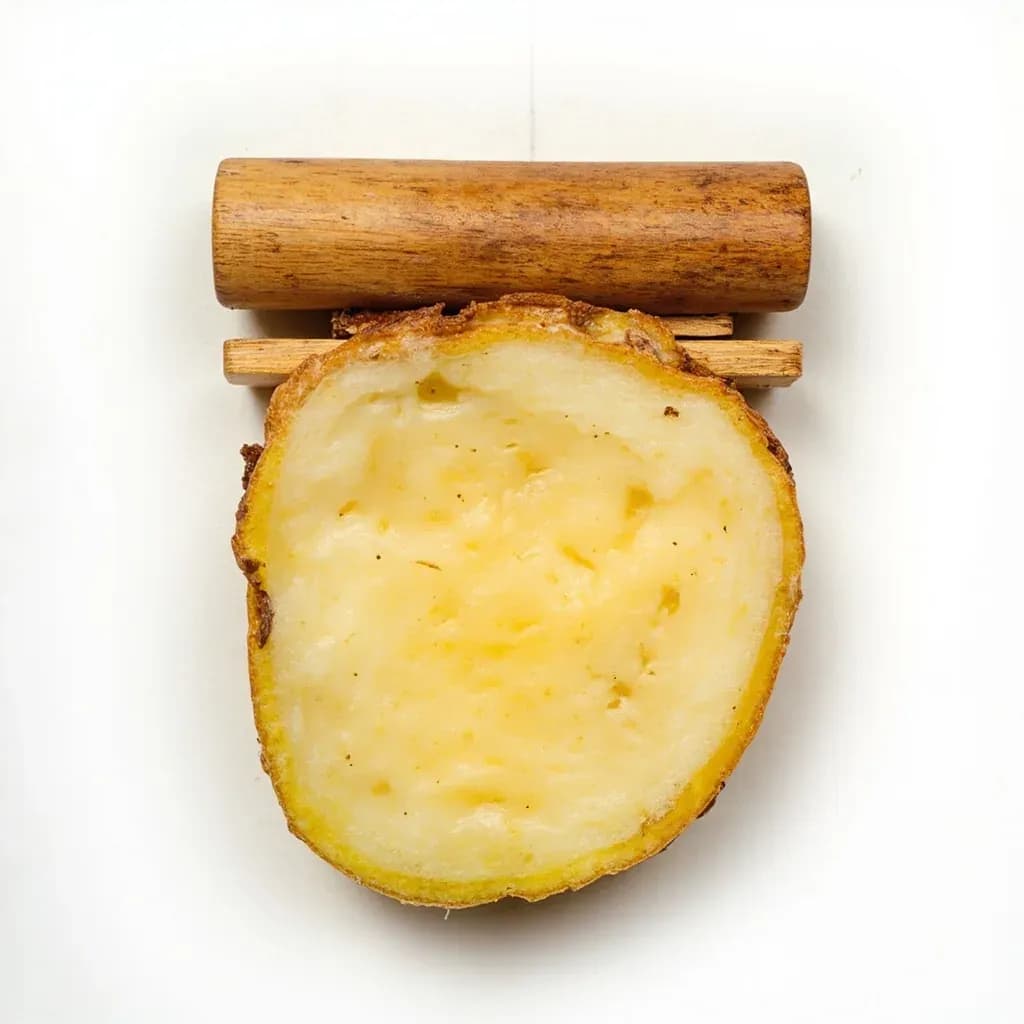
A hinged wooden or plastic press that flattens fried plantain rounds into crisp tostones.
A tostonera is a small hinged press, traditionally of wood, used to flatten partly fried plantain chunks before they return to the oil. The cook sets a softened plantain piece between the two boards and presses down to make a thin disc that fries up crisp on the outside and tender within. It is a staple Caribbean and Latin American tool for making tostones and patacones.
A tostonera is a simple, hinged two-plate press built specifically to flatten fried green plantain rounds into the thin, even discs that become tostones. Two flat pressing faces — usually 3 to 4 inches across — are joined by a hinge at the back, with handles (or a single lever) at the front that close the plates together under hand pressure. The geometry is the whole point: by squeezing the plantain evenly across its width, the press produces a uniform 1/4-inch thickness that no improvised tool (a glass, a jar lid, the bottom of a skillet) reliably achieves. As a result, the second fry cooks each piece identically, giving tostones their signature crisp exterior and tender, starchy interior.
The press is used between two fries, never on raw plantain. Green plantain rounds are cut, fried briefly at around 325°F until just cooked through but still pale and pliable, then transferred — while hot — to the tostonera and squeezed flat. That timing window is the tool's main constraint: cold rounds crack rather than flatten, and over-pressing squeezes the flesh out the sides as a hot oil jet. Material matters less than people think: a $10 plastic press and a carved lignum-vitae version do the same job, with plastic releasing more cleanly and wood absorbing flavor and oil over time (which many cooks treat as seasoning rather than a flaw).
Originally Cuban, the tostonera is now standard across the Caribbean and coastal Latin America, from Puerto Rico and the Dominican Republic to Venezuela, Colombia, and Central America. Despite its specialized name, cooks reach for it in any dish where a starchy round needs a controlled, even smash — fried green banana slices, thick croquettes, patty-style fritters — and it is distinct from the wire plantain slicer (cortador), which scores raw green plantains lengthwise before frying.
Alternatives
Types & varieties
Two carved hardwood discs (often guayacán or lignum vitae) on a hinge; classic Cuban form, heavier, decorative, and prone to cracking if soaked
Lightweight, dishwasher-safe, inexpensive; the mass-market default and the easiest to release food from
Sturdy, often riveted; delivers very even pressure but can dent soft plantains if forced
Single long handle that drives one plate down onto a fixed base; easier on the wrist for large batches
Imprints a waffle or grill pattern on the plantain; mostly decorative and less common in traditional tostone prep
Anatomy and mechanics
Every tostonera is the same basic machine: two flat pressing faces, a rear hinge, and a front handle or lever that closes them. The hinge is the load-bearing element — it sets the parallel travel of the plates, which is what gives tostones their uniform thickness. Better-made presses seat the hinge tightly so the plates close flat; worn or loose-pin hinges let the plates tilt and produce lopsided discs. The pressing surface is sized to a single plantain round, typically 3 to 4 inches across, so the cook works one piece at a time rather than batching through a wide mouth like a tortilla press.
Wood versus plastic: what actually changes
Material affects three things: weight, stick resistance, and longevity. Wood is heavier, holds onto oil and flavor over time, and needs the same care as a wooden spoon or board — wiped clean, never soaked, and occasionally rubbed with food-grade mineral oil to prevent splitting. Plastic is lighter, slicker, and survives a dishwasher, but the hinge pin can work loose and the plates can develop shallow grooves over years of use. Metal presses are the most durable but deliver force aggressively; beginners tend to over-press with them.
- Wood: heavier, develops a seasoned surface over time, needs care to avoid splitting
- Plastic: lightest, cleanest release, cheapest hinge
- Metal: most durable, easiest to over-press, can dent soft plantains
Output and yield
One medium green plantain yields roughly 8 tostones when cut on a slight bias at 3/4 inch thick; cutting straight across at 1/2 inch yields closer to 10 smaller rounds. Bias cuts produce the classic oval tostone with more surface area for crisping, while straight cuts give tighter, more uniform circles better suited to stacking or sandwiching (as in a jibarito).
Common uses
Tips & pitfalls
- Press only after the first fry, while the plantain is still hot and pliable — cold rounds crack instead of flattening.
- Lightly oil the plates or sandwich the plantain between two small squares of parchment or plastic wrap to stop sticking; a light dusting of salt on the surface helps too.
- Cut rounds on a slight bias (about 30–45°) for the classic oval tostone with more crisping surface.
- Press firmly but don't slam — excess force squeezes plantain out the sides and can squirt hot oil.
- Hold the press level and squeeze slowly and evenly so the disc flattens uniformly to about 1/4 inch.
- Season the pressed rounds immediately so salt sticks to the oily surface before the second fry.
- Work in small batches and keep pressed tostones warm on a tray while you finish the first pass through the oil.
- Wipe wooden tostoneras clean without soaking, and condition occasionally with food-grade mineral oil to prevent splitting.
- If you don't own one, a heavy skillet bottom, a flat-bottomed glass, or two wooden cutting boards hinged with a strip of duct tape work in a pinch — a jar lid or mug will not give even pressure.
Good to know
- Origin
- Cuba; standard across the Caribbean and Latin America (Puerto Rico, Dominican Republic, Venezuela, Colombia, Central America)
- Also called
- tostonera, prensa de plátano, plantain smasher
- Components
- Two flat pressing plates (round or square) joined by a hinge, with two handles or a single lever
- Pressing surface
- Roughly 3–4 in (7–10 cm) across
- Pressing action
- Flattens a 1/2–3/4 in fried plantain round to about 1/4 in (6 mm)
- Used with
- Green (unripe) plantains after the first fry, while still hot
- Cleaning
- Hand wash and towel dry; wooden versions must not be soaked
- Related tool (do not confuse)
- Wire plantain slicer (cortador) — slices raw plantain lengthwise and is not interchangeable
Also called
tostonera · plantain smasher · tostones press · patacon press
Related

Peeler
Swift blade for stripping skin off fruit and vegetables

Grater
Sharp-toothed surface for shredding cheese and vegetables

Microplane
Ultra-fine rasp for citrus zest, garlic, and hard cheese

Mixing Bowl
All-purpose bowl for combining, whisking, and tossing

Whisk
Looped wires that beat air into eggs, cream, and sauces

Spatula
Flat blade for flipping, lifting, and scraping

Slotted Spoon
Pierced spoon that lifts solids and drains the liquid behind

Wooden Spoon
Gentle, heat-friendly spoon for stirring anything