Prep Tools
Plating Spoon
A precision spoon chefs use to drag, swoosh, and dot sauces when plating dishes.
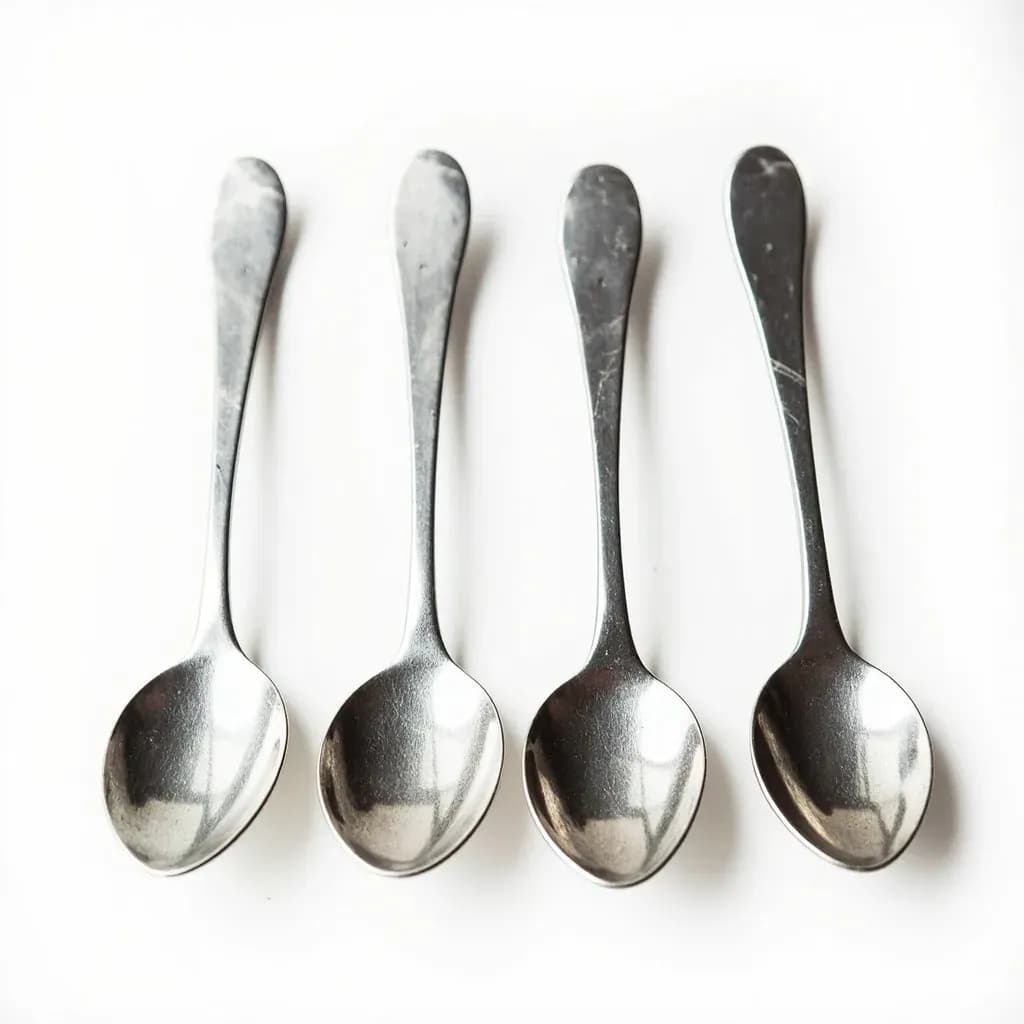
A plating spoon is a chef's finishing tool with a shallow, often elongated or quenelle-shaped bowl designed for controlled sauce work. Cooks use it to draw clean swooshes, place neat dots, and spread purées across a plate, and the deeper saucing variant doubles as a small ladle for pooling sauce. The thin edge and balanced weight give the precise control prized in fine-dining presentation.
The plating spoon is a small-bowled, long-handled spoon designed for a single job: putting sauces, purées, and small garnishes exactly where you want them on the plate. Unlike a serving or tasting spoon, its bowl is shallow and compact — roughly an inch across — and its handle is long enough to keep your knuckles clear of the plate rim. That balance gives the cook the control of a paintbrush and the reach of a palette knife in one tool.
It matters because restaurant plating is largely an exercise in repeatable, controlled contact with the plate. A regular teaspoon dumps too much sauce; a ladle is too clumsy for fine work. The plating spoon lets you drop a clean dot of romesco, drag a clean stripe of carrot purée, or lift a single caper without crushing it. The shape and shallow volume of the bowl determine how a sauce releases and how cleanly each motion finishes, which is why experienced cooks think of the spoon as a precision instrument rather than a serving utensil.
Most professionals reach for stainless versions because they are affordable, dishwasher-safe, and neutral in flavor. Higher-end kitchens sometimes use copper or silver-plate for feel and tradition, treating them the way a painter treats a favorite brush. On the pass the plating spoon is paired naturally with offset plating tweezers, the combination cooks call the "saucier pair."
Alternatives
Types & varieties
Classic small, deep round bowl, ideal for drizzling and dotting thin to medium sauces.
Flatter oval bowl that releases cleanly for sweeping and smearing purées and coulis.
Bowl angled off the handle for knuckle clearance above deep-rimmed plates and bowls.
Holes in the bowl drain excess liquid when lifting garnishes from a poaching bath or oil.
Long flat handle with a small round bowl, used in Chinese fine dining to drip soy- and oil-based sauces in precise dots and trails.
Twin oval bowls joined together; technically a shaping tool for quenelles, but often grouped with plating spoons in a drawer.
Stainless handle with a soft silicone bowl that will not scratch plates and holds thicker sauces such as aïoli or romesco.
Heavier and often hand-hammered; favored in some classic French kitchens for balance, heat conduction, and feel.
Reading the bowl: how shape changes the mark
The single biggest variable on a plating spoon is the bowl, and it dictates what kind of mark the spoon will leave. A deeper round bowl holds more liquid and, when tilted, releases it in a steadier stream for drizzling reduced jus or olive oil into a thin trail. A flatter oval bowl releases faster and leaves a wider, softer mark, the right shape for dragging a stripe of butternut purée across the plate. Offset bowls keep your hand farther from the food, which matters when you are working inside a deep coupe or a wide-rimmed bowl. Choosing the right bowl for the mark you want is more important than any wrist technique.
- Round, deeper bowl: drizzles, dots, and controlled drops of thin to medium sauce.
- Oval, flatter bowl: smears, swooshes, and broad strokes of purée.
- Offset bowl: knuckle clearance for deep bowls and rimmed plates.
- Perforated bowl: lifts wet garnishes without dragging liquid onto the plate.
- Silicone bowl: thick sauces that would cling to or stain metal.
Sauce viscosity: the test that decides the result
Most plating frustrations are really viscosity problems in disguise. A sauce that runs off the plate will not hold a dot no matter how steady the hand; a sauce that is too thick will cling to the spoon and tear when released. The quick test is to coat the back of a spoon, draw a line through the coat with a finger, and watch what the line does. If the line holds its edge cleanly, the sauce will dot. If the line slowly fills in, it will pool and smear. Chilling the spoon briefly in ice water helps very fluid sauces — olive oil, reduced vinegar, light fruit coulis — hold a drop on contact, and warming the spoon helps buttery sauces release cleanly without breaking.
- Coats the back of a spoon and holds a clean line: good for dots.
- Fills the line back in: better suited to a smear than a dot.
- Too thin: chill the spoon or reduce the sauce further.
- Too thick: warm the spoon or thin the sauce with a little stock or water.
- Always wipe the bowl between passes; a sticky bowl is the most common reason dots lose their edge.
Common uses
Tips & pitfalls
- Wipe the bowl between every dip — sauce that clings from the last pass is the fastest way to ruin clean dots and lines.
- Match spoon size to the plate: smaller bowls give more control on small or rimmed plates, larger bowls on broad coupe plates.
- Hold the spoon close to the bowl rather than at the end of the handle; the closer grip is steadier and gives you painterly control.
- Use the back (underside) of the spoon to drag a purée into a long, clean smear — the convex curve leaves a smoother edge than the bowl itself.
- For round dots, hold the spoon perpendicular to the plate, drop, and pull straight up; for elongated dots, drag slightly sideways as you lift.
- Test sauce viscosity on the back of the spoon before plating — a sauce that holds a clean line through a finger swipe will hold its dot on the plate.
- Chill the spoon briefly in ice water when working with very fluid sauces like extra-virgin olive oil or reduced vinegars; the cold metal helps the drop keep its shape on contact.
- Do not substitute a regular teaspoon: the proportions and balance are wrong and you will fight the tool on every motion.
Good to know
- Also called
- Saucier spoon, plating or cuisine spoon, saucing spoon
- Typical length
- 6–8 inches (15–20 cm) overall
- Bowl size
- Small, shallow oval or round bowl, roughly 1–1.5 inches (2.5–4 cm)
- Material
- Stainless steel is standard; copper, silver-plate, and silicone-tipped versions exist
- Handle style
- Long, thin, straight handle, often slightly flattened at the tip
- Related tool
- The quenelle spoon is a twin-bowl shaping tool, distinct but often grouped with plating spoons
- Care
- Stainless is dishwasher-safe; hand-wash silver-plate and copper to avoid tarnish and pitting
- Pairs with
- Offset plating tweezers form the classic sauciers' pair on the pass
Also called
Saucing Spoon · Saucing Spoon (Spread Ladle) · Chef Plating Spoon · Quenelle Spoon
Related

Peeler
Swift blade for stripping skin off fruit and vegetables

Grater
Sharp-toothed surface for shredding cheese and vegetables

Microplane
Ultra-fine rasp for citrus zest, garlic, and hard cheese

Mixing Bowl
All-purpose bowl for combining, whisking, and tossing

Whisk
Looped wires that beat air into eggs, cream, and sauces

Spatula
Flat blade for flipping, lifting, and scraping

Slotted Spoon
Pierced spoon that lifts solids and drains the liquid behind

Wooden Spoon
Gentle, heat-friendly spoon for stirring anything