Prep Tools
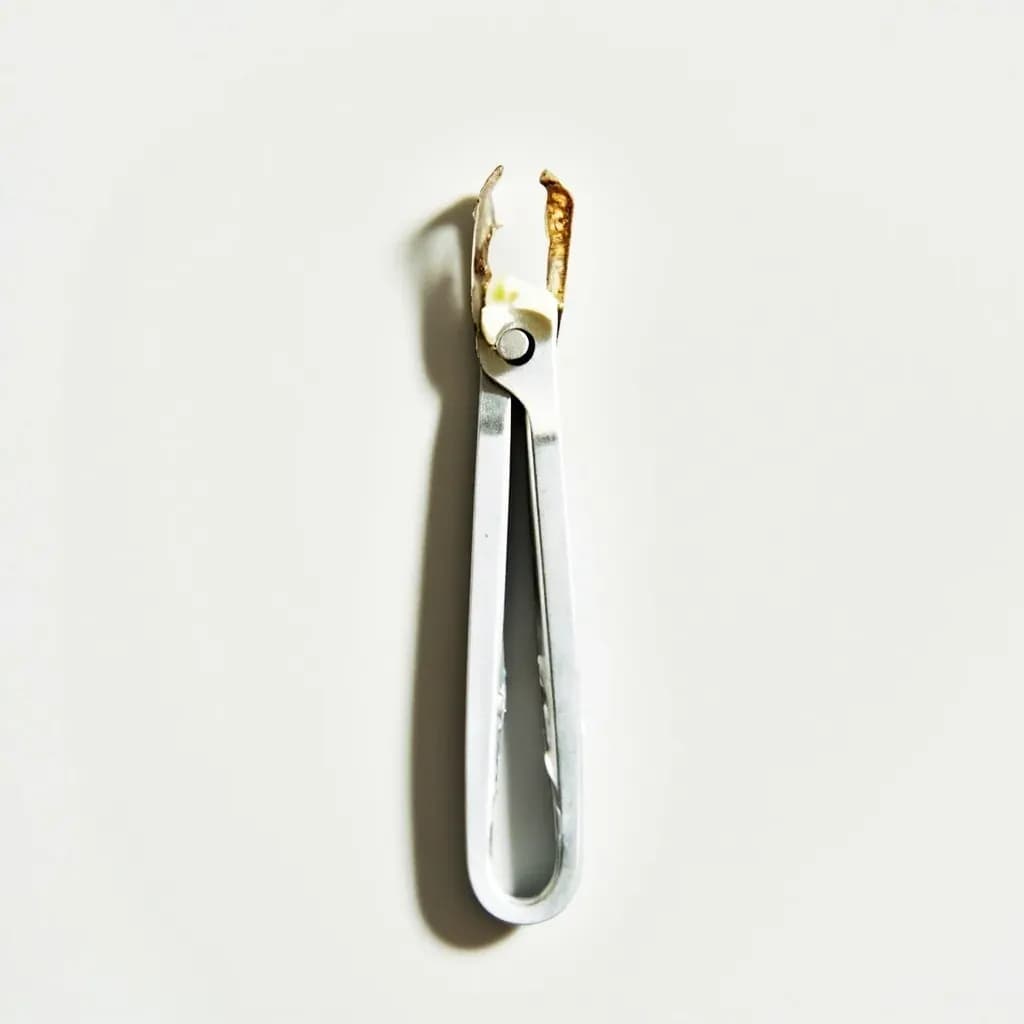
Plating Tweezers
Precision tweezers for placing garnishes and delicate elements when plating.
Plating tweezers are long, precise tweezers used to position garnishes, herbs, microgreens, and small components exactly when plating dishes. They give chefs fine control for arranging delicate elements without crushing or smudging the plate. Offset and straight tips suit different placement tasks in fine-dining presentation.
Plating tweezers are slim, stainless-steel precision tools — long, fine-tipped implements designed exclusively for the final stage of dish assembly. Unlike kitchen tongs, which are built for gripping and turning larger items, or chopsticks, which rely on a pinching motion that obscures the plate, plating tweezers extend the chef's fingertips 6 to 12 inches while leaving the hand well clear of the food. The result is repeatable, accurate placement of components too small or too fragile to handle with fingers: a single microgreen, an edible petal, a 2-millimeter dot of gel.
The tool emerged alongside architectural and modernist plating in the early 2000s, when fine-dining kitchens began building dishes from many small, deliberately positioned elements rather than a few large ones. In that context, tweezers are not a flourish but a functional extension of the hand: they convert the chef's natural fine-motor control into a steady, repeatable motion over the plate, and they make it possible to place items 1–3 mm across without smudging sauces or disturbing neighboring components. A good pair has balanced spring tension, tips that meet precisely along their full length, and enough length to reach the far edge of a wide plate or the back of a shallow bowl.
Most professional stations keep two to four pairs on hand — different lengths and tip shapes for garde-manger, the hot line, and pastry — and replace them only when the tips drift out of alignment, which is the single most common reason a serviceable pair gets retired.
Alternatives
Types & varieties
Standard form, best for direct top-down placement of small garnishes over a narrow plate or bowl
Tips bent at an angle so the hand stays clear of the plate rim, improving visibility for precise work
Gentle curve useful for reaching across a wide plate or into the corners of a rectangular dish
Sliding ring or scissor-style lock holds an item hands-free for batch plating of identical components
Tiny spoon ends for picking up drops of sauce, oil, or individual grains of caviar
Blunt flat tips that grip broader items like herb leaves or petals without tearing or bruising
Fine teeth that grip slippery items such as fish roe, olive stones, or wet garnishes
Long, slim models (often 12+ inches) for cake decoration, chocolate work, and buffet display service
How to Hold Them
Grip matters as much as the tool itself. The most precise hold is the pencil grip: index finger resting on top of the upper arm, thumb on the lower, with the middle finger bracing from below for stability. This position keeps the wrist relaxed and lets the fingers — not the elbow or shoulder — make the final placement, which is what produces the millimeter-level accuracy plating tweezers exist for. A clenched fist or a thumb-only pinch reduces control dramatically and tends to fatigue the hand within a service.
- Pencil grip (index on top, thumb below, middle finger bracing) gives the steadiest, most fatigue-resistant control.
- Offset or angled tips are worth the extra cost when plating wide plates: the bend moves your hand out of your own sightline.
- Practice picking up and releasing a single microgreen on a prep plate before service so the motion becomes automatic under pressure.
Tweezers, Tongs, and Chopsticks
Plating tweezers are often confused with two other precision tools, but each belongs to a different job. Kitchen tongs are built for turning and lifting larger items over heat, with broad tips and a scissor-like action; chopsticks, the traditional precision tool in many Asian cuisines, rely on a pinching motion between the fingers that tends to obscure the line of sight to the plate. Plating tweezers sit between them: long, spring-loaded, with fine tips designed for placing small components at a distance while the hand stays clear of the food. Knowing which one to reach for is part of using them well.
- Tongs: broad tips, for turning and lifting, not for millimeter placement.
- Chopsticks: skilled, but the pinching grip blocks the sightline and limits reach across a wide plate.
- Plating tweezers: long, fine, spring-loaded — built specifically for placing tiny components accurately at a distance.
Common uses
Tips & pitfalls
- Hold like a pencil — index on top, thumb below, middle finger bracing — for the steadiest, most fatigue-resistant control.
- Choose offset or angled tips whenever you need an unobstructed line of sight to the plate, especially on wide or shallow vessels.
- Wipe the tips on a damp cloth between plates; carrying sauce, oil, or food coloring from one dish to the next is one of the most common plating mistakes.
- Keep at least one pair dedicated to sweet work and one to savory; flavor transfer between, say, chocolate and cured fish is a real risk.
- Never use plating tweezers over direct heat; high temperatures can discolor the steel and warp fine tips.
- Replace tweezers the moment the tips no longer meet cleanly along their full length — misaligned tips tear leaves and can scratch porcelain glaze.
- Do not substitute cosmetic, first-aid, soldering, or electronics tweezers; they are rarely food-grade and lack the spring tension, length, and tip geometry built for plating.
- Store tips-up in a dedicated drawer, in a padded roll, or on a magnetic strip; a bent tip is the most common reason plating tweezers are retired early.
Good to know
- Material
- Food-grade stainless steel, typically 18/10 or 18/8
- Typical length
- 6 to 12 inches (15–30 cm); pastry and garde-manger versions can reach 14 inches
- Tip configurations
- Pointed, flat, serrated, offset, curved, and spoon-tipped
- Origin in cuisine
- Adopted broadly in fine-dining kitchens from the early 2000s alongside architectural plating
- Maintenance
- Hand-wash and dry immediately; sanitize between uses to prevent flavor or color carry-over
- Storage
- Tip-up in a dedicated drawer or padded roll to prevent bending and tip misalignment
- Price range
- Roughly $10–$60 per pair for kitchen-grade models; pro-grade sets run higher
- Also called
- Culinary tweezers, plating tongs, garnish tweezers
Also called
plating-tweezers · tweezers · plating-tweezer · kitchen-tweezers
Related

Peeler
Swift blade for stripping skin off fruit and vegetables

Grater
Sharp-toothed surface for shredding cheese and vegetables

Microplane
Ultra-fine rasp for citrus zest, garlic, and hard cheese

Mixing Bowl
All-purpose bowl for combining, whisking, and tossing

Whisk
Looped wires that beat air into eggs, cream, and sauces

Spatula
Flat blade for flipping, lifting, and scraping

Slotted Spoon
Pierced spoon that lifts solids and drains the liquid behind

Wooden Spoon
Gentle, heat-friendly spoon for stirring anything