Prep Tools
Poi Board (Papa Ku'i 'Ai)
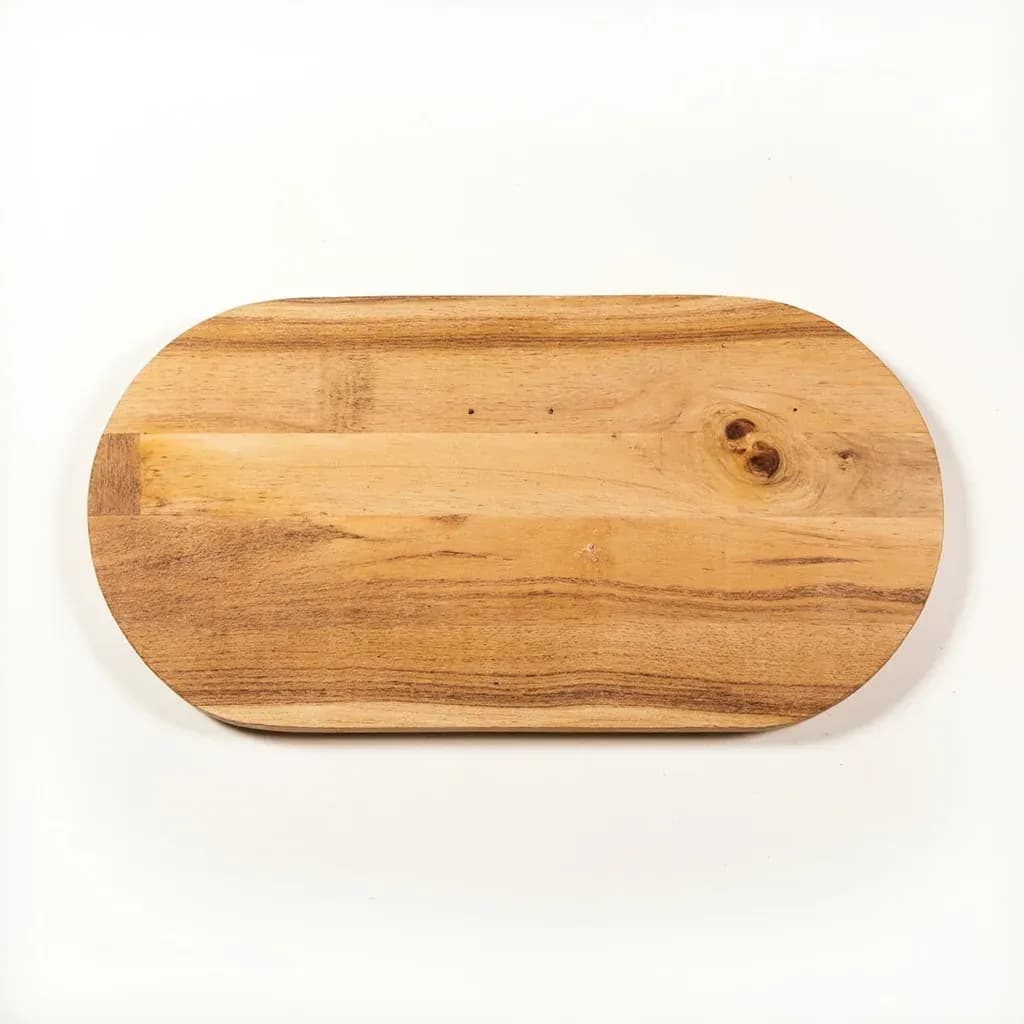
A broad wooden board on which steamed taro is pounded into Hawaiian poi.
A poi board, or papa ku'i 'ai, is a wide, slightly concave wooden board that serves as the work surface for making poi. Steamed and peeled taro corm is placed on the board and pounded with a stone pounder until it becomes a smooth, sticky paste, with water added gradually to reach the desired thickness. It is a traditional Hawaiian tool used together with the poi pounder.
The papa ku'i 'ai is the Hawaiian pounding board — a broad, gently sloped slab of dense hardwood on which steamed taro (kalo) is broken down into pa'i 'ai and eventually thinned to poi. More than a prep surface, it is a matched system with the heavy basalt pōhaku ku'i 'ai: the board's downward slope and shallow catchment groove let gravity do the work of feeding taro toward the operator, while the stone's weight crushes fibers that no knife or food processor can replicate. The result is a smooth, slightly tacky paste with a flavor and body that machines cannot quite match, because traditional pounding ruptures individual starch cells gradually rather than shearing them all at once.
Traditional boards are hewn from a single log — most famously 'ōhi'a lehua, with koa, naio, or milo as alternatives — because glue seams trap bacteria and split under repeated impact. Modern commercial operations often substitute food-grade polymer, which is lighter and easier to sanitize but loses the heft and the cultural resonance of the original. Even at home, the board functions as both a tool and a gathering point: ku'i 'ai is traditionally a communal chore, often accompanied by chant, and an heirloom papa ku'i 'ai is passed through Hawaiian families the way a good butcher block is elsewhere.
Alternatives
Types & varieties
Heaviest, most durable option; dense reddish wood naturally resistant to abrasion and moisture.
Prized for its golden color and workability; historically used in chiefly households.
Oversized single-log board, 1.5 m or longer, used at large gatherings or hālau to feed many people at once.
Used in modern commercial poi shops and luaus; non-porous, easy to sanitize, and far lighter to move than a hardwood slab.
Smaller, single-user version roughly 60–90 cm long, designed to be operated by one or two people at a kitchen counter or low table.
The Board and the Stone as a System
A papa ku'i 'ai is rarely used alone. It is engineered to work with the pōhaku ku'i 'ai, a smooth, fist-to-boulder-sized basalt pestle. The board's slope and catchment groove do half the laborer's job: as the stone crushes and smears the taro, gravity pulls the paste downhill into the channel, where it pools for the next round of pounding and the slow addition of water. This is why traditional boards are angled rather than flat — a level surface makes the cook fight the taro instead of letting physics help. The matched weight of stone and slope of board is what makes a long session of ku'i 'ai feasible for multiple participants without exhausting any one of them.
Choosing and Sourcing a Board
A usable papa ku'i 'ai can be acquired in two ways: a traditional hardwood heirloom or a modern polymer commercial board. Each has trade-offs.
- Look for pieces carved from a single log — any visible glue line is a red flag, since seams will split under pounding and harbor bacteria.
- Prefer dense tropical hardwoods ('ōhi'a lehua, koa, naio, milo); avoid softwoods like pine, which splinter and absorb moisture.
- Polymer boards are a practical choice for those without access to a traditional board or for commercial sanitation requirements, though they lack the weight and resonance that make the ritual satisfying.
- A home board in the 60–90 cm range suits most families; go longer only if you regularly feed a crowd or want to host a true communal pounding.
Care and Longevity
Traditional hardwood boards last for generations if treated right; neglected ones crack, harbor mold, and become unsafe. The care routine is closer to that of a fine wooden countertop than to a standard cutting board.
- Oil a new hardwood board generously with food-grade mineral oil for the first week, then monthly, to slow moisture absorption and cracking.
- Hand-wash only; never soak, and never run through a dishwasher. For 'ōhi'a boards, scrub with sea salt and warm water rather than dish soap, which can penetrate the grain and linger.
- Dry the board flat or upright immediately after washing; traditional boards are sometimes left outdoors to sun-bleach, which inhibits surface mold.
- Inspect regularly for deep cracks or splits and retire the board if any appear — they will catch and tear the paste and cannot be fully sanitized.
Common uses
Tips & pitfalls
- Always start with fully cooked, fork-tender taro; under-steamed corms will not break down smoothly and will leave fibrous lumps in the paste.
- Wet the board lightly before the first strike to prevent the paste from sticking, and keep a small bowl of water at hand for dipping the stone, not the board.
- Begin pounding at the top of the slope and let the taro migrate downward into the groove; this conserves effort and keeps the mass uniform.
- Rotate the pōhaku ku'i 'ai with a controlled wrist snap rather than lifting it overhead — Hawaiian technique favors a heavy, low swing that uses the stone's mass, not the arm's.
- Add water in small splashes only after the paste is fully broken down; too much water early produces a gluey, gummy texture that resists smoothing.
Good to know
- Hawaiian name
- Papa ku'i 'ai (pā ku'i 'ai)
- Also called
- Poi-pounding board, poi board
- Traditional material
- Single slab of dense Hawaiian hardwood, most famously 'ōhi'a lehua; also koa, naio, or milo
- Modern material
- Food-grade polymer or high-density polyethylene for commercial/communal use
- Typical length
- Roughly 60–90 cm (2–3 ft) for home use; communal boards can exceed 1.5 m (5 ft)
- Width
- Around 30–45 cm (12–18 in)
- Slope and groove
- Slight downward angle toward the operator, with a shallow channel or raised lip to catch accumulating pa'i 'ai
- Companion tool
- Pōhaku ku'i 'ai — a heavy basalt pounding stone
- Construction
- Hewn from a single log with no seams, to prevent bacterial harboring and splitting under pounding impact
- Care
- Hand-wash, dry immediately, oil with food-safe mineral oil; never soak; traditional boards sanitized with sea salt and sun
Also called
papa kui ai · poi pounding board · taro pounding board
Related

Peeler
Swift blade for stripping skin off fruit and vegetables

Grater
Sharp-toothed surface for shredding cheese and vegetables

Microplane
Ultra-fine rasp for citrus zest, garlic, and hard cheese

Mixing Bowl
All-purpose bowl for combining, whisking, and tossing

Whisk
Looped wires that beat air into eggs, cream, and sauces

Spatula
Flat blade for flipping, lifting, and scraping

Slotted Spoon
Pierced spoon that lifts solids and drains the liquid behind

Wooden Spoon
Gentle, heat-friendly spoon for stirring anything