Prep Tools
Polenta Stirrer (Făcăleț)
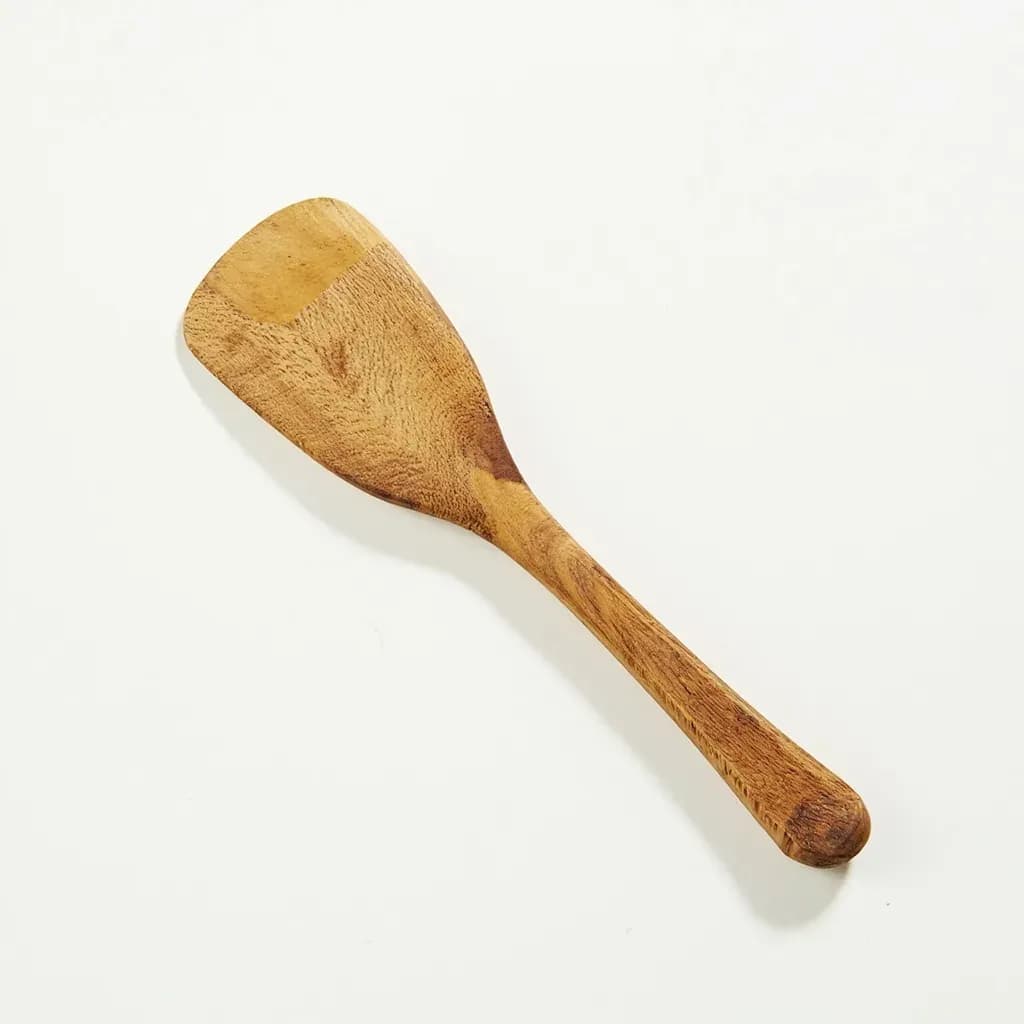
A long wooden paddle or stick for stirring thick polenta and cornmeal porridge.
A polenta stirrer is a sturdy wooden tool, in Romania a făcăleț, used to keep cornmeal mush moving as it thickens over heat so it cooks evenly and stays lump-free. The long handle keeps hands away from the spitting, viscous porridge while the cook stirs continuously for mămăligă or Italian polenta. A taut thread is traditionally used alongside it to slice the firm finished loaf cleanly.
The făcăleț is a Romanian long-handled wooden stirring paddle, purpose-built for cooking mămăligă, the dense cornmeal porridge that stands in for bread at most Romanian meals. Unlike a Western wooden spoon, it is sized for a caçan — a deep, often copper pot — and for the particular challenge of polenta: a thin slurry that transforms over 30 to 40 minutes into a mass stiff enough to be cut with a string. Its length keeps the cook's hand safely above the radiant heat of a wood-fired hearth, while the flat, spade-like blade at the working end can drive through the thickening cornmeal with real authority.
What distinguishes the tool is less its shape than the technique it encourages. The făcăleț is moved in slow, deliberate figure-eights rather than hurried circles, a motion that scrapes the bottom of the pot and folds the mixture back on itself so that no skin of scorched cornmeal develops on the caçan. The same blade doubles as the cook's doneness gauge: when the porridge is ready, the făcăleț is simply left standing in the pot, and a properly cooked mămăligă will hold it upright on its own — a quiet, elegant test that has no real equivalent in Western polenta cookery.
Beyond utility, the făcăleț carries the weight of household memory. It is typically carved from a single billet of beech, used daily for decades, and passed from one generation to the next.
Alternatives
Types & varieties
The most common form — a long shaft with a flat, spade-like blade, used in a steady figure-eight stirring motion
Northern Moldavian and Bukovinian versions end in two or three prongs, useful for breaking up lumps in early-stage polenta
A plain tapered stick with no widened end, the oldest and most rustic form, still used in rural kitchens where carved paddles were once a luxury
Ornamentally carved handles or shafts, often given as wedding gifts or hung on the wall as a display piece in traditional interiors
The Upright-Spoon Test
The most distinctive feature of făcăleț cookery is the way the tool doubles as a thermometer of doneness. Late in cooking, the cook stands the paddle vertically in the center of the caçan and lets go. If the cornmeal has reached the correct density — thick enough to slice, soft enough to spread — the făcăleț will remain standing on its own, held upright by the stiffening porridge around its shaft. If it slumps, more cooking (and usually more water in small splashes) is needed. There is no timing equivalent; experienced Romanian cooks read the texture through the paddle itself.
- Used at the end of cooking, not throughout — the polenta is left to settle for a minute before the test
- A făcăleț that slowly leans is a sign the polenta is still too loose and needs another 5–10 minutes
- A făcăleț that stands rock-steady indicates the classic slicing consistency, suitable for serving with cheese, sour cream, or stews
Stirring Technique
Romanian cooks use the făcăleț with a deliberate, two-handed figure-eight or slow spiral, scraping the bottom of the caçan on every pass. The motion is unhurried but constant; stopping allows a film of cooked cornmeal to set on the copper, which is the most common cause of a bitter, scorched taste in finished mămăligă.
- Hold the shaft with both hands — one near the top, one mid-shaft — for leverage
- Scrape the bottom in long, slow strokes; the flat blade is meant to clear the entire floor of the caçan
- Wet the blade in cold water between passes during the first 15 minutes to keep the slurry from clumping around it
Common uses
Tips & pitfalls
- Use only wood — metal utensils will scratch traditional copper caçan pots and can react with the corn
- Keep a făcăleț dedicated to polenta; strong flavors and oils from other cooking will leach into the porous grain and transfer to the cornmeal
- Season new wooden făcăleți by rubbing them with a thin coat of neutral cooking oil and letting them sit overnight before first use
- Never soak the wood in water — wipe clean with a damp cloth and dry standing upright to prevent cracking
- Stir in a steady figure-eight or spiral pattern, not just in circles, to keep the polenta moving away from the bottom of the pot where it scorches most easily
- Wet the blade in cold water before dipping it into hot polenta, especially in the first 15 minutes, to keep the thickening cornmeal from sticking to the wood
- If the blade develops deep burn marks or cracks from years of use, sand it smooth with fine-grit paper and re-oil rather than replacing it — the patina is part of the tool's character
- Avoid leaving the făcăleț standing in a finished pot during extended serving; the residual heat can dry the wood near the blade and lead to splits over time
Good to know
- Origin
- Romania and the broader Balkans/Moldova region
- Traditional Material
- Hardwood, most commonly beech (fag), sometimes oak or pear wood
- Typical Length
- 80–150 cm (about 3–5 ft), with regional variation
- Shape
- Long shaft ending in a flat, spade-like or paddle-shaped blade; some regional variants have a forked or pierced tip
- Construction
- Carved from a single piece of wood, no glue or metal fittings
- Also Called
- Făcăleț (Romanian); in parts of Moldavia also 'malaiș' or 'făcău'
- Cultural Status
- Considered an heirloom in Romanian households, often passed down through generations
- Consistency Test
- Properly cooked mămăligă is judged by whether the făcăleț stands upright in the pot unaided
Also called
Facalet · Mamaliga Stirrer · Polenta Paddle
Related

Peeler
Swift blade for stripping skin off fruit and vegetables

Grater
Sharp-toothed surface for shredding cheese and vegetables

Microplane
Ultra-fine rasp for citrus zest, garlic, and hard cheese

Mixing Bowl
All-purpose bowl for combining, whisking, and tossing

Whisk
Looped wires that beat air into eggs, cream, and sauces

Spatula
Flat blade for flipping, lifting, and scraping

Slotted Spoon
Pierced spoon that lifts solids and drains the liquid behind

Wooden Spoon
Gentle, heat-friendly spoon for stirring anything