Prep Tools
Porró (Wine Pourer)
A Catalan glass wine vessel with a long spout for pouring a shared stream into the mouth.
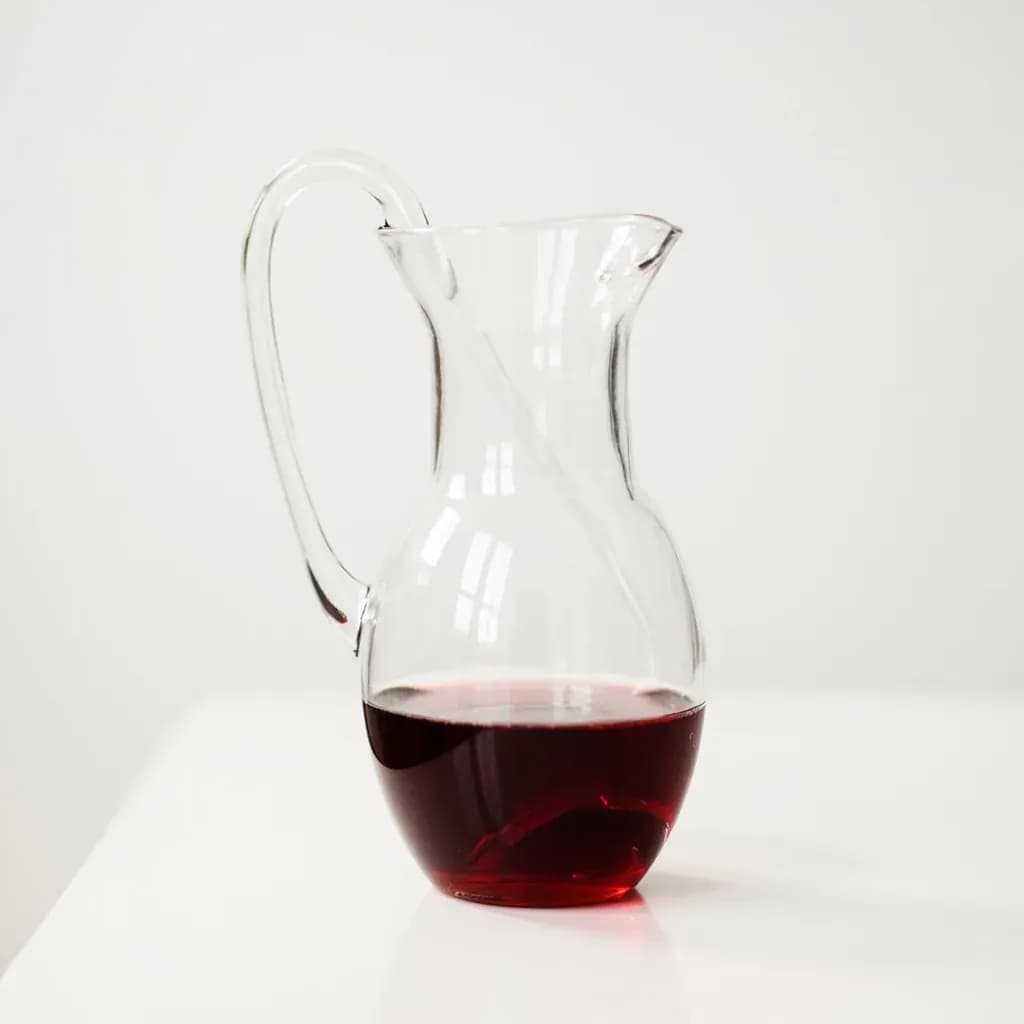
A porró is a traditional Catalan and Spanish glass wine pitcher with a wide body and a long tapered spout. Drinkers tip it to pour a thin arc of wine directly into the mouth without the vessel touching their lips, making it communal and hygienic. It is a festive fixture at gatherings and traditional meals.
The porró is a Catalan wine vessel with a long, tapering spout and (in most modern versions) a small air-vent hole near the bulb. It is designed to pour a thin, controlled stream of wine from a distance, with the drinker catching the arc in an open mouth rather than touching the spout to the lips. The shape is functional: the long spout gives the pour its characteristic trajectory, and the air vent regulates flow — cover the hole with a finger and the stream slows, uncover it and the pour quickens. The vessel is almost always hand-blown glass in the classic form, though glazed earthenware, pewter, and plastic imitations exist.
What makes the porró interesting in a kitchen context is that it is less a pouring tool than a pace-setting object. Because the drinker has to aim, the spout cannot touch the table or face, and the vessel must be tilted precisely to keep a steady stream, drinking from a porró is slow, slightly awkward, and communal. The traditional 1–1.5 L format is passed around the table, with each person pouring for the next — a ritual that, in practice, keeps the wine flowing gently and forces a shared rhythm to the meal. It is a fixture of the Catalan vermut hour, Sunday family lunches, and harvest celebrations in wine regions like Penedès and Empordà, and it appears repeatedly in the work of Catalan modernista painters such as Santiago Rusiñol and Ramon Casas.
For a cook or host, the porró is worth knowing as a piece of regional tableware rather than a serious serving vessel. It is beautiful on a table, useful for a Catalan-themed dinner, and a good talking piece — but it is fragile, awkward to clean, and unforgiving of haste. If you buy one, expect to spill during the first several pours; this is normal and, in Catalan tradition, part of the point.
Alternatives
Types & varieties
The classic Catalan version; clear blown glass, sometimes with a faint green or amber tint; the most common in homes and restaurants.
Older rural form made from glazed clay; holds temperature better, feels more rustic, and is common in the Empordà region.
Decorative, often sold as a souvenir; historically associated with bourgeois Catalan dining rooms rather than everyday use.
Small ~0.25 L version for one drinker; easier to handle and good for learning the aim before tackling the communal size.
Larger 1–2 L vessel meant to be passed around the table; the traditional format for vermut and family meals.
How to drink from a porró
The technique is simple in principle and reliably messy in practice. Hold the bulb in your dominant hand with the spout pointing away from you, brace the base against the palm or forearm, and tilt slowly until wine begins to flow from the spout. Aim the stream into your open mouth, letting it land on the lower lip with the head tipped slightly back. Keep the spout at least a few centimeters from your face; touching the rim to your lips or teeth is considered a faux pas and risks chipping the thin glass. The pour stops the moment you tilt the spout sharply upward, which is far cleaner than setting the vessel down mid-stream.
- Start with water over a sink or outdoors — expect to spill on the first few attempts.
- If the stream breaks into drops, lower the tilt slightly and steady the hand; the flow is gravity-fed and very sensitive to angle.
- Pour for the person opposite you before pouring for yourself; passing the porró around the table is the social core of the ritual.
Wine, vermut, and food pairings
A porró is a vessel, not a recipe, but it sits inside a very specific Catalan food culture. The most common pairing is the vermut hour — a late-morning or early-afternoon apéritif of slightly bitter vermouth, soda, and small plates of conserves. Larger communal porrons appear at Sunday family lunches and harvest meals, usually with young red, rosé, or white from the surrounding region. Decorative pewter or tin porrons, with their shorter spouts, are sometimes used as olive-oil pourers at the table — a practical alternative for cooks who do not want to risk a glass spout at every meal.
- Vermut: dry or sweet Catalan vermouth, with olives, anchovies (anchoas), botifarra, and esqueixada.
- Young red: light reds from Penedès or Empordà, served cool rather than chilled.
- Rosé and white: summery options for outdoor vermut sessions; rosé hides spills on a tablecloth slightly better than red.
- Snack pairings: pa amb tomàquet, formatge de cabra, and marinated cockles (clòtxines) are traditional alongside the pour.
Care and storage
A porró is more fragile than it looks. The spout is thin-blown and chips easily if it clinks against another glass or a hard edge, and the bulb will crack if the vessel is dropped on stone. Treat it as you would a good wine decanter: hand-wash only, dry the spout thoroughly before storing, and keep it upright in a cabinet where it cannot roll.
- Rinse soon after use; tannin from red wine builds up in the narrow spout and is hard to shift once dry.
- Use a flexible bottle brush for the spout, or shake a small amount of uncooked rice with warm water to dislodge residue.
- Avoid dishwashers — the long spout catches against racks and the heat cycling can crack hand-blown glass.
Common uses
Tips & pitfalls
- Tilt the spout upward sharply to stop the flow instantly — cleaner than trying to set the porró down mid-pour, and far easier than twisting the wrist back to vertical.
- Never let the spout touch your lips or teeth; it is considered a faux pas and chips the thin-blown tip on most traditional models.
- Pour for your neighbor before yourself; the social rhythm of passing the porró around the table is the whole point of the vessel.
- Use a young, inexpensive wine; the technique matters more than the bottle, and spills are inevitable until you have practiced.
- Pour over a dark tablecloth or bare wood — any wine, red or white, leaves an instant mark on pale linen if a stream goes astray.
- Rinse soon after use and clean the spout with a flexible bottle brush or a shake of rice and warm water; tannin left to dry in the narrow spout is nearly impossible to remove later.
Good to know
- Origin
- Catalonia (northeastern Spain), with parallel use in Aragon, Valencia, the Balearics, and Northern Catalonia (Southern France)
- Traditional names
- Porró (Catalan); porrón (Spanish)
- Earliest records
- Documented in Catalan culture from at least the 18th–19th century, with mouth-blown glass versions; folk tradition links it to older Mediterranean drinking vessels
- Material
- Traditionally mouth-blown glass; also glazed earthenware, pewter, tin, and modern plastic
- Typical capacity
- 0.25 L (individual) to 2 L (communal); the classic shared porró is 1–1.5 L
- Key feature
- Long, narrow spout (15–25 cm) with a small air-vent hole that controls flow when covered or uncovered with a finger
- Drinking method
- Held at arm's length or above the head; wine is aimed in a thin stream into the drinker's open mouth without the spout touching the lips
- Cultural occasions
- Vermut hour, grape harvest (verema), Sunday family meals, and Catalan festivals such as xató
- Cleaning
- Hand-wash only; narrow spout requires a bottle brush or warm soak to clear residual tannin from red wine
Also called
porrón · porron wine pourer
Related

Peeler
Swift blade for stripping skin off fruit and vegetables

Grater
Sharp-toothed surface for shredding cheese and vegetables

Microplane
Ultra-fine rasp for citrus zest, garlic, and hard cheese

Mixing Bowl
All-purpose bowl for combining, whisking, and tossing

Whisk
Looped wires that beat air into eggs, cream, and sauces

Spatula
Flat blade for flipping, lifting, and scraping

Slotted Spoon
Pierced spoon that lifts solids and drains the liquid behind

Wooden Spoon
Gentle, heat-friendly spoon for stirring anything