Prep Tools
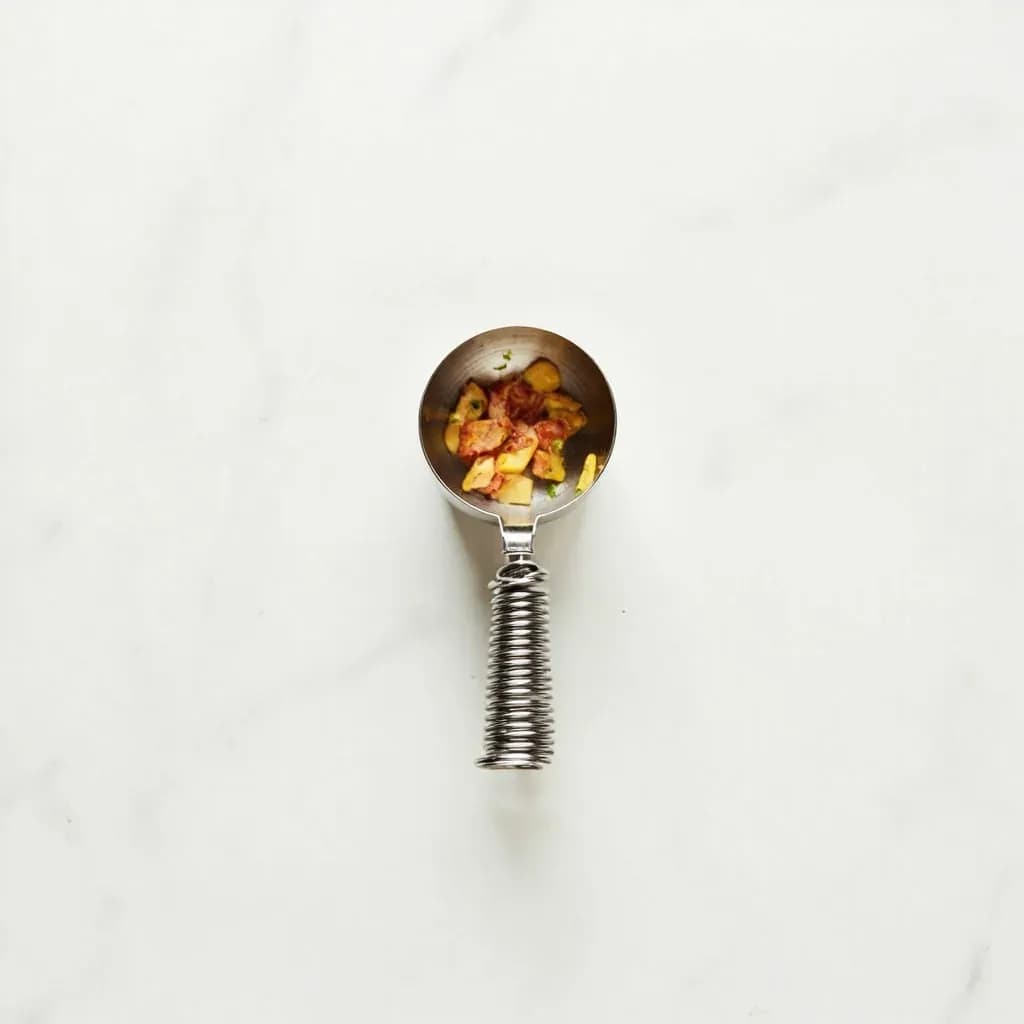
Portion Scoop (Disher)
A spring-release scoop that dispenses uniform portions of dough, batter, or scoops of food.
A portion scoop, or disher, is a half-sphere scoop with a sweeping spring-loaded blade that releases its contents cleanly. It delivers consistent, repeatable portions of cookie dough, muffin batter, meatballs, mashed potatoes, or ice cream. Color-coded handles correspond to standardized scoop sizes, making it a staple for both bakeries and high-volume kitchens.
A portion scoop — known in professional kitchens as a disher — is a spring-loaded scoop with a thumb lever that sweeps the bowl clean and drops its contents in a single, identical piece. The bowl is sized to a numbered standard in which the number equals scoops per quart: a #20 holds one-twentieth of a quart, a #100 holds one-hundredth. That deceptively simple convention is the disher's great strength; once you internalize a few anchor sizes, you can portion cookies, muffins, meatballs, or ice cream faster and more consistently than with a scale or a measuring cup. Because the tool measures by displacement, it is fundamentally a portioning device rather than a measuring one — a #20 of stiff cookie dough weighs noticeably more than a #20 of whipped batter — but in practice that variability is small enough that dishers govern portion control across nearly every professional baking and plating line.
Dishers are sold as round, oval, and spade (flat-blade) bowls, with handles color-coded by size so a cook can grab the right one mid-service without looking. They range from #6, which deposits roughly two-thirds of a cup, down to the diminutive #100 used for melon balls and amuse-bouche garnishes. The handful of sizes most home and prosumer cooks will ever need — a #20 or #24 for drop cookies, a #10 for muffins, a #40 for small cookies or ice cream — covers the vast majority of baking and portioning tasks.
The disher earned its place on the line because uniform portions cook evenly and present cleanly. Cookies from the same scoop spread to the same diameter, muffins crown at the same height, and meatballs finish in the same minute. Outside of baking, the same scoop gives a plated side of rice or mash a tidy half-sphere, fills a sandwich roll with the right amount of filling, or drops a uniform medallion of compound butter onto a hot steak. It scales gracefully from a home baking sheet to a busy restaurant line, and its numbering system is shared across home and pro tools alike.
Alternatives
Types & varieties
Hemispherical bowl; the everyday workhorse for cookies, muffins, meatballs, and ice cream.
Elongated bowl that lays down an oblong portion; used for sandwich fillings, deviled-egg filling, and hoagie toppings.
Flat, paddle-shaped blade rather than a bowl; drops a clean portion of stiff cookie dough without shearing chips or nuts.
One-piece stainless build with a sealed spring; preferred in high-volume and commercial dishwashing for hygiene and durability.
Lighter and color-coded; common in cafeterias and baking lines; less expensive than all-metal models.
Soft-grip or heat-resistant handles for comfort during long service or hot work.
Sizes #70–#100 with a small, sharp-edged bowl for melon balls, butter balls, and amuse-bouche garnishes.
Reading the Numbers
The disher numbering system rewards a small investment in memorization. The number is scoops-per-quart: a #24 yields 24 portions per quart, a #40 yields 40. Three anchor sizes cover most work. A #20 or #24 is the standard drop-cookie portion (about 3 to 3.5 tablespoons of typical dough), a #8 or #10 is the muffin-and-cupcake liner size (about a half to a third of a cup), and a #40 or #60 is the right call for small cookies, truffles, and ice cream scoops. From those anchors you can intuit the rest: a #30 sits between the cookie and muffin sizes for things like hush puppies and mini muffins, while #70 and #100 are garnish-only territory.
Because the number measures volume displaced, not weight, do not assume a #20 is exactly 2 tablespoons or 1 ounce. The stamped handle is an industry convention; the actual yield of a #20 is closer to 3.25 tablespoons, or roughly 1.6 oz depending on whether the dough is stiff or aerated. When a recipe must be exact — for costed bakery production, for example — weigh one scoop of your specific dough or batter and convert the recipe by weight.
- #20 / #24 — drop cookies (≈3–3.5 Tbsp)
- #8 / #10 — standard muffins and cupcakes (≈⅓–½ cup)
- #40 / #60 — small cookies, truffles, ice cream
- #70 / #100 — melon balls, butter balls, canapés
- #6 / #8 — large muffins, stuffing, mashed-potato portions
Matching Bowl Shape to the Job
Bowl geometry is doing real work in a disher, and the right shape can be the difference between a clean drop and a jammed lever.
- Round: the default; ideal for hemispherical portions that will be finished as spheres or flattened into rounds.
- Oval: choose for elongated deposits — sandwich salad, deviled-egg filling, hoagie spreads — where a round would mound in the wrong direction.
- Spade: essential for stiff, chunky doughs (chocolate chip, oatmeal, nut-laden). The flat blade slips through the dough without crushing inclusions, and the spring flicks the portion cleanly without a bowl to clog.
- Mini / sharp-edged: the small bowl on a #70–#100 is intentionally sharp so it cuts clean spheres out of melon flesh, butter, or cream cheese for garnishing.
Common uses
Tips & pitfalls
- Remember the rule: the disher number equals scoops per quart. Memorize a few anchor sizes (#20 cookies, #8 muffins) and work from there.
- Dip the bowl in hot water and shake off the excess between scoops when working with sticky ice cream, cookie dough, or mashed potato; the heat flash-coats the bowl and releases cleanly.
- Squeeze the lever fully so the bowl sweeps clean — a partial squeeze leaves a ragged portion and drags the next scoop.
- Match bowl shape to the task: oval for elongated portions, spade for stiff chocolate-chip dough so you don't crush the chips.
- Buy at least one color per size used in a service so a cook can grab the right tool by color in a hot, fast line.
- Rinse or soak the spring shaft after sweet or salty batters — dried residue stiffens the action and shortens the tool's life.
- For weight-accurate baking, weigh one scoop of your dough or batter and convert the recipe by weight rather than relying on the volume claims stamped on the handle.
- Common mistake: assuming a #20 equals 2 tablespoons or 1 ounce. The actual yield of a #20 is closer to 3.25 tablespoons (≈1.6 oz) of most doughs; sizes are an industry convention, not a measurement standard.
- Common mistake: using a round disher for stiff, chunky cookie dough — the chips and nuts jam the sweep; switch to a spade disher instead.
Good to know
- Also known as
- Disher, cookie scoop, ice cream scoop (small sizes), portion control scoop
- Sizing system
- Numbered by scoops per quart: a #20 = 20 scoops fill one quart; larger number = smaller portion
- Color coding
- Handles are color-coded by size to speed selection in busy kitchens; many makers follow a de facto industry palette
- Common sizes in pro kitchens
- #6, #8, #10, #12, #16, #20, #24, #30, #40, #60, #70, #100
- Bowl shapes
- Round (most common), oval (oblong portions like sandwich fillings), and spade (for stiff cookie dough)
- Origin
- Spring-release ice cream scoop patented in the late 19th / early 20th century; the numbered, color-coded disher as used in foodservice became standard mid-20th century
- Certification
- Many commercial dishers are NSF-certified for sanitary color coding and food-safe materials
- Cleaning
- Most commercial dishers are dishwasher-safe; spring shaft should be flushed clean of sticky residue after use
Also called
Disher · Cookie Scoop · Ice Cream Scoop · Spring-Loaded Scoop
Related

Peeler
Swift blade for stripping skin off fruit and vegetables

Grater
Sharp-toothed surface for shredding cheese and vegetables

Microplane
Ultra-fine rasp for citrus zest, garlic, and hard cheese

Mixing Bowl
All-purpose bowl for combining, whisking, and tossing

Whisk
Looped wires that beat air into eggs, cream, and sauces

Spatula
Flat blade for flipping, lifting, and scraping

Slotted Spoon
Pierced spoon that lifts solids and drains the liquid behind

Wooden Spoon
Gentle, heat-friendly spoon for stirring anything