Prep Tools
Precision Gram Scale
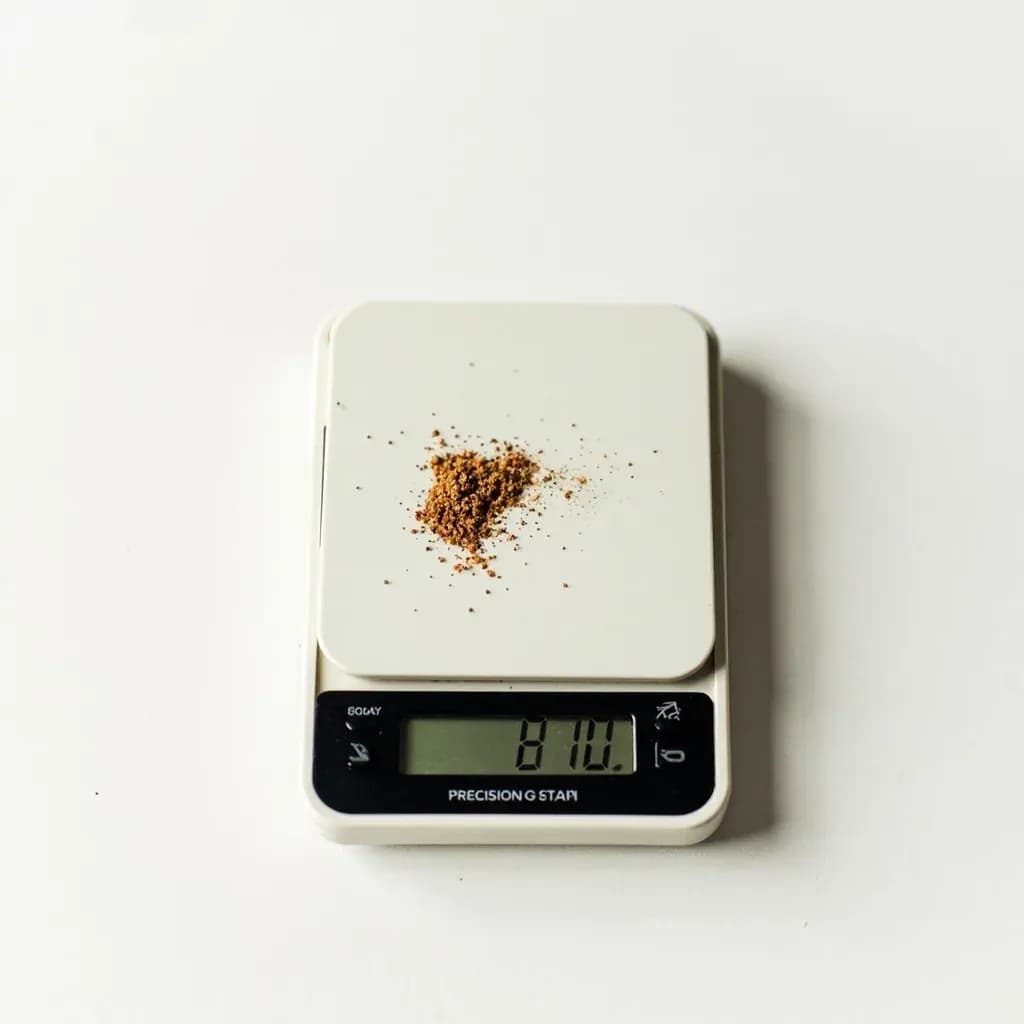
A high-resolution digital scale that weighs to 0.01g for spices, salts, and additives.
A precision gram scale is a small digital scale that measures down to a hundredth of a gram, used for weighing tiny quantities like leavening, hydrocolloids, curing salts, and yeast. Such accuracy matters in fermentation, modernist cooking, and baking where small errors compound. It typically includes a tare function and a calibration weight.
A precision gram scale is a digital kitchen scale that resolves to a tenth of a gram or finer, well beyond the spring-and-dial or 5-gram-increment digital scales that dominated home kitchens into the 1990s. The working parts are simple: a stainless platform sits atop a single-point strain-gauge load cell, and the minute deflection of that cell under weight is translated into a number on the display. The category only became affordable for home cooks in the 2000s, when jewelry-style load cells dropped in price and the same hardware began appearing under names like American Weigh, Smart Weigh, and Jennings. Today, sub-gram accuracy is within reach of anyone who bakes bread, cures meat, or pulls espresso shots — 0.1 g kitchen scales are inexpensive, and 0.01 g lab-style scales are affordable enough for serious home use.
The reason this resolution matters in cooking is that several categories of food work by percentage of total mass, not by volume. Bread dough lives or dies on salt at roughly 1.8–2.2 % of flour weight, a margin where a half-teaspoon of table salt can be the difference between a well-fermented loaf and one that will not rise. Cured salmon uses salt at 2.5–3 % of flesh weight. Pour-over coffee is built around brew ratios like 1:16 or 1:17, which means the dose of beans is the entire foundation of the recipe. None of these are practical to measure by teaspoons; all of them become trivial by weight. A precision scale turns "a pinch" into an actual number, which makes recipes portable, repeatable, and easy to scale up or down.
The trade-off is that finer resolution brings new sensitivities. A 0.01 g scale will register the air current from a passing arm, the warmth of a hand two inches above the platform, and the slow drift of a refrigerator compressor in the next room. It is not a fragile instrument, but it rewards a steady, level, draft-free surface and a patient hand. Capacity shrinks as resolution grows: a true 0.01 g scale typically maxes out at 100–500 g, which is enough for spices, salts, and a single espresso shot, but not for a bowl of bread dough. Most serious cooks eventually own two scales — a 0.01 g lab-style scale for small work and a 0.1 g or 1 g kitchen scale for everything else — and that combination covers almost every situation in a working home or small-professional kitchen.
Alternatives
Types & varieties
Battery-powered, 100–500 g capacity, 0.01 g resolution. Portable, useful for travel, small spice measures, and weighing food additives where tenths of a gram matter.
1–5 kg capacity, 0.1 g or 1 g resolution. The everyday workhorse for baking, portioning, and general cooking; accepts bowls and pots up to its capacity.
100–500 g capacity, 0.01 g (occasionally 0.001 g) resolution. The choice when sub-decimal accuracy matters — curing salt, spice blends, food additives, and small-batch confectionery.
Built-in timer and often a flow-rate readout, rechargeable, sized to fit a V60 dripper or espresso drip tray. Examples include Acaia Pearl, Acaia Lunar, Timemore Black Mirror Basic+, and Decent scales.
Identical hardware to 0.01 g lab-grade scales, sold under brands like American Weigh, Smart Weigh, and Jennings. Many cooks repurpose them as low-cost kitchen lab scales.
1–2 kg capacity at 0.1 g resolution, with a larger platform to accept saucepans, mixing bowls, or sheet pans during candy and chocolate work.
Resolution, accuracy, and what you actually need
Resolution and accuracy are not synonyms, and the difference matters when you choose a scale. Resolution is the smallest increment the display can show — a 0.1 g scale reads in tenths, a 0.01 g scale in hundredths. Accuracy is how close that reading is to the true weight, and on a healthy consumer scale it is ±1 division, meaning a 0.1 g scale is accurate to within ±0.1 g. For bread, pastry, and most general cooking, 0.1 g is plenty: it lets you measure 6.8 g of salt in a 500 g dough, which is 1.36 % — well within the precision your flour weight and technique already allow. The step up to 0.01 g earns its keep for salt in curing, espresso doses, single-origin spice blends, food additives such as MSG, ascorbic acid, and maltol, and any recipe where a tenth of a gram shifts the result. The step up to 0.001 g is rarely useful in a kitchen and brings real sensitivity to drafts and vibration.
Calibration, care, and the load cell
The single-point strain gauge inside every consumer kitchen scale is a small metal block that flexes microscopically under load. It is robust, but it is the one part you can damage, and the most common cause is impact — dropping the scale, or setting a heavy pot down hard. Recalibrate monthly with a known 100 g or 200 g reference weight, and again any time the scale has been dropped, moved between very different temperatures, or shows persistent zero drift (the reading wandering when nothing is on the platform). Calibration is a one-button operation on most modern scales, and a 100 g or 200 g reference weight is a modest one-time investment that pays for itself in confidence.
- Set the scale on a hard, level, vibration-free surface. A stone countertop beats a wooden cutting board, and a dishwasher running in the next room will register as drift on a 0.01 g model.
- Shield the platform from drafts. An open window, an HVAC vent, or a hand passing overhead will deflect 0.01 g readings noticeably.
- Let the scale acclimate 15–20 minutes to room temperature before calibrating if it has been stored in a cold pantry or a hot car.
- Replace batteries promptly. Scales typically lose accuracy as voltage drops, before the display dims.
- Never rest hot pots, pans, or tempered chocolate directly on the platform; heat warps the load cell over time. Use a trivet or let the vessel cool to room temperature.
- Weigh dry ingredients before adding liquids to avoid splashing the platform and skewing later tared readings.
Working with the scale: a few useful habits
The single most useful habit is taring properly. Place the bowl, jar, or parchment liner on the platform, press tare, and confirm the display reads zero before every addition. Never add readings in your head — "I added 12 g, then 18 g, so that is 30" is exactly the kind of error the scale is supposed to eliminate. A second useful habit is to weigh ingredients in the order they go into the recipe, so each addition tares on top of the last; for bread and pastry this also lets you verify the total dough weight at the end, which is a quick sanity check on hydration and yield.
- Use a small parchment square as a liner for honey, peanut butter, or cocoa butter; tare after placing the liner so its weight is zeroed out.
- Remember that 1 g is not 1 mL except for water. 1 mL of honey weighs roughly 1.4 g, 1 mL of all-purpose flour roughly 0.5 g, 1 mL of melted butter roughly 0.91 g.
- For pour-over coffee, weigh the beans first. Place the carafe (with the dripper on top) on the scale and tare, then pour water through the dripper — the scale shows cumulative water mass in real time, and that figure is what drives your 1:16 or 1:17 brew ratio.
- For sourdough starter feeding, weigh starter, flour, and water at the same ratio (typically 1:1:1 or 1:2:2) for predictable rise times.
Common uses
Tips & pitfalls
- Tare the container and any liner (parchment, silicone mat, cup) before every addition — never add readings in your head, because the entire point of the scale is to make that error impossible.
- Set the scale on a hard, level, vibration-free surface. Refrigerator compressors, dishwashers, and footfall show up as drift on a 0.01 g model.
- Shield the platform from drafts. An open window or HVAC vent will deflect 0.01 g readings.
- Let the scale acclimate 15–20 minutes to room temperature before calibrating if it has been stored in a cold pantry or a hot car.
- Calibrate monthly — or after any drop — with a known 100 g or 200 g calibration weight.
- For bread and pastry, weigh salt to 0.1 g. Dough lives or dies by tenths of a percent of flour weight, and a 0.5 g difference in 500 g of dough is meaningful.
- Never exceed the stated capacity, even momentarily. Overloading permanently damages the strain gauge and causes zero drift.
- Weigh dry ingredients before adding liquids to avoid splashing the platform and skewing later tared readings.
Good to know
- Resolution classes
- 0.01 g (lab or pocket), 0.1 g (mid-range), or 1 g (standard kitchen)
- Typical capacity
- 100–500 g for 0.01 g models; 1–5 kg for 0.1 g and 1 g models
- Accuracy
- ±1 displayed division, so a 0.01 g scale is accurate to within ±0.01 g when properly calibrated
- Load cell
- Single-point strain gauge on virtually all consumer models
- Units
- g, oz, lb:oz, dwt, grains, carats, taels; many include a water-volume approximation for ml
- Calibration
- Manual or one-button with a 100 g or 200 g reference weight; recalibrate monthly or after a drop
- Platform
- Stainless steel, typically 80–160 mm square
- Operating environment
- 10–30 °C (50–86 °F); allow 15–20 minutes of acclimation after moving from a cold pantry or hot car
Also called
0.01g scale · jeweler's scale · micro scale
Related

Peeler
Swift blade for stripping skin off fruit and vegetables

Grater
Sharp-toothed surface for shredding cheese and vegetables

Microplane
Ultra-fine rasp for citrus zest, garlic, and hard cheese

Mixing Bowl
All-purpose bowl for combining, whisking, and tossing

Whisk
Looped wires that beat air into eggs, cream, and sauces

Spatula
Flat blade for flipping, lifting, and scraping

Slotted Spoon
Pierced spoon that lifts solids and drains the liquid behind

Wooden Spoon
Gentle, heat-friendly spoon for stirring anything