Baking & Pastry
Proofing Cabinet (Proofer)
A warm, humid enclosure that creates ideal conditions for proofing yeast dough.
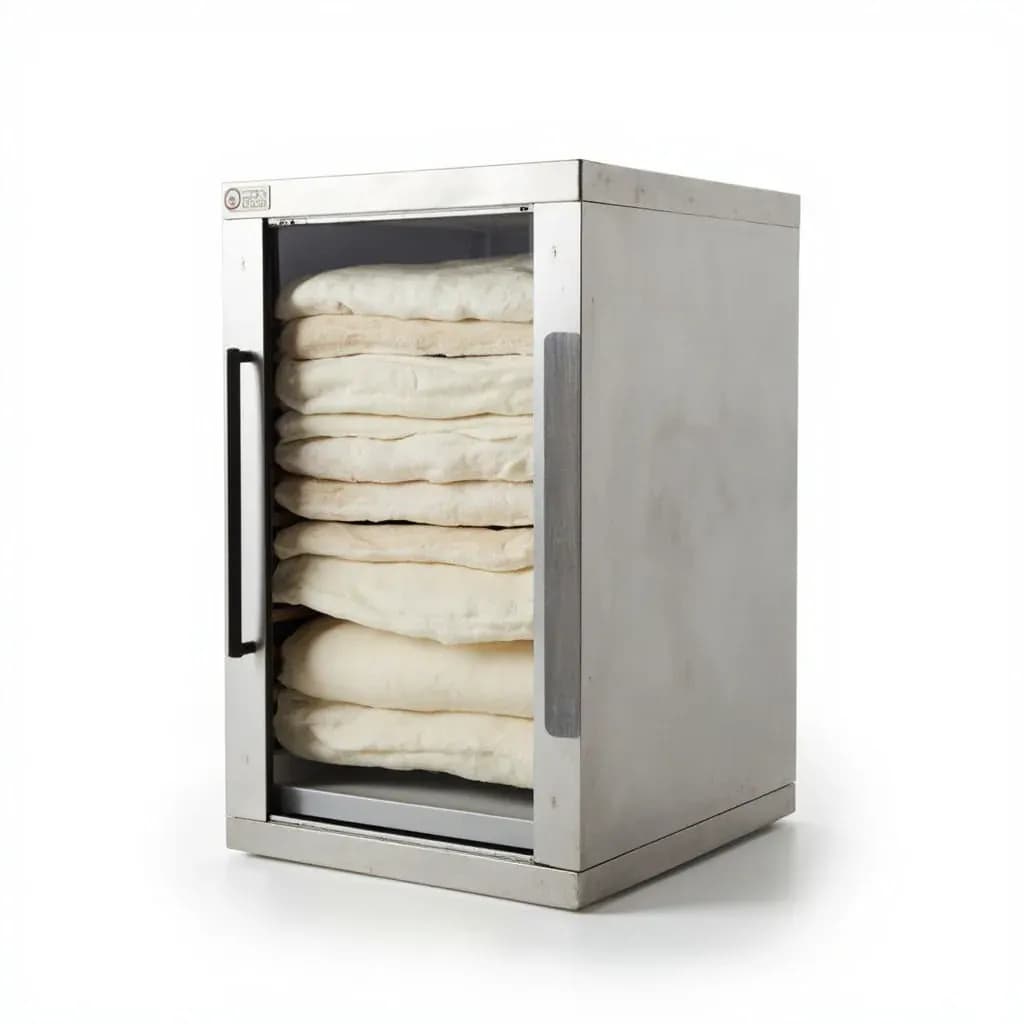
A proofing cabinet, or proofer, is an insulated enclosure that holds a warm temperature and controlled humidity to give yeast dough an ideal rising environment. Bakeries use it to proof breads and pastries consistently and quickly, regardless of the ambient kitchen climate. The humidity keeps the dough surface from drying and forming a skin during the rise.
A proofing cabinet is a humidor for dough: an insulated, temperature-controlled enclosure that also holds humidity at a steady level, so yeast-leavened dough ferments the same way every time regardless of season, climate, or the whims of a drafty kitchen. It matters because yeast activity and dough surface behave as two separate problems. Temperature governs how fast the yeast ferments and how the gluten relaxes; humidity governs whether the dough's outer skin dries into a crust or stays supple enough to expand. A countertop spot, an oven with the light on, or a warm laundry room can hit one of these targets but rarely both at once, which is why home loaves often tear at the sides or form a leathery skin before they finish rising.
In practice, the cabinet works by holding a thermostat-driven heater and a water pan (or, in commercial models, a plumbed steam line) inside a sealed, fan-circulated box. The operator dials in something like 80°F and 80% relative humidity, waits for the chamber to equilibrate, then loads shaped dough for a predictable, repeatable proof. That repeatability is the real value: a baker can develop timing around a specific cabinet setting, and dough formulas that flopped in a cool winter kitchen start working in July.
The skill a proofer demands is not the machine itself but reading the dough inside it. Hydration, yeast percentage, enrichments like butter and eggs, and ambient flour temperature all change how a given setting actually performs, so a good baker uses the clock only as a rough guide and judges by feel: visible puff, a slow spring-back when pressed, and a light, airy weight in the hand.
Alternatives
Types & varieties
Standard upright cabinet with a hinged door and fixed racks; the workhorse of small-to-mid bakeries.
Tall cabinet built to accept a wheeled rack of sheet pans; high-volume bakeries roll whole loads in and out at once.
Compact electric unit sized for 18×13" pans; common in cafés, bakeries with limited floor space, and serious home kitchens.
Single unit that proofs on one side and bakes on the other, or switches modes; saves floor space in small shops.
Refrigerated cabinet that holds shaped dough cold overnight and then shifts to warm proofing on a programmed schedule; the standard tool for next-morning bake-off.
Room-sized enclosure, often adjoining the oven deck, built into the bakery floor plan for very high throughput.
Plumbed model that injects live steam for precise humidity; favored for crusty hearth breads and laminated doughs where surface control is critical.
Small plastic or metal cabinet with a low-watt heater and water tray, sold for serious home bakers in countertop sizes.
How temperature and humidity do different jobs
Treat these as two dials, not one setting. Temperature drives fermentation speed and the rate at which butter in laminated or enriched dough softens. Humidity drives whether the dough's outer skin stays elastic or skins over into a thin crust that will split and tear when the loaf goes into the oven. Most proofing problems blamed on the oven actually originate here: a skin formed during proof cannot stretch during oven spring, so the loaf tears at the side or bottom seam.
Matching humidity to the dough
- Lean hearth breads (baguettes, country loaves): 70–75% humidity. A slightly drier surface grips the flour dusting, holds its shape on the peel, and scorches into a crackling crust.
- Enriched doughs (brioche, challah, panettone): 80–90% humidity. The fat and egg content already keep the crumb tender, so a dry skin is the main risk; keep the surface supple.
- Laminated doughs (croissants, danishes): 85–90% humidity. The butter layers must stay pliable; if the surface dries, the layers fuse and the dough won't lift in the oven.
- Pizza and focaccia: 75–80% humidity. Enough moisture to keep the dough extensible, but not so much that the surface gets gummy under toppings or oil.
Home-kitchen workarounds
Without a cabinet, the closest substitutes target the same two variables. The classic oven trick — turn on the oven light, set a roasting pan of boiling water on the floor, and shut the door — produces roughly 80–85°F and high humidity, which handles most bread and roll proofs. A microwave with a cup of hot water and the door closed works for slower proofs, though the temperature falls as the water cools. For long, cold fermentations, the refrigerator plays the retarder's role, and dough can be shaped cold and then moved to a warm, humid spot to finish.
Common uses
Tips & pitfalls
- Always preheat the proofer with the water pan filled for at least 15–20 minutes before loading dough, so humidity and temperature have actually stabilized; loading into a cold, dry cabinet is the most common cause of a sudden skin.
- Keep dough pieces at least 2–3 inches apart on the pan; over-proofing in a warm, humid box can cause spreading and collapse, especially with enriched doughs and soft rolls.
- Don't exceed roughly 110°F (43°C). Above that, yeast is damaged and the surface can skin over before the crumb has finished proofing, leaving a blowout when the dough hits the oven.
- Check dough by feel, not just the clock. It should look visibly puffed, hold a slow, partial indentation when gently pressed with a floured finger, and feel light and airy in the hand.
- Clean and refill the water reservoir daily. Stale water breeds mold and sour off-odors that transfer straight into the dough, and a slimy pan will eventually contaminate a whole batch.
- Rotate pans if your proofer runs hot in one corner, as many reach-in models do. A thermometer left inside for a day will show you where the cool and warm zones are.
- Avoid venting steam directly onto the dough; some countertop proofers discharge in a way that beads water on top, leaving gummy spots that scorch. Vent the unit, tilt the pan, or open the door briefly to clear condensation.
- For one-pan jobs at home, set the shaped dough on a sheet tray with a cup of hot water and tent loosely with a clean kitchen towel; skip the tent for very wet doughs that need to dry slightly before scoring.
Good to know
- Also called
- Dough proofer, proof box, proofing oven (when combined with baking), retarder-proofer (when refrigerated)
- Typical proofing temperature
- 75–95°F (24–35°C); most cabinets are adjustable from roughly 80–115°F (27–46°C)
- Typical proofing humidity
- 70–90% relative humidity, generated by a water pan, spray, or steam injection
- Common sizes
- Half-size (holds 18×13" sheet pans) and full-size (holds 18×26" sheet pans); also countertop, roll-in, and walk-in formats
- Construction
- Insulated stainless steel cabinet with heating element, water reservoir or plumbed steam line, thermostat, and usually a circulating fan and glass door
- Distinguishing feature
- Controls both temperature and humidity independently, unlike an oven or a warm spot on the counter
- Origin
- Developed for commercial bakeries in the early-to-mid 20th century as industrial bread production replaced open-room proofing; home countertop proofers became widely available in the 2000s
- Related equipment
- Often paired with a retarder (refrigerated proofer) for cold-fermentation schedules, or built into a combo proofer-oven
Also called
Proofing Box · Temperature-Controlled Proofing Box · Proofer · Dough Proofer
Related

Muffin Pan
Multi-cup pan for muffins, cupcakes, and egg bites

Bundt Pan
Fluted ring mold for showstopping cakes with a center hole

Springform Pan
Latch-release pan that frees delicate cakes without flipping

Pie Dish
Sloped round dish for crisp-bottomed pies and quiches

Tart Pan
Fluted pan with a pop-out base for clean-edged tarts

Rolling Pin
Rolls dough into even sheets for pastry and bread

Pastry Brush
Brushes on egg wash, glaze, butter, and marinades

Bench Scraper
Flat blade that divides dough and clears your work surface