Appliances & Heat
Proofer / Proofing Cabinet
A warm humid box that holds dough at an ideal temperature so yeast rises evenly and reliably.
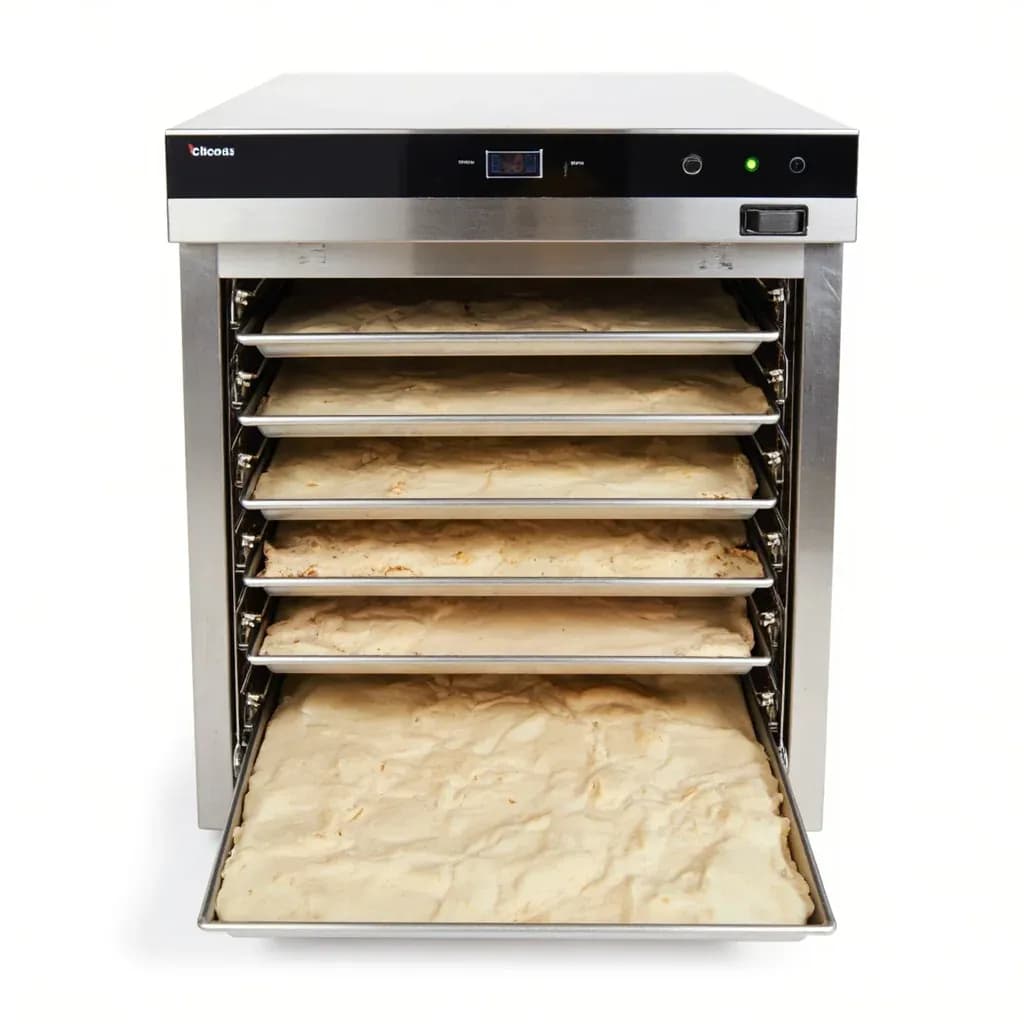
A proofer is a cabinet or enclosed box that maintains warm, humid conditions to help yeasted dough rise consistently. Steady temperature and moisture keep the surface from drying and crusting and speed fermentation to a predictable schedule. A retarder-proofer can also chill dough to slow the rise, letting bakers hold and time their bakes.
A proofer is a small, insulated cabinet — think of it as a mini-greenhouse for dough — that holds both temperature and relative humidity at the levels yeast and gluten actually want. Most yeast performs its best work between 75 and 85°F, and most doughs rise more evenly when the surrounding air is 70–90% humid, the moisture keeping the surface of the dough supple so it can expand without cracking. A proofer is the rare piece of equipment that controls both variables at once, which is why bakers reach for one whenever the dough is delicate, enriched with butter and eggs, or layered with cold fat.
For lean, crusty hearth loaves a warm, covered bowl on the counter will often do, which is why proofers are sometimes dismissed as a luxury. But once you start working with brioche, cinnamon rolls, or laminated doughs like croissants and Danish, humidity stops being optional. A dry proofing environment dries out the outer skin of the dough, which then tears during oven spring, deflates laminated layers, and leaves butter brittle between folds. A proofer removes that variable entirely, turning final fermentation into a calm, predictable step rather than a fight with plastic wrap and damp towels.
The unit itself is simple: an electric heating element, a thermostat or digital controller, a pan or reservoir for water, and sometimes a small fan or vent. Home countertop models are roughly the size of a microwave; commercial units slide under a sheet-pan rack or fill a small room.
Alternatives
Types & varieties
Compact plug-in box with a clear door and humidity tray; the workhorse for serious home bakers tackling sourdough, brioche, and croissants.
Tall rolling cabinet designed to slide under a sheet-pan rack; built for bakery-volume output.
A small heated, humidified room built into a bakery that holds many racks at once.
Refrigerated cabinet that both retards dough cold overnight and proofs it warm in the morning; a small-bakery favorite.
Single unit that proofs dough and then bakes without transferring trays; common in cafés and small shops.
Styrofoam cooler, oven with only the light on, or a wooden box with a low-wattage bulb and a pan of water.
Many stand mixers and bread machines include a short 'proof only' setting that warms the bowl to about 80°F.
Matching humidity to the dough
Humidity is the half of the proofer most home bakers underestimate, and it is also where a proofer earns its price tag over a bare warm spot. As a rule of thumb, lean hearth breads — baguettes, country loaves, ciabatta — want the lower end of the range, around 70–75%, especially when the shaped loaves are coated in rice flour and need to keep that dry outer film so they release cleanly off a peel. Enriched doughs (brioche, challah, panettone) and laminated doughs (croissants, Danish, rough puff) want the upper end, 85–90%, because their high butter and egg content sets up fast and a dry skin will crack, split, or seal the layers together before the dough has finished rising.
- Lean hearth loaves: 70–75% humidity
- Enriched pan loaves and buns: 80–85% humidity
- Laminated doughs: 85–90% humidity
- Pizza, bagels, English muffins: 75–80% humidity
When a proofer is worth it (and when it isn't)
A proofer is most valuable when humidity, not just warmth, is the limiting factor. For everyday lean sandwich loaves, a covered bowl on top of the fridge is usually fine. For anything enriched, laminated, or destined for a wood-fired oven with a long steam phase, the proofer pulls its weight immediately.
- Worth it for: brioche, cinnamon rolls, babka, panettone, croissants, Danish, puff pastry, soft pretzels, bagels, pizza balls, and pâte à choux.
- Skip it for: sturdy rye breads, sourdough batards meant to bake from the fridge, and any dough you plan to cold-retard overnight anyway.
- Bonus uses: culturing yogurt and ripening sourdough starter at around 75–80°F.
Common uses
Tips & pitfalls
- Preheat the empty proofer for 10–15 minutes before loading dough — putting dough into a cold box stalls the yeast and the humidity has to climb from scratch.
- Verify the actual temperature with a separate oven thermometer; the dial on most home proofers can drift several degrees from the readout.
- Refill the water tray or reservoir whenever humidity drops; a dry proof dries the dough's skin, which then cracks during oven spring and ruins the bloom.
- Aim the humidity to the dough, not the recipe: 70–75% for lean hearth loaves with a rice-flour coat, 85–90% for croissants, brioche, and Danish where butter and egg set fast.
- Proof to visual cues rather than the clock — the dough should look pillowy, pass the poke test (a slow, partial spring-back when gently pressed), and have grown roughly 50–75% in size.
- Don't drape plastic wrap directly over dough inside a hot, humid proofer — condensation pools on the underside and makes the surface gummy and weak.
- Open the door as little as possible; every opening vents warmth and humidity and can collapse a delicate, fully-proofed loaf.
- Sanitize the interior regularly — warm, damp interiors grow mold quickly, particularly if you bake with enriched doughs that leave sugary residues.
Good to know
- Also called
- Proofing cabinet, proof box, fermentation cabinet
- Typical temperature range
- 75–95°F (24–35°C); most bread doughs proof best at 75–85°F (24–29°C)
- Typical humidity range
- 70–90% relative humidity; enriched and laminated doughs favor 80–90%
- Capacity (home countertop)
- Roughly 0.5–2.5 cu ft, fitting one to several sheet pans or loaf pans
- Capacity (commercial)
- Full sheet-pan racks (typically 8–20 pans) or walk-in rooms
- Power source
- Electric heating element plus a water tray or steam generator for humidity
- DIY alternatives
- Turned-off oven with the light on, a cooler with a warm water jug, or an Instant Pot on the yogurt setting
- Term origin
- 'Proof' from the older English 'prove' — the baker proves the dough is alive and ready to bake
Also called
Retarder-Proofer · Dough Resting Container · Dough Proofing Container · proofing cabinet · proving drawer
Related

Stovetop
The everyday burners where most cooking actually happens

Oven
Enclosed dry heat for roasting, baking, and braising

Grill
Live-fire or gas grates for char, smoke, and high heat

Smoker
Low, slow heat and wood smoke for barbecue and brisket

Air Fryer
Countertop convection that crisps with little or no oil

Slow Cooker
Set-and-forget low heat for stews, beans, and braises

Pressure Cooker
Sealed steam pressure that cooks tough food in a fraction of the time

Rice Cooker
Foolproof, perfectly steamed rice every single time