Prep Tools
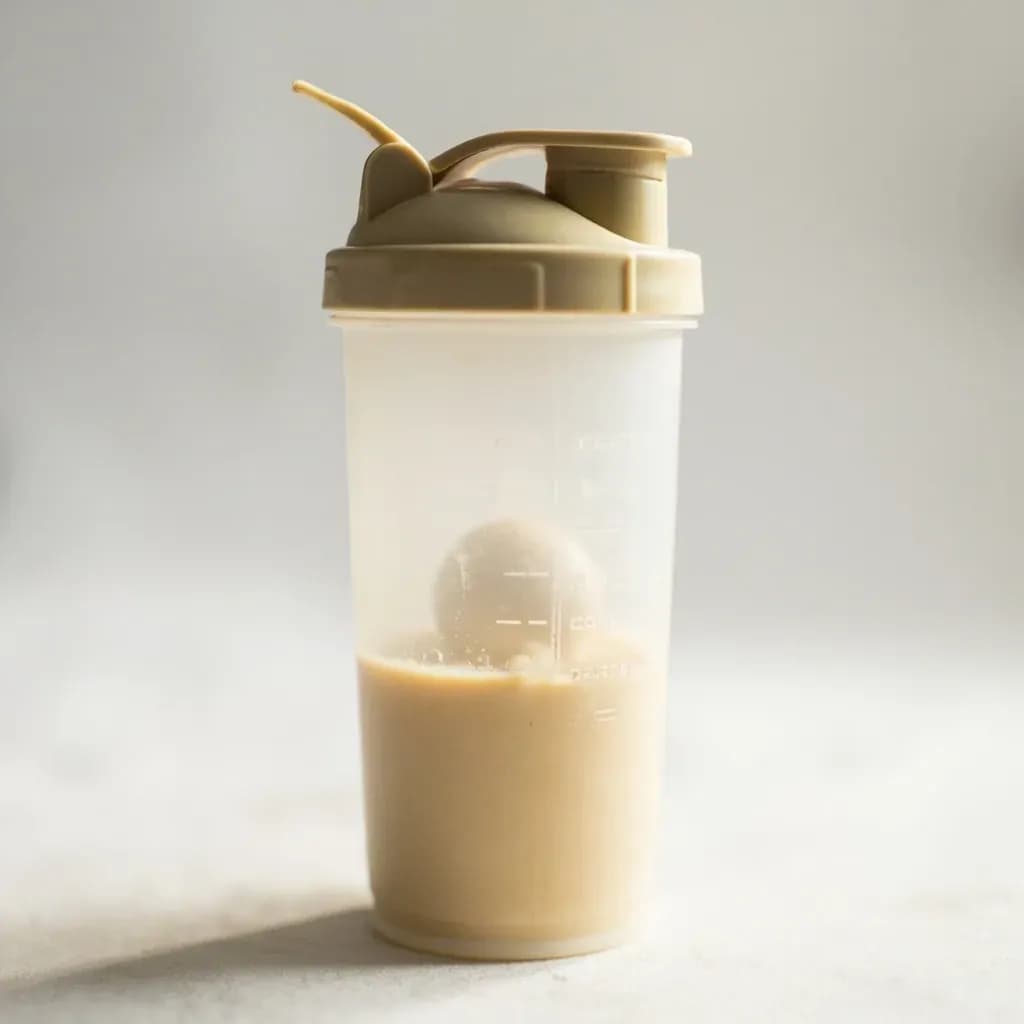
Protein Shaker Bottle
A lidded bottle with a mixing ball or grid for blending powders and dressings smooth.
A protein shaker bottle is a sealed plastic bottle containing a wire whisk ball or mixing grid that breaks up clumps when shaken. Beyond protein powder, cooks use it to emulsify vinaigrettes, mix pancake batter, dissolve cornstarch slurries, and shake cocktails. The leak-proof lid makes it convenient for quick, mess-free mixing.
A protein shaker bottle is a sealed, handheld mixing vessel built around an internal agitation element — a free-floating whisk ball, a built-in plastic grid, or a contoured interior — that breaks up powder and emulsifies liquids through vigorous shaking. The modern form was popularized by sports nutrition in the late 1990s, but it is a direct descendant of the bar and cobbler shakers used behind cocktail bars for over a century, and it inherits the same physics: rapid, repeated acceleration forces the mixing element to ricochet through the liquid, shearing clumps and homogenizing emulsions in a way a spoon or stir stick cannot match inside a closed container.
In the kitchen, the shaker bottle earns its keep anywhere a cook needs a lump-free, pourable mixture in small volumes — typically a single serving of dressing, marinade, or batter. The sealed lid emulsifies oils into water-based liquids without splatter, and the pour spout gives controlled flow for plating. Stainless steel and glass versions extend the tool to hot liquids; standard Tritan plastic models are best kept to cold or room-temperature work.
The mixing element defines performance. A whisk ball is a springy metal or plastic sphere that bounces unpredictably, hitting clumps from every angle; a built-in agitator grid sits in the lid and shears liquid through its lattice as the bottle is shaken. Neither replaces a blender — anything thicker than a pourable batter stalls the element and leaves residue in the corners — but for thin-to-medium viscosity mixtures, a shaker bottle is faster, easier to clean, and more precise for single-serving work than hauling out a countertop machine.
Alternatives
Types & varieties
Springy metal or plastic ball that ricochets around the bottle to break up clumps; the most common mixing insert
Built-in or removable plastic lattice, often integrated into the lid, that shears powder as you shake; handles finer powders well
Lightweight, shatter-resistant, translucent with measurement marks; the everyday standard
More durable, keeps drinks colder, no plastic taste, but heavier and typically lacks see-through markings
Battery-powered impeller that mixes hands-free; useful for thicker shakes and for accessibility
Borosilicate or soda-lime glass with silicone sleeve; inert flavor, dishwasher friendly, but heavier and breakable
Compartment in the lid or base stores a serving of powder separately for travel
Rounded internal contour and wide mouth that mix via pure shaking; fewer parts, simpler to clean
Choosing the right mixing element
The mixing element is the soul of the shaker bottle, and the choice between a whisk ball and an agitator grid shapes how the tool performs. A whisk ball is a free-floating spring that tumbles unpredictably, hitting dry powder from below, beside, and above. It is forgiving of shaking technique — even a lazy side-to-side motion usually breaks up whey, cocoa, or matcha. A built-in grid, by contrast, is stationary and works by forcing liquid through narrow channels as you shake, so it demands a more vigorous, sustained motion to generate the same shearing force. Grids tend to win on very fine powders (instant espresso, micronized creatine) and on small batches where the ball cannot build up enough momentum, but they are harder to clean and more prone to trapping residue in the lattice.
When to reach for it in the kitchen
Think of the shaker bottle as a precision tool for single-serving emulsions and dissolutions, not a small blender. It shines for vinaigrettes, creamy dressings for two, thin marinades for poultry or fish, and lump-free pancake or waffle batter for one or two people. It is also excellent for cold sauces that need a fast, stable emulsion — a single portion of aioli, a quick tzatziki, or a citrus vinaigrette where you want the oil to stay suspended. Anything thicker than a pourable pancake batter belongs in a countertop blender; thick mixtures stall the mixing element and leave a stubborn ring of residue in the bottle's corners.
Care and maintenance
Protein residue is the enemy of a clean shaker bottle. Whey and casein form a thin, nearly invisible film that dries onto plastic and develops odor quickly. The fix is a quick rinse with warm water and a drop of dish soap immediately after use. For periodic deep cleaning, fill the bottle with warm water and a teaspoon of baking soda, shake, and let it sit for ten minutes before scrubbing with a bottle brush. The rubber seal ring under the lid is the most common source of leaks — pull it out with each wash, dry it, and check for cracks; a torn or misplaced seal will empty the bottle into a gym bag or kitchen drawer without warning.
Common uses
Tips & pitfalls
- Always add liquid before powder — pouring powder in first is the number one cause of stubborn clumps stuck to the bottom
- Leave at least one to two inches of headspace; overfilling is the most common reason lids pop or leak mid-shake
- Shake for 15–30 seconds with a side-to-side motion followed by up-and-down strokes — pure vertical shaking leaves powder trapped at the lid
- A drop of vanilla extract or a pinch of salt noticeably improves flavor masking in unflavored or chalky whey
- Rinse with warm water and dish soap immediately after use; dried protein film causes odor and bacteria growth
- For stubborn residue, fill with warm water, add a teaspoon of baking soda, shake, and let sit ten minutes before scrubbing
- Skip hot liquids in plastic versions — heat warps Tritan and can compromise the seal; reach for stainless or glass instead
- Never shake carbonated beverages in a sealed shaker; pressure will blow the lid off and make a memorable mess
- Tethered flip caps fray at the hinge — pull from the spout, not the tether, when opening
- Check the rubber seal ring each wash; a missing or cracked seal is the usual cause of leaks in a bag or gym floor
Good to know
- Typical capacity
- 16–32 oz (450–900 mL); 20–24 oz is the most common sweet spot
- Body material
- BPA-free copolyester (Tritan), polypropylene, stainless steel, or borosilicate glass with silicone sleeve
- Mixing elements
- Whisk ball (stainless or plastic spring), removable plastic agitator/grid, or built-in lid-mounted screen
- Lid style
- Screw-on with flip cap, spout, or push-button drink opening; most have a tethered cap
- Dishwasher safe
- Many plastic models are top-rack safe; stainless and glass are usually fully dishwasher safe
- Measurement marks
- Most include oz and mL markings molded into the side for accurate liquid dosing
- Temperature tolerance
- Plastic versions are not suited to boiling liquids; stainless and glass handle hot work
- Price range
- Basic models $5–10; stainless or electric versions $20–50+
Also called
shaker bottle · blender bottle
Related

Peeler
Swift blade for stripping skin off fruit and vegetables

Grater
Sharp-toothed surface for shredding cheese and vegetables

Microplane
Ultra-fine rasp for citrus zest, garlic, and hard cheese

Mixing Bowl
All-purpose bowl for combining, whisking, and tossing

Whisk
Looped wires that beat air into eggs, cream, and sauces

Spatula
Flat blade for flipping, lifting, and scraping

Slotted Spoon
Pierced spoon that lifts solids and drains the liquid behind

Wooden Spoon
Gentle, heat-friendly spoon for stirring anything