Prep Tools
Rotary Cheese Grater
A hand-cranked drum grater that shreds hard cheese, nuts, or chocolate quickly and safely.
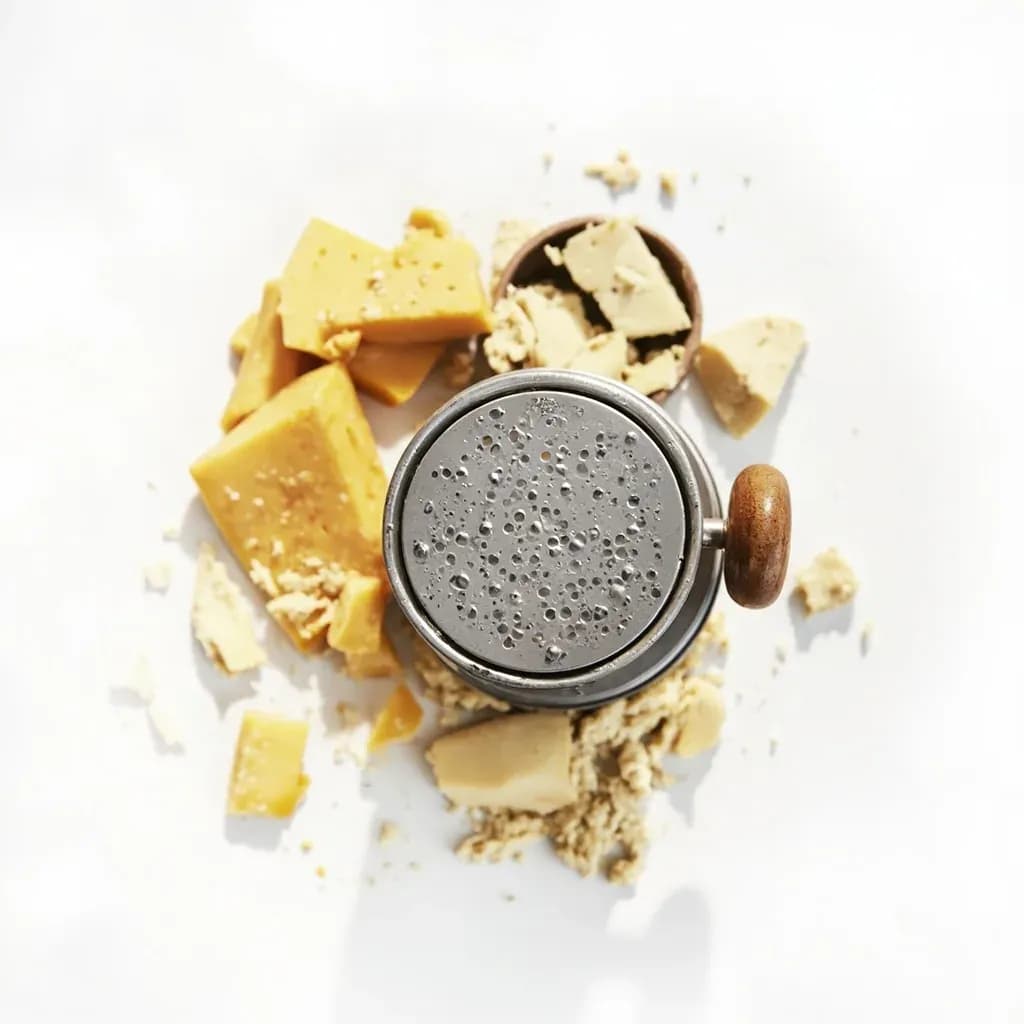
A rotary cheese grater holds food in a hopper pressed against a perforated rotating drum that is turned by a hand crank. As the drum spins it shaves the cheese, nuts, or chocolate into fine shreds without the user's fingers ever touching the blade. It is a tableside and prep tool prized for grating hard cheeses like Parmesan fast and with no scraped knuckles.
A rotary cheese grater is a hand-cranked drum grater that turns a small chunk of hard cheese, firm chocolate, or toasted nuts into uniform shreds with a few turns of the handle. The food sits in a small hopper and is pressed against a rotating cylindrical drum studded with sharp teeth, while a hinged or spring-loaded pusher keeps fingers well clear of the cutting surface. Because the work is mechanical rather than dependent on the cook's arm strength, it produces consistent results with less effort than a box grater and far more safely than a rasp-style microplane.
The tool earned its place in European kitchens for a practical reason: aged hard cheeses like Parmesan, Pecorino Romano, and Grana Padano are too dry and tough to grate comfortably by hand, yet too precious in flavor and cost to leave to clumsy hand-grating. A rotary grater shaves them into fine, light shreds that melt quickly into hot pasta or risotto without the waxy coating you get from pre-shredded bagged cheese. The same mechanism handles cold butter for pastry, dark chocolate for dessert, toasted nuts for garnishes, and stale bread for fresh crumbs — anything firm enough to hold its shape against the drum.
Knowing the tool's limits matters as much as knowing its strengths. Anything soft or moist — fresh mozzarella, cream cheese, room-temperature butter — will smear against the drum, clog the teeth, and turn the job into a lengthy cleanup. Cheese meant for this grater should be cold and aged; everything else is a job for a different tool.
Alternatives
Types & varieties
Single fixed drum, usually fine-to-medium; simplest and least expensive design
Comes with 2–4 drums — fine, coarse, slicing, sometimes a julienne or rasping drum — that swap onto a central axle
Sits on a silicone suction cup that grips the counter; easy to move and store
Attaches to the edge of a counter or table with a screw clamp; very stable for heavy use
Vertical hopper with a long crank handle; gravity feeds the food down onto the drum
European-style 'cheese mill' form, often all-metal with a small hopper and short crank; favored for grating hard cheese at the table
Matching the drum to the job
Most rotary graters that come with multiple drums are sold with three: a fine drum for hard cheese and chocolate, a medium drum for nuts and coarse cheese, and a slicing drum for firm vegetables. The fine drum is the workhorse — Parmesan comes off it like a snowfall and dark chocolate comes out as soft shavings that melt on contact. The medium drum is better for toasted nuts and for grating aged cheddar where you want a more visible shred. The slicing drum, when included, is a real bonus: a peeled carrot or a piece of daikon feeds through it into uniform rounds safely, with no exposed blade to worry about.
The general rule is that the harder and drier the food, the finer the drum you can use. A slightly softer aged cheese like manchego will want a medium drum, while a rock-hard block of Grana Padano can handle the fine setting without complaint.
Keeping the grater working
The single most common complaint about rotary graters is a drum that clogs, slips, or stops cutting cleanly, and almost every one of those problems traces back to either the wrong food or a missed cleaning step. Dried cheese packed into the teeth is the usual culprit: it caked on during storage, hardens the moving parts, and makes the next use feel dull even when the steel is still sharp. A stiff bottle brush and warm soapy water, used within a few minutes of finishing, will get more out of the drum than any amount of soaking. Most drums are dishwasher-safe, but the plastic body usually is not, and prolonged soaking can rust the axle on cheaper models.
Common uses
Tips & pitfalls
- Chill the cheese in the freezer for 10–20 minutes before grating; very cold, hard cheese shaves cleanly instead of smearing against the drum
- Let the crank do the work — pushing the pusher harder does not change the cut, it only risks jamming the drum or stripping the gears
- Fill the hopper just enough to keep the drum engaged; overfilling causes cheese to spin in place instead of feeding through
- Stop and clear the drum the moment you feel resistance; a clogged drum is the main cause of broken handles and stripped gears
- If grating chocolate, use a cold, firm bar; warm chocolate will clump and coat the drum
- Tap the housing gently over a bowl at the end of the job to release the last bits of cheese caught inside, then brush the drum clean
- Wash the drum promptly — dried cheese is hard to remove and a stiff bottle brush gets more out than running water alone
- When reassembling, make sure the drum clicks fully into its locked position or it will slip and jam against the housing
- Keep the suction base (if present) clean and slightly damp before mounting so it grips the counter properly
- Never use on soft cheese, fresh mozzarella, or cream cheese — these smear, clog the teeth, and are nearly impossible to clean out
Good to know
- Type
- Hand-cranked drum grater
- Primary function
- Shreds hard cheese, nuts, chocolate, and other firm foods
- Typical materials
- Stainless steel grating drum; plastic or metal body; wood or plastic handle
- Mounting
- Free-standing on the counter; some models add a silicone suction-cup base or screw clamp
- Drum options
- Interchangeable drums in fine, medium, and coarse; some sets include a slicing drum
- Best for
- Hard aged cheeses (Parmesan, Pecorino Romano, Grana Padano, aged cheddar), firm chocolate, toasted nuts, dried bread
- Capacity
- Small hopper, typically accepts a chunk roughly 1–2 inches across at a time
- Safety
- Fingers never touch the grating surface; a hinged or spring-loaded pusher keeps the food against the drum
Also called
rotary grater · drum grater · crank cheese grater · Mouli grater
Related

Peeler
Swift blade for stripping skin off fruit and vegetables

Grater
Sharp-toothed surface for shredding cheese and vegetables

Microplane
Ultra-fine rasp for citrus zest, garlic, and hard cheese

Mixing Bowl
All-purpose bowl for combining, whisking, and tossing

Whisk
Looped wires that beat air into eggs, cream, and sauces

Spatula
Flat blade for flipping, lifting, and scraping

Slotted Spoon
Pierced spoon that lifts solids and drains the liquid behind

Wooden Spoon
Gentle, heat-friendly spoon for stirring anything