Prep Tools
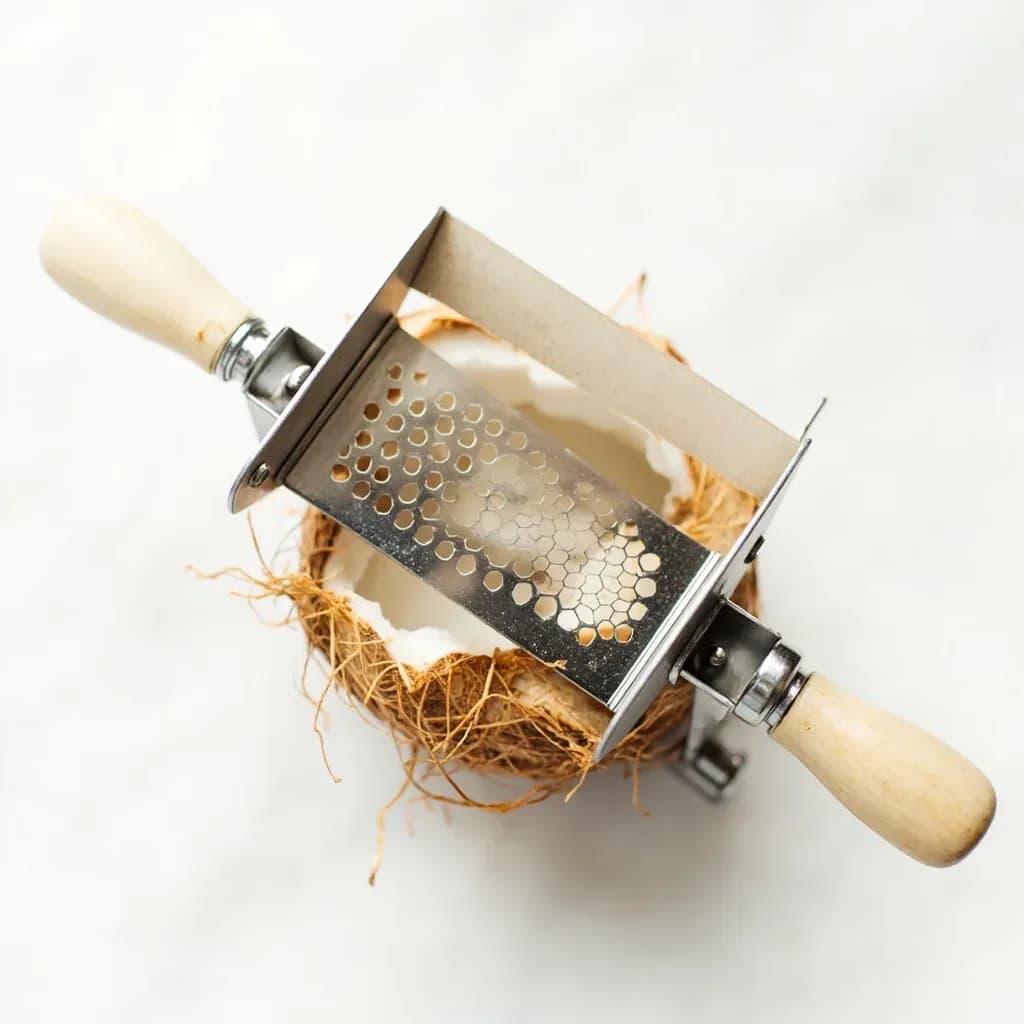
Rotary / Hand Coconut Grater
A hand-cranked or clamp tool that scrapes fresh coconut flesh from the shell.
A rotary coconut grater is a clamp- or stand-mounted tool with a serrated rotating blade that shreds the white flesh straight out of a halved coconut. The cook holds the coconut against the spinning toothed head and turns a crank, producing fine moist gratings for curries, chutneys, sweets, and coconut milk. Common across South and Southeast Asian kitchens, it is far faster and safer than prying and grating by hand.
The rotary/hand coconut grater is a specialist tool built for one task that no general-purpose grater handles well: extracting clean, uniformly fine shreds of flesh from a halved fresh coconut. Where a box grater or food processor struggles with the awkward curved shape, hard brown skin, and dense texture of a coconut half, this tool's curved or serrated blade meets the flesh at a fixed angle as the cook rotates the shell against it, separating the white meat from the shell in a single continuous motion. The result is moist, fluffy shreds roughly 1–3 mm thick — the exact texture expected in South Indian thoran, Sri Lankan pol sambol, Filipino kakanin, Caribbean sweet cakes, and the first stage of hand-pressed coconut milk.
What sets these graters apart from improvised solutions is the geometry of the blade and the stability of the mount. A properly designed unit presents the cutting edge at an angle that lifts the flesh away in even ribbons while leaving a thin brown membrane on the shell. Clamp and stand designs also free both hands for work: one drives the coconut, the other applies steady downward pressure. That is why the tool remains a fixture in tropical kitchens from Kerala to Bahia: for fresh coconut, nothing electric matches its speed, cleanliness, or economy.
Choosing one is largely a question of blade hardness and clamp stability. A hardened stainless or carbon-steel blade and a clamp that does not creep under load will outlast a prettier tool with a soft blade and a thin screw. For cooks outside the tropics who grate coconut only occasionally, a small bench-clamp model stores easily and finishes a shelled half in a fraction of the time a box grater or processor would take.
Alternatives
Types & varieties
The most common type worldwide; a C-clamp or screw clamp fixes the unit to a table edge and the cook holds the coconut half against a curved blade.
Freestanding box-style unit with a hand crank turning a toothed drum or disk; the coconut half is fed against the drum.
Traditional low wooden stool frame with a protruding serrated blade, used across Kerala, Tamil Nadu, and Sri Lanka; the user sits and scrapes downward.
Usually a cast-iron clamp with a serrated arched blade on a wooden base, very similar in operation to the South Asian models.
Lightweight clamp or hand-held units found across the Philippines and Brazil, sometimes paired with a small press for milk extraction.
Getting clean, dry shreds
The texture of the finished coconut depends almost entirely on the maturity of the nut and the pressure applied during grating. A few habits separate fluffy, cooking-ready shreds from a wet, claggy pile.
- Choose fully mature brown coconuts; young or 'white' coconuts have flesh that is too soft and slippery to grate cleanly and will smear against the blade.
- Chill the halved coconut for 15–20 minutes before grating — colder flesh releases less water and sheds in drier, fluffier ribbons.
- Hold the half flesh-side down against the blade and rotate with firm, even pressure; rocking the shell produces uneven shreds and tears brown skin into the pile.
- Pause every quarter-turn to scrape accumulated coconut off the inside of the shell and clear the blade; a packed blade crushes rather than cuts and floods the bowl with liquid.
- Work over a wide bowl or tray to catch both shreds and any coconut water that drips out as the flesh is removed.
From shreds to milk
A hand grater is the traditional first stage of cold-process coconut milk. The fine, low-moisture shreds it produces yield more milk with less effort than the coarse output of a box grater, because there is more surface area and less water to dilute the press.
Common uses
Tips & pitfalls
- Use fully mature brown coconuts, not young white ones — young flesh is too soft and slippery to grate cleanly and will smear against the blade.
- Crack the nut, drain the water, and split into halves before grating; reserve the water for drinks, curries, or rice.
- Hold the coconut half flesh-side down against the blade and rotate steadily with firm, even pressure for uniform shreds.
- Chill the coconut halves briefly before grating; colder flesh releases less water and produces drier, fluffier shreds.
- Clean and dry the tool immediately after use — coconut residue turns rancid within hours and will corrode cast-iron parts quickly.
- Sharpen or replace the blade as soon as shreds turn chunky or the tool 'skips'; a dull blade crushes rather than cuts and floods the bowl with liquid.
- Clamp the tool to a sturdy surface and wear an apron — grating throws small flecks of flesh, and a shifting clamp is the most common cause of scraped knuckles.
Good to know
- Primary use
- Shreds fresh coconut flesh directly from the halved shell into fine, moist flakes.
- Typical input
- Mature brown coconuts, halved and drained; flesh 8–15 mm thick works best.
- Output size
- Fine, fluffy shreds roughly 1–3 mm thick, ready for direct cooking.
- Common design
- Bench-clamp or stand-mounted unit with a curved or serrated stainless-steel blade; the operator presses and rotates a coconut half against the blade by hand.
- Power source
- Manual — human-powered by hand pressure and rotation; no electricity required.
- Footprint
- Clamp models are about 15–25 cm wide and fix to a table edge; standing models are larger and sit on the counter.
- Origin and tradition
- Long-standing tool in South Indian, Sri Lankan, Filipino, Caribbean, coastal West African, and Brazilian kitchens.
- Maintenance
- Blade is the wear part; sharpen or replace when shreds turn chunky. Oil cast-iron components and dry thoroughly to prevent corrosion.
Also called
Hand Coconut Grater · hand-coconut-grater · Coconut Scraper · Coconut Grater
Related

Peeler
Swift blade for stripping skin off fruit and vegetables

Grater
Sharp-toothed surface for shredding cheese and vegetables

Microplane
Ultra-fine rasp for citrus zest, garlic, and hard cheese

Mixing Bowl
All-purpose bowl for combining, whisking, and tossing

Whisk
Looped wires that beat air into eggs, cream, and sauces

Spatula
Flat blade for flipping, lifting, and scraping

Slotted Spoon
Pierced spoon that lifts solids and drains the liquid behind

Wooden Spoon
Gentle, heat-friendly spoon for stirring anything