Prep Tools
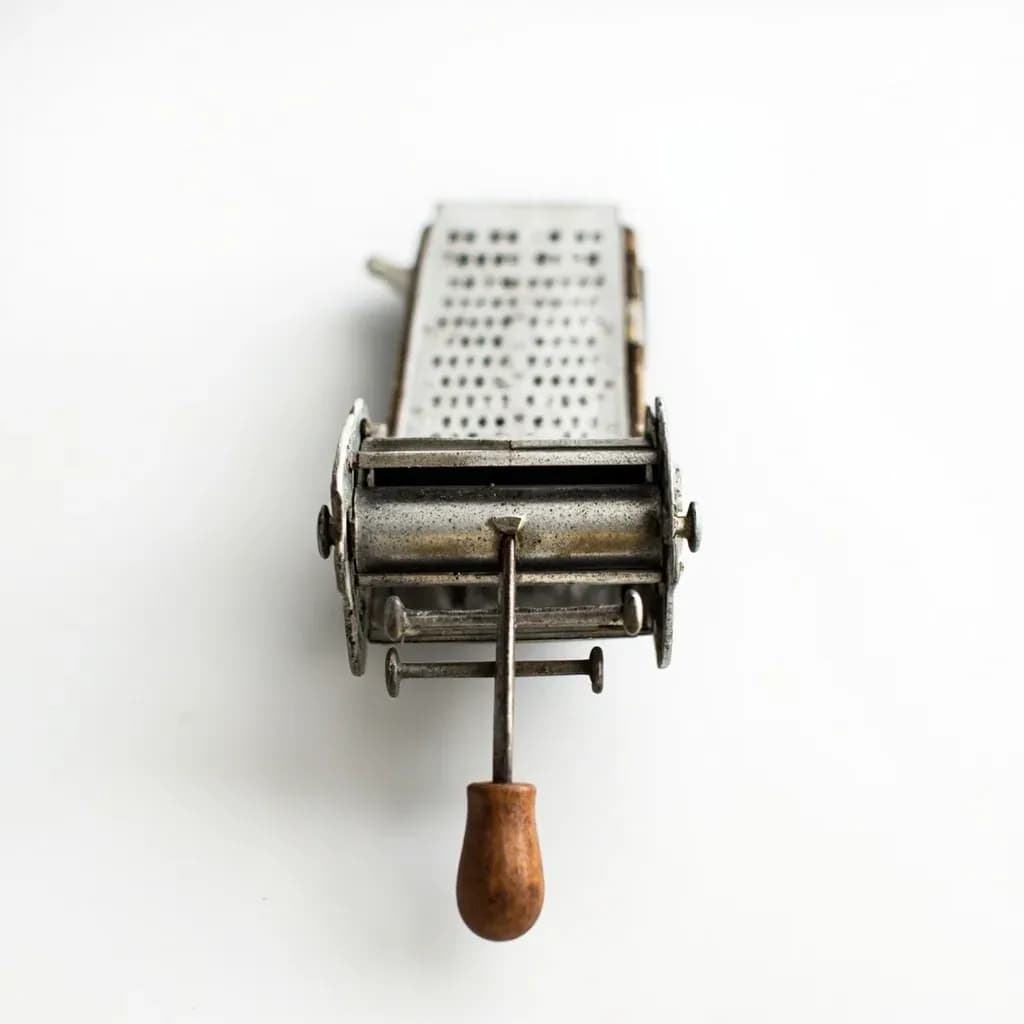
Rotary Grater
A crank-operated drum grater for shredding cheese, nuts, or chocolate without touching the blade.
A rotary grater is a handheld tool with a clamp-fed hopper and an interchangeable perforated drum turned by a side crank. Food pressed into the hopper is shaved against the spinning drum into fine or coarse shreds, depending on the drum fitted. Swappable drums make it versatile for grating cheese, slivering nuts, or grating chocolate cleanly and safely.
The rotary grater is a crank-operated tool that shears food against a spinning cylindrical drum fitted with raised stainless-steel teeth. Turning the handle does the work; the cook simply feeds a block of hard food into the hopper. The geometry matters: a box grater's downstroke yields a dense, wet pile, while a rotary drum produces a long, light, almost feathery shred that Italians call a nuvola when it lands on pasta or carpaccio — shreds that melt on contact with hot food rather than clumping.
The design is essentially French and essentially unchanged since Jean Mantelet patented his Mouli-series crank tools in 1932. Hard, cold, dry ingredients are the sweet spot; soft, wet, warm, or fibrous foods clog the teeth and turn the crank into a struggle. Within that envelope — aged cheese, cold butter, firm chocolate, day-old bread, nuts, firm root vegetables — a rotary grater is faster, cleaner, and easier on the hands than any rasp or box grater, which is why a serious kitchen keeps one within reach even after acquiring every Microplane on the market.
Alternatives
Types & varieties
Clamp- or suction-mounted with a collection tray; the standard restaurant and serious-home model.
Swappable drums for fine, medium, coarse, and sometimes slicing; common in European kitchens and the most flexible design.
The original French design (Moulinex/Mouli), tall vertical body, side handle, often in enameled metal; built to last decades.
Smaller pistol-grip model held over a bowl; better for small jobs, less stable, harder on the wrist.
A larger-drum version aimed specifically at hard aged cheeses like Parmigiano-Reggiano and Pecorino Romano, sometimes sold as a 'cheese windmill.'
Rotary grater vs. Microplane
The two are often shelved together and frequently confused, but they cut differently and are best used for different jobs. A Microplane-type rasp is a fixed flat blade of photo-etched or stamped steel with sharp raised cutting edges; the cook drags the food across it. A rotary grater is a moving drum of raised teeth; the cook turns a handle and the drum does the shearing. The Microplane excels at aromatics and small amounts — citrus zest, garlic, fresh horseradish, whole nutmeg, a tablespoon of hard cheese. The rotary grater excels at volume and uniformity — a full cup of grated cheese in under a minute, a half pound of chocolate for a torte, cold butter for scones. The Microplane gives a dry, sand-like grate; the rotary gives a long, light, pillow-like shred that melts and clings to pasta in a way finer gratings cannot. A well-equipped kitchen keeps both, and reaches for the rotary when the answer to 'how much cheese' is more than a garnish.
Drum care and longevity
The drum is the working part; everything else is housing. Sharp teeth cut cleanly and last for years of regular use; dull or bent teeth shred unevenly and turn hard cheese to powder. Three habits decide how long a rotary grater survives: keep food cold and firm, keep the body dry, and keep the drums apart when stored. Cheese fat solidifies inside the gear housing if the body is soaked; once that happens the crank stiffens and the axle begins to pit. Plastic-gear models are the usual failure point — the Mouli-type metal-bodied units and modern Cuisipro and OXO models use metal or reinforced nylon gearing and routinely last decades.
Common uses
Tips & pitfalls
- Chill the cheese well — even 15 to 20 minutes in the freezer firms it up and dramatically reduces crumbling and clogging the drum.
- Cut the cheese to fit the hopper opening; an oversized wedge will not engage the drum properly and will stall the crank.
- Turn the crank at a steady, moderate pace. Forcing the handle or jamming extra food stalls the mechanism and can bend the drum's teeth.
- Always let the drum come to a stop before lifting the pusher or hopper — lifting while spinning can crack the gears in cheaper plastic models.
- Disassemble and tap out fine residue after every use; cheese fats solidify in the mechanism, and a long soak will pit the metal and sour the next batch.
- Hand-wash and thoroughly dry the body. The crank and gear housing are the failure point on most rotary graters, and water trapped inside rusts the axles.
- If shreds are turning to powder, the drum is dull or the cheese is too cold and dry — let the cheese temper 5 minutes at room temperature before resuming.
- Avoid soft, high-moisture cheeses (fresh mozzarella, young cheddar, brie). They smear the drum instead of cutting cleanly; use a box grater or Microplane for those.
- Store drums separately from the body if you only use the tool occasionally; nested drums stored damp will develop a metallic taste and odor.
- A strip of parchment under the tray catches every last shred and slides the cheese straight into a pan without scraping.
Good to know
- Origin
- France; the rotary kitchen-grater concept was popularized in the early 1930s by Jean Mantelet, founder of the Mouli/Moulinex company.
- Patent
- Mantelet filed his original crank-driven kitchen tools in 1932; the rotary grater and rotary slicer were among the first products.
- Mechanism
- A hand-turned crank rotates a cylindrical drum fitted with raised stainless-steel cutting teeth; food is pressed against the drum and exits as shreds.
- Primary materials
- Stainless-steel grating drum; plastic or cast-aluminum housing; often a clear plastic or metal collection tray.
- Typical dimensions
- Tabletop models are roughly 20–25 cm tall with drum diameters of 6–8 cm.
- Drum textures
- Usually sold in fine, medium, and coarse variants; some sets include a slicing drum that produces ribbons rather than shreds.
- Mounting
- Most countertop models clamp to a work surface or attach via a rubber or levered suction base to keep the body steady under pressure.
- Yield
- Produces a uniform, fluffy shred of hard cheese roughly twice the volume of a box-grater shred of the same weight, because the cut is longer and airier.
- Cleaning
- Drums and tray are usually dishwasher-safe; the crank and gear housing is typically hand-wash only and must be kept dry to protect axles and bearings.
- Skill level
- Beginner; minimal force needed once the drum is sharp and the food is firm.
Also called
rotary cheese grater · drum grater · crank grater · Mouli grater
Related

Peeler
Swift blade for stripping skin off fruit and vegetables

Grater
Sharp-toothed surface for shredding cheese and vegetables

Microplane
Ultra-fine rasp for citrus zest, garlic, and hard cheese

Mixing Bowl
All-purpose bowl for combining, whisking, and tossing

Whisk
Looped wires that beat air into eggs, cream, and sauces

Spatula
Flat blade for flipping, lifting, and scraping

Slotted Spoon
Pierced spoon that lifts solids and drains the liquid behind

Wooden Spoon
Gentle, heat-friendly spoon for stirring anything