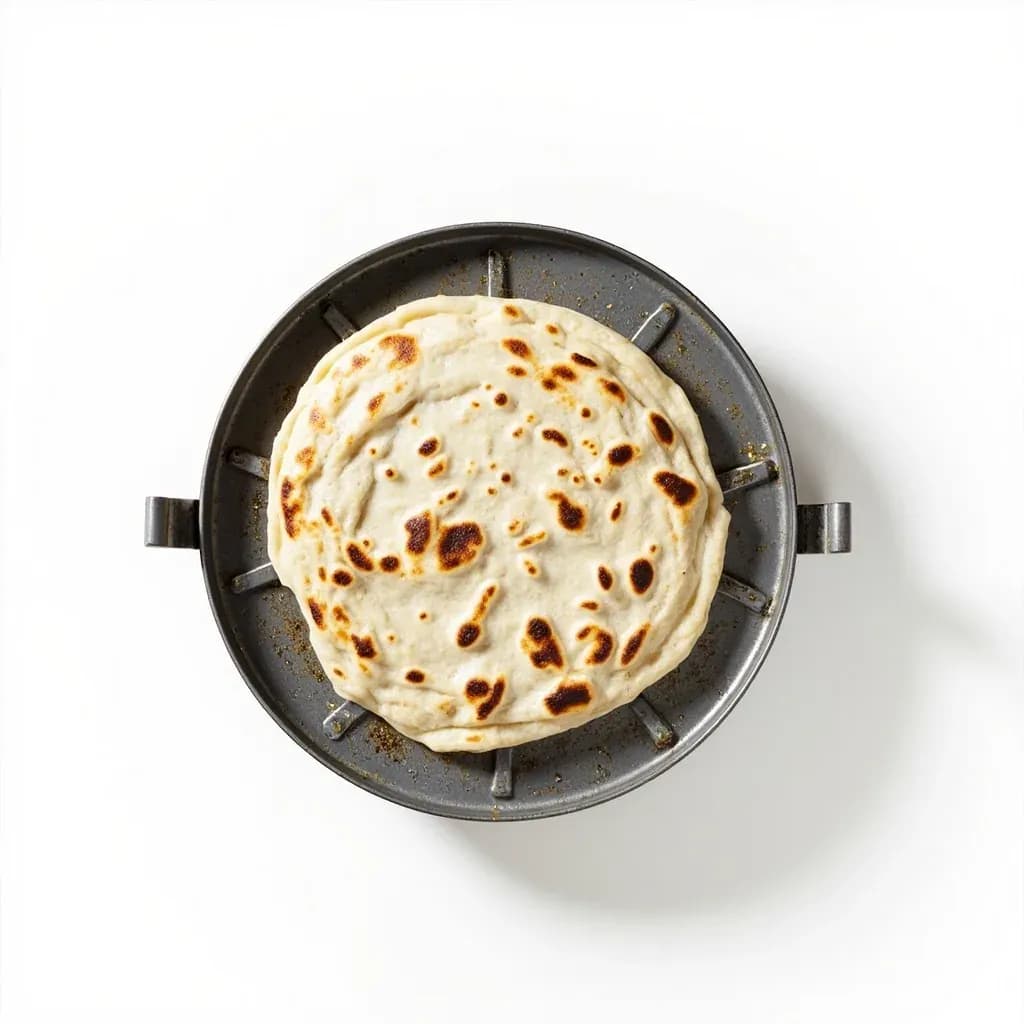
Prep Tools
Roti Press (Pelpan)
A hinged press that flattens dough balls into thin round flatbreads without a rolling pin.
A roti press is a hinged tool, usually two flat round plates joined by a lever, that flattens a ball of dough into a thin even disc when pressed shut. It speeds up shaping roti, tortillas, and similar flatbreads by replacing hand-rolling, giving uniform rounds quickly. Cast-iron and tortilla-press style versions are common, sometimes used with parchment to stop sticking.
A roti press is a hinged tool with two flat, circular plates that close together like a clamshell, flattening a ball of dough into a thin, even round in a single motion. The Pelpan, the Dutch-made cast-aluminum original, became a kitchen fixture across Suriname, Indonesia, and the wider Indo-Dutch diaspora because it removes the rolling-pin skill gap from flatbread making. The cook simply places a portioned dough ball on the lower plate, closes the lever, and lifts a perfectly round disc — a result that takes years of practice to replicate with a pin.
What separates the press from a rolling pin is the geometry of the force. A pin applies force in a chosen direction and can shear dough outward unevenly, risking the delicate air pockets between layers; a press squeezes evenly between two parallel surfaces, so soft, oil-rested doughs spread radially without losing their internal layering. That is why it excels at flaky breads like roti canai, roti prata, and stuffed paratha, where the goal is many thin sheets that puff apart during cooking rather than a single compressed disc.
The tool also behaves differently from a tortilla press. A tortilla press is a short, heavy, two-plate squash used cold on masa or rested flour dough; a roti press has a long lever that multiplies hand pressure and is light enough to be held over a flame to set the dough's surface before it goes to the pan. This combination of leverage, light weight, and heat tolerance is what gives the roti press its specific place in the kitchen.
Alternatives
Types & varieties
The classic cast-aluminum press in 25 cm and 30 cm sizes; the standard for roti canai, roti prata, and Surinamese roti
Heavier and more rust-resistant than cast aluminum; favored in professional kitchens
18–20 cm diameter for single-serve chapatis, small parathas, or portion-controlled tortillas
A related but distinct category: a hinged press with a built-in heating element; not a substitute for the manual press
Two-handed design for heavier doughs or thicker stuffed breads like murtabak and stuffed paratha
How it compares to a rolling pin and a tortilla press
A rolling pin is the right tool when you need directional control — sheeting puff pastry, stretching pizza dough into an oval, or rolling pie dough to an even thickness across a large rectangle. A roti press is the right tool when you need a uniform, round, thin disc from a soft, rested, often oiled dough. It cannot replicate the directional layering of a pin, and trying to use it for puff pastry or stiff pasta dough will only crack the dough. A tortilla press sits between the two: heavier and unlevered, designed for short, cold masa. Roti press doughs are typically warmer, oilier, and more elastic, which is why the levered, lighter design works.
- Use a rolling pin for laminated puff pastry, pie dough, and pizza.
- Use a tortilla press for masa and short, cold flour doughs.
- Use a roti press for soft, oil-rested flatbread doughs and stuffed parathas.
Doughs that work, and doughs that don't
The press rewards well-hydrated, rested, often oil-coated doughs. Lean, stiff, or cold doughs (pasta, pie crust, biscuit) resist the parallel plates and crack at the edges. Laminated yeasted doughs respond best because the oiled layers slide rather than tear. The press is also unsuited to large puff-pastry sheets — the hinge cannot produce the directional sheeting that creates the layered rise.
Common uses
Tips & pitfalls
- Portion dough into equal balls of roughly 40–60 g for roti canai so the press can spread them to the plate edge without tearing.
- Lightly oil both plates before each press; sticky dough resists release and tears at the rim.
- Close the press with firm, even pressure rather than slamming — slamming traps air pockets and can split laminated dough.
- Let laminated dough balls rest in oil for 10–15 minutes before pressing so the layers slide rather than tear at the edges.
- Keep a bench scraper or thin knife handy to lift the pressed sheet off the plate; thin dough stretches and sticks if left to sit.
- Hold the closed press over a gas flame for 2–3 seconds after pressing to set the surface and start the puff before transferring to a hot tawa.
- Avoid harsh abrasives and the dishwasher; cast aluminum scratches easily and develops a seasoned patina that improves release over time.
- Never press cold, stiff dough — let it come to room temperature or warm slightly so it spreads instead of cracking at the seam.
Good to know
- Also known as
- Roti maker, roti press, Pelpan press (after the original Dutch brand)
- Origin
- Popularized in the Netherlands and former Dutch colonies; the Pelpan brand was developed in the Netherlands for Surinamese and Indo-Dutch home cooks
- Material
- Cast aluminum or stainless steel plates; wood or heat-resistant plastic handle
- Mechanism
- Two flat circular plates joined by a hinge, with a levered handle that presses the top plate down onto the dough
- Typical diameter
- 25–30 cm pressing surface; compact models around 18–20 cm
- Heat tolerance
- Most cast-aluminum models tolerate an open gas flame or a dry tawa to set the surface or start the puff
- Cleaning
- Hand-wash only, dry immediately; abrasive cleaners scratch cast aluminum
- Skill level
- Beginner-friendly; produces uniform rounds without rolling-pin technique
Also called
pelpan · tortilla press · flatbread press · roti maker press
Related

Peeler
Swift blade for stripping skin off fruit and vegetables

Grater
Sharp-toothed surface for shredding cheese and vegetables

Microplane
Ultra-fine rasp for citrus zest, garlic, and hard cheese

Mixing Bowl
All-purpose bowl for combining, whisking, and tossing

Whisk
Looped wires that beat air into eggs, cream, and sauces

Spatula
Flat blade for flipping, lifting, and scraping

Slotted Spoon
Pierced spoon that lifts solids and drains the liquid behind

Wooden Spoon
Gentle, heat-friendly spoon for stirring anything