Prep Tools
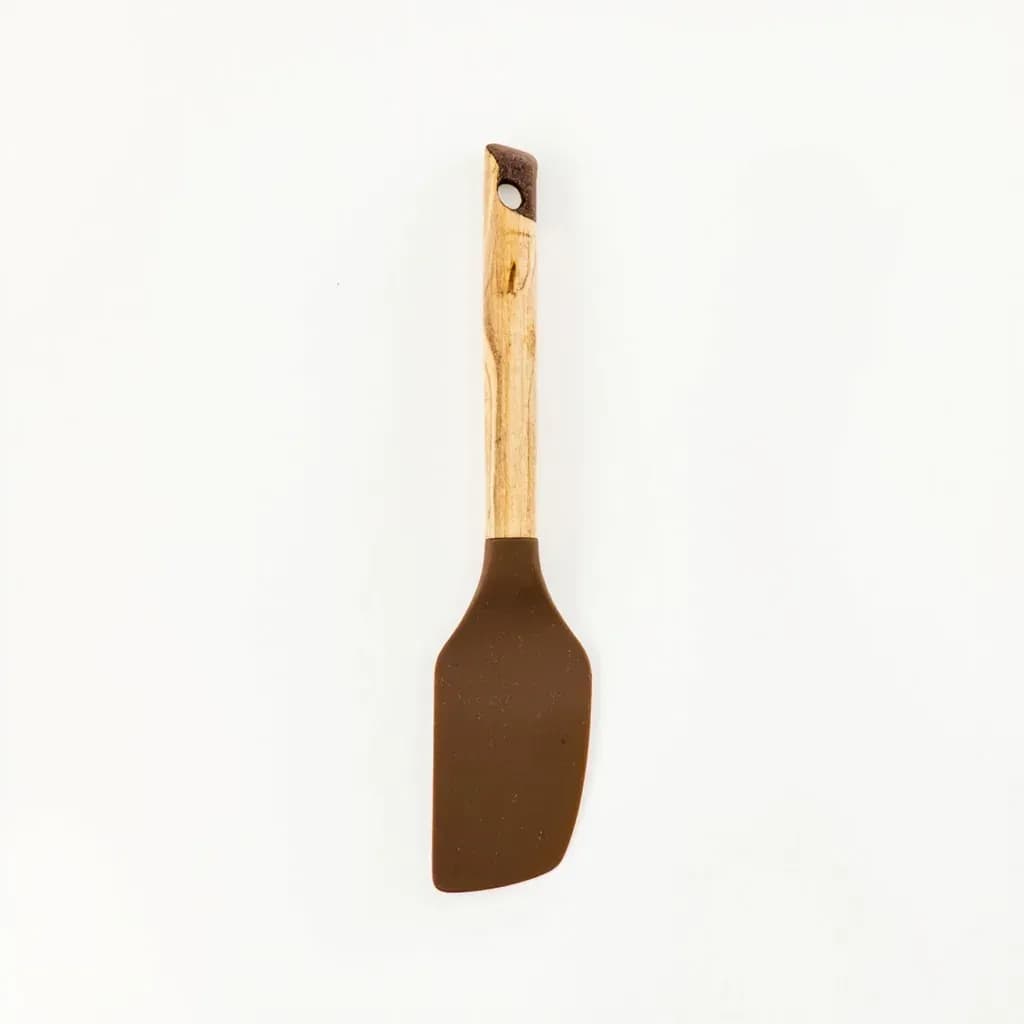
Rubber/Silicone Spatula (Scraper)
Flexible-headed scraper that bends to bowl walls, folding batter, scraping every bit of jam or sauce, and stirring custard without scratching the pot.
The rubber spatula — most often a flexible silicone scraper today — is the tool you reach for when the whisk stops being useful and the wooden spoon is too stiff. Its job is contact: conforming to the curve of a bowl, hugging the bottom of a pot, and pulling every last bit of batter, sauce, or jam into the dish where it belongs. What separates a good one from a frustrating one is the head — a flat, slightly tapered rectangle of food-grade silicone that bends without buckling and recovers its shape, so it scrapes cleanly against a curved wall instead of leaving a ribbon of batter behind.
The shift from natural rubber to food-grade silicone in the late twentieth century changed what the tool could do. Rubber handled room-temperature mixing well but softened, stained, and sometimes imparted flavor at higher heats. Silicone shrugs off temperatures up to roughly 500–600°F, doesn't react with acid, and tolerates years of dishwasher use. That is why "rubber spatula" is now something of a misnomer in most kitchens — virtually every scraper on the market today is silicone, and the older rubber versions have largely been replaced, surviving mostly in a few budget models and specialty lines.
In practice, a silicone scraper does three distinct jobs: it scrapes (cleaning bowls, pots, and jars), it folds (combining delicate mixtures without deflating them), and it stirs in tight spaces (custards, pan sauces, risotto, jam). A cook who owns only one spatula usually owns this one, and a cook who cooks seriously usually owns three or four, each shaped for a different task.
Types & varieties
Rectangular flexible head with a straight edge; the standard for scraping bowls and folding batters.
Hybrid with a curved, deeper bowl-shaped head; good for stirring sauces, deglazing, and reaching into the corners of a sauté pan.
Short (~6 in) with a narrow, slightly tapered head sized to fit inside jars of peanut butter, mayo, mustard, and other condiments.
One-piece molded, rated to 500–600°F; safe to leave in a sauté pan or pot while cooking.
Seamless head-to-handle construction; most hygienic, fully dishwasher safe, often the professional choice.
Traditional style with a removable silicone or rubber head screwed into a wooden handle; head is usually dishwasher safe, handle hand-wash only.
Standard in commercial kitchens; head color identifies use (red for raw meat, green for produce, blue for raw fish, etc.) to prevent cross-contamination.
Angled head keeps knuckles off the rim and reaches into deep pots and Dutch ovens more comfortably.
Budget alternative to silicone; lower heat tolerance (~400°F), shorter lifespan, and a tendency to feel tacky or pick up odors with use.
Choosing the right head for the job
The shape of the head matters as much as the material. A perfectly flat, straight-edged scraper is the right tool for folding whipped egg whites into a batter — its edge cuts cleanly through the mixture and its flat face lifts from the bottom in a thin sheet. A spoonula, with its deeper curved bowl, is better for stirring jam, deglazing a pan, or working in a wide sauté pan where a flat scraper can't scoop. A narrow mini scraper is sized for jars and is the only reasonable tool for getting the last quarter-cup of peanut butter out of the bottom. Most cooks benefit from owning at least two: a long-handled flat scraper for bowls, and a spoonula or jar scraper for stovetop work.
- Flat-edged head: folding, scraping bowls, smoothing batters in pans.
- Spoon-shaped head: stirring sauces, jam, custards; deglazing.
- Narrow jar head: condiments, small-batch mixing in glasses or mugs.
- Long handle (12–14 in): deep pots, Dutch ovens, and stand-bowl scraping.
Care, cleaning, and when to retire one
True food-grade silicone is one of the most durable materials in the kitchen. It does not absorb odors, does not stain permanently, and tolerates years of dishwasher cycles. The failure modes are almost always mechanical: the edge gets nicked by a knife and the nick slowly tears; the joint between a two-piece head and handle traps moisture and food; or a low-grade TPE scraper begins to feel sticky, pick up smells, or lose flexibility. White or translucent silicone shows stains less than bright colors, but discoloration from tomato, turmeric, or beet is cosmetic only and does not affect performance.
- Hand-wash wood-handle versions; the wood will crack and the joint will loosen in the dishwasher.
- Inspect the edge periodically for nicks; once cut, silicone tears propagate quickly.
- A sticky, smelly, or stiff scraper is usually low-grade TPE — replace it.
- Stains from strongly colored ingredients are harmless; a baking-soda paste will lift most of them.
Common uses
Tips & pitfalls
- Choose one-piece molded silicone for any stovetop work — two-piece (head screwed into handle) versions trap food and moisture at the joint and usually can't handle direct heat.
- Buy at least two: a long flat scraper for bowls and a short one for jars and condiments.
- Never hold a silicone scraper over an open flame or rest it on a burner — it will scorch even within its rated temperature range.
- Don't scrape hot pans with the edge of a thin silicone head at sharp angles; the edge can eventually tear or split along it.
- Keep silicone away from sharp knives, serrated bread knives, and bench-scraper edges — once nicked, silicone tears propagate quickly.
- Color-code your home set the way restaurants do — for example, one red scraper dedicated to raw meat tasks — to prevent flavor and contamination crossover.
- Use the folding motion: hold the spatula vertical, cut down through the center of the mixture, scrape along the bottom of the bowl, and fold the lifted portion over the top, rotating the bowl a quarter turn each pass.
- If a silicone scraper feels tacky, develops an off smell, or loses flexibility within a few months, it is probably TPE, not silicone — retire it.
Good to know
- Also known as
- Bowl scraper, rubber scraper, scraper spatula, batter scraper
- Primary materials
- Food-grade silicone (modern standard); natural or synthetic rubber (older and lower-heat); thermoplastic elastomer (budget alternative)
- Heat tolerance
- Food-grade silicone ~400–600°F (200–315°C); natural rubber ~200–250°F (95–120°C); low-grade silicone or TPE degrades above ~350°F
- Typical lengths
- 8–14 in overall; mini/jar sizes 6–8 in; full-size 11–13 in
- Head shapes
- Flat-edged scraper (classic), spoon-shaped, tapered/concave, jar-shaped narrow, mini round
- Handle materials
- One-piece molded silicone, plastic, stainless steel, or wood (removable-head style)
- Dishwasher safe
- All-silicone and plastic-handle versions: yes. Wood-handle versions: hand-wash only.
- Color-coding
- Common in white, red, blue, black; in commercial kitchens colors are assigned by task (HACCP system) to prevent cross-contamination
- Non-reactive
- Yes — silicone and rubber do not react with acidic ingredients and do not transfer flavors or odors
- Price range
- ~$5–$25 for consumer models; professional restaurant-grade up to ~$30–$40
- History
- Natural-rubber scrapers existed in the late 19th and early 20th centuries; modern silicone versions emerged after food-grade silicone was developed in the 1970s and reached home kitchens in the 1980s–1990s
Also called
bowl scraper · rubber spatula · silicone scraper · spatula scraper · batter spatula