Prep Tools
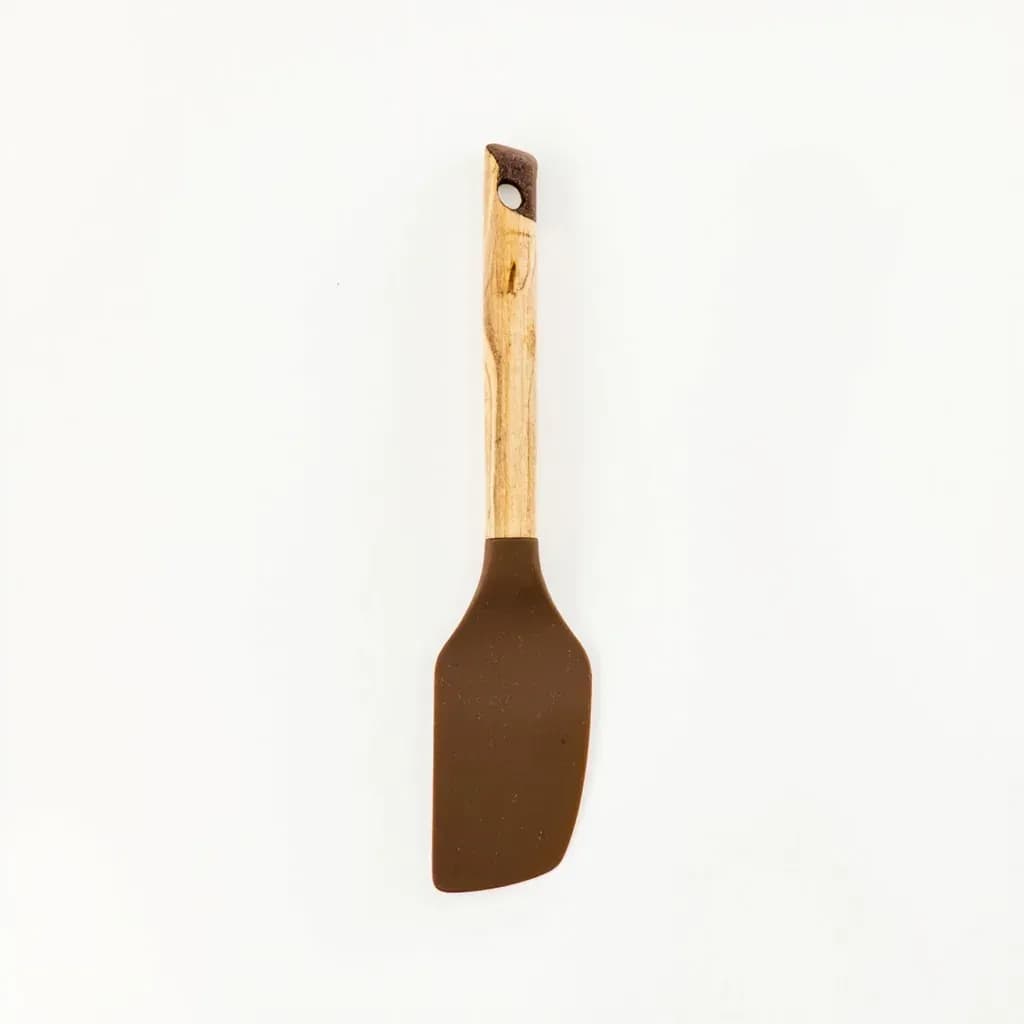
Silicone Spatula
A heat-resistant flexible spatula for scraping bowls, folding batter, and stirring sauces.
A silicone spatula is a flexible, heat-resistant spatula with a soft silicone blade on a handle, used to scrape bowls clean, fold batters gently, and stir sauces without scratching nonstick pans. Its pliable edge conforms to curved surfaces, getting every bit of mixture out of bowls and jars. Unlike older rubber spatulas, food-grade silicone tolerates high cooking temperatures without melting.
A silicone spatula is a hand tool with a flexible, food-grade silicone head—molded as one piece with the handle or bonded to a rigid core—used for scraping, folding, stirring, and spreading. The head is a synthetic polymer of silicon and oxygen that tolerates sustained heat well beyond natural rubber or most plastics, and it is chemically inert, so it will not interact with acidic sauces, wine reductions, or baking-soda batters. That combination of heat tolerance and chemical inertness is what made silicone the default spatula material once nonstick cookware became standard in the late twentieth century, largely replacing the natural-rubber spatulas that preceded it.
How the head is built sets the practical limits. Silicone is produced in a range of durometers, from very soft (for sweeping whipped egg whites through a bowl without deflating them) to quite firm (for sautéing, where you want an edge that pushes food rather than bending under it). Most heads are reinforced internally with nylon or stainless steel, and the core dictates the heat ceiling: nylon-cored heads typically cap near 400°F (200°C), while stainless-cored stir spoons are rated to 600°F (315°C) and beyond. Handle attachment is the usual weak point—one-piece molded spatulas have no seam to fail, but two-piece versions with hard plastic or wood handles can wick water into the joint, loosen, or crack over time.
A silicone spatula is the right tool whenever you need a soft, non-scratching edge against a nonstick pan, an enameled surface, or the curved wall of a mixer bowl, or whenever you need something that can sit in a warm pot without softening or off-gassing. It is not designed for very low temperatures, where silicone becomes brittle and can crack, and it should never touch direct flame or a broiler element.
Alternatives
Types & varieties
Long, thin, flexible head with a straight edge; the workhorse for cleaning mixing bowls and folding batter.
Curved spoon-like bowl at the tip; ideal for scooping the last of batters, sour cream, or pan sauces.
Long, narrow, slim-profile head designed to reach down into jars of mayonnaise, peanut butter, or yeast.
Small 6–8 in version for spice jars, small bowls, or scraping the inside of a food processor bowl.
Long, narrow blade with an offset handle used for spreading batters and smoothing frosting on cakes.
Stainless-steel-cored, all-silicone spoon built for continuous stovetop stirring at full pan temperatures.
Silicone head and handle molded as a single unit with no seam; eliminates the crevice where food can lodge and is generally the most durable construction.
Silicone head bonded to a rigid plastic or wood handle; lighter, but the head-to-handle joint is the usual failure point.
Flexible-headed scraper that bends to bowl walls, folding batter, scraping every bit of jam or sauce, and stirring custard without scratching the pot.
Reading the label: FDA vs. LFGB and what the core is made of
Two details on the spec sheet or hangtag tell you almost everything you need to know about whether a silicone spatula is worth buying. The first is the food-contact certification, and the second is the core material hidden inside the head.
- FDA-grade silicone meets the U.S. food-contact standard; LFGB-grade (German) is stricter on extractables and is the better proxy for a clean, plasticizer-free silicone. When a maker cites LFGB, you can generally trust the head.
- Very cheap, unbranded silicone is often filled with lower-grade polymers. The tell is a greasy feel or a film that transfers to paper after the spatula has been washed—that is plasticizer bleed, and the tool should be discarded.
- A nylon core caps usable heat around 400°F (200°C) and can deform if left resting against a hot pan wall. A stainless-steel core is what lets premium stir spoons advertise 600°F (315°C) ratings.
- Wood-handled silicone spatulas are not dishwasher-safe—hand-wash and dry upright, or the handle will split along the grain long before the silicone head wears out.
Choosing the right durometer for the job
Durometer is the measure of how firm a silicone head is. It is the single biggest variable in how a spatula actually feels and behaves, and it is worth matching to the task rather than buying one tool for everything.
- Soft heads (low durometer) bend easily and conform to the curve of a bowl, which is what you want when folding whipped egg whites or cream into a heavier base—stiffness would knock the air out.
- Medium heads are the everyday all-purpose choice: firm enough to push vegetables around a sauté pan, soft enough to scrape a bowl clean.
- Firm heads (high durometer) behave more like a turner than a scraper; they are useful for pan work and for spreading thick frostings or ganache smoothly.
- For nonstick cookware specifically, prefer medium-soft over very firm—any hard edge, even silicone, can eventually mark delicate coatings if you press hard.
Common uses
Tips & pitfalls
- Match the durometer to the job: soft heads for folding and bowl-scraping, firm heads for sautéing and pan work.
- Check the temperature rating before leaving the spatula resting in a hot pan; stainless-cored models run hotter than nylon-cored ones.
- Avoid direct flame contact and the heating element of a broiler—the silicone can scorch even when the rated ceiling is well above the ambient pan temperature.
- Skip abrasive scrubbers and steel wool on the head; they rough the surface and make it stain and hold odors more readily.
- To remove strong odors or stains (curry, tomato, turmeric), make a baking-soda paste and let the head sit in it overnight, or simmer the head in water with a tablespoon of baking soda for a few minutes.
- Buy only spatulas advertised as FDA- or LFGB-grade silicone; bargain-bin silicone can contain plasticizers that migrate into fatty foods.
- If a silicone head ever feels greasy or leaves a sheen on a paper towel, that is plasticizer bleed from low-grade material—retire it.
- Inspect the head-to-handle joint every few months; once water gets in, it cannot be fully cleaned out and the bond will eventually fail, usually mid-recipe.
- Wood-handled silicone spatulas belong in the sink, not the dishwasher—hand-wash and dry upright so the handle does not split.
Good to know
- Material
- Food-grade silicone head (a synthetic polymer of silicon and oxygen), typically over a rigid nylon or stainless-steel core; handles may be silicone-wrapped steel, hard plastic, or wood.
- Heat resistance
- Food-grade silicone is generally rated for 400–600°F (200–315°C); the exact ceiling depends on the maker and the core—stainless-cored spatulas run to the higher end, nylon-cored ones to the lower.
- Cold behavior
- Becomes brittle well below freezing and can crack; not designed for cryogenic or freezer work.
- Length range
- Standard spatulas 8–14 in (20–36 cm); mini jar versions 6–8 in (15–20 cm); full-size stir spoons up to 16 in (40 cm).
- Chemical reactivity
- Inert with acidic ingredients (citrus, tomato, wine) and with batters containing baking soda or vinegar; will not leach flavor or color into food.
- Surface compatibility
- Will not scratch nonstick coatings, enameled cast iron, or seasoned carbon steel when used as intended.
- Dishwasher safe
- All-silicone and silicone/stainless versions usually are; wood-handled and some plastic-handled models are top-rack only or hand-wash only—check the maker's guidance.
- Standards
- Reputable spatulas are made from FDA- or LFGB-grade silicone; LFGB (the German food-contact standard) is the stricter of the two and a useful proxy for purity.
Also called
Rubber Spatula · Teigschaber · Bowl Scraper
Related

Peeler
Swift blade for stripping skin off fruit and vegetables

Grater
Sharp-toothed surface for shredding cheese and vegetables

Microplane
Ultra-fine rasp for citrus zest, garlic, and hard cheese

Mixing Bowl
All-purpose bowl for combining, whisking, and tossing

Whisk
Looped wires that beat air into eggs, cream, and sauces

Spatula
Flat blade for flipping, lifting, and scraping

Slotted Spoon
Pierced spoon that lifts solids and drains the liquid behind

Wooden Spoon
Gentle, heat-friendly spoon for stirring anything