Prep Tools
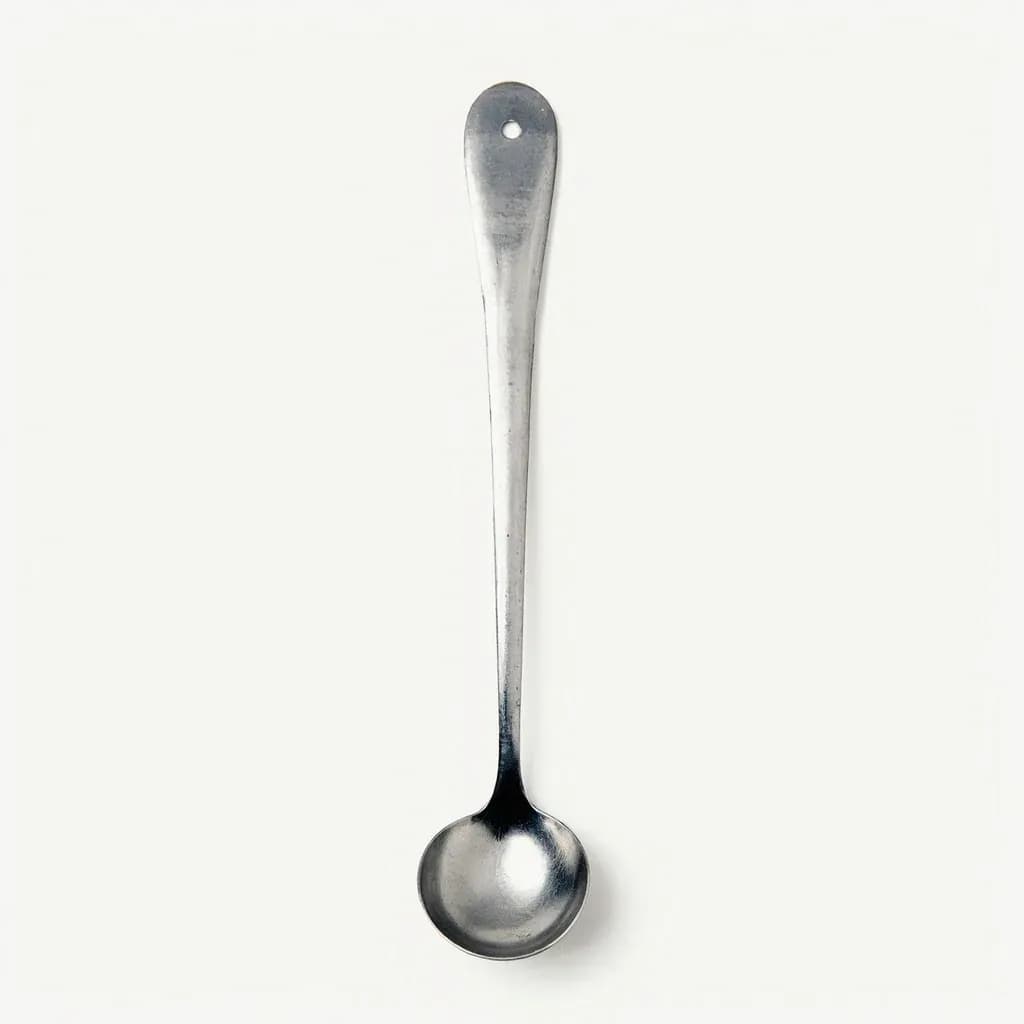
Saucier Ladle (Spouted)
A ladle with a pouring lip and often a strainer edge for portioning and saucing precisely.
A spouted saucier ladle is a small to mid-size ladle whose bowl has a shaped pouring lip, sometimes on both sides, for drizzling sauces, jus, and dressings with control. The directed spout lets the cook plate neat ribbons and pools of sauce without drips, and some have a notched rim to hold back solids. It is a finishing and plating tool in saucier and pastry work.
The saucier ladle is the precision instrument of the sauce station, designed to do what a round-bowled soup ladle cannot: deliver a clean, controlled ribbon of liquid exactly where you want it. Its defining feature is the forward pour spout — a small, formed lip on the rim of a shallow, oval bowl that shapes the flow into a steady stream rather than a sloppy cascade. In a professional kitchen, this means a single motion can finish a plate with a precise swoosh of demi-glace, a measured pool of beurre blanc, or a controlled pour of consommé, with minimal drips, no splashing, and no waste. Outside the pass, the same tool fills ramekins, portions custards, and bastes roasts with equal accuracy.
A round soup ladle is a volume mover; a saucier ladle is a portioning tool. The difference is bowl geometry and lip — the shallow, sloping sides of a saucier pan inspired the ladle's shape, and that shape gives the cook visual feedback about how much liquid is leaving the bowl. Most commercial sizes run from 1 to 6 fluid ounces (30 to 180 mL), with the 1-ounce (30 mL) size being the workhorse for saucing plates and the 4- to 6-ounce (120 to 180 mL) size handling stocks, soups, and basting. The bowl itself often carries a second feature on the side opposite the spout: notches or perforations that act as a built-in strainer, catching peppercorns, herb stems, and bay leaves as you lift aromatics out of an infused liquid.
Material and construction matter as much as shape. One-piece stamped stainless steel (18/10 or 18/8) is the line standard — no welds, no crevices, NSF-listed, and durable enough to take any heat a kitchen can throw at it. Plastic and high-heat nylon versions exist for non-stick and enameled cookware, and color-coded models let allergen-managed operations assign a dedicated tool to gluten-free, raw protein, or vegetable stations. Whichever you choose, the ladle is meant to be hung by its handle, dipped, and tilted — not used as a stirring spoon or a measuring cup.
Alternatives
Types & varieties
Plain pouring lip, no notches; the everyday portioning workhorse.
Notches on the side opposite the spout catch peppercorns, herb stems, and bay leaves while ladling stocks and consommés.
Holes punched through the bowl for draining blanched vegetables, dumplings, or poached items.
Solid-colored handle and bowl used in commercial kitchens to separate allergens (purple for gluten-free, red for raw meat, green for vegetables).
Bent end that hooks over a pot rim to keep the ladle from sliding in.
Compact 4 to 6 in handle for shallow pans, saucier pans, and tabletop use.
Bowl and handle formed from a single sheet; no welds or crevices, easiest to sanitize.
Safe for non-stick and enameled cookware; typically rated to roughly 400°F.
Mirror-image version with the spout on the opposite side for left-handed cooks; less common and usually a special order.
Pouring technique
The spout turns the ladle into a precision instrument, but only if you use it correctly. A good pour starts below the surface and finishes in the air.
- Dip the spout just below the liquid surface, then tilt the bowl to start the pour — this prevents a slug of air breaking the stream and gives an even flow from the first second.
- Lift and tilt as the bowl empties, ending the pour with a short wrist flick to drop the last of the sauce off the lip cleanly.
- For thin sauces and consommés, hold the ladle low and pour from a short drop; for thick reductions, pour from higher so the sauce falls cleanly off the spout.
- For plate work, anchor your elbow and move the plate with your free hand rather than chasing it with the ladle — steadier, faster, and more accurate.
Sizing guide
Match the ladle to the portion, not the other way around.
- 1 oz (30 mL) — finishing sauces on plates, filling small molds, portioning batters into muffin tins.
- 2 oz (60 mL) — purées, bisques, plating soups in shallow bowls.
- 4 oz (120 mL) — stocks, broths, basting, and general service work.
- 6 oz (180 mL) and up — large-batch ladling, deep pots, catering volumes.
Care and maintenance
A saucier ladle has one moving part: you. Keep the bowl round and the spout aligned, and the tool will pour true for years.
- Wash and dry the bowl after every use; dried sauce builds up around the spout and eventually distorts the stream.
- Polish mirror-finish bowls with a soft cloth before service — scratches and film show sauce residue to the guest.
- Inspect the seam at the handle base on welded models; if it darkens, roughens, or traps residue, retire the ladle to non-food use.
- Store hanging by the handle loop or hook, never nested in a drawer where the spout can be knocked out of alignment.
Common uses
Tips & pitfalls
- Begin each pour with the spout just below the surface and finish with a short wrist flick — the flick drops the last of the sauce off the lip cleanly, with no drips running back down the bowl.
- Use the notched or perforated side as a built-in strainer for stocks seasoned with whole peppercorns, parsley stems, or bay leaves.
- Choose one-piece stamped stainless for line and garde-manger work; welded bowls can hide residue in the seam and are harder to pass health inspection.
- Reserve a dedicated color-coded ladle for allergens and another for raw proteins to prevent cross-contamination in busy services.
- Match the ladle to the job: keep a 1 oz (30 mL) saucing ladle for plates and a 4 to 6 oz (120 to 180 mL) ladle for stocks and soups.
- Don't use a metal ladle in non-stick or enameled cookware — switch to high-heat nylon or silicone, which won't score the surface.
- Never use a saucier ladle to stir — scraping the spout along a pan bottom bends the lip and wrecks the pour.
- Hang by the handle's hook or loop, never by the bowl — a bent bowl throws off the spout alignment and ruins the stream.
Good to know
- Tool type
- Spouted portioning ladle, named for its use with the saucier pan and similar shallow, curved cookware.
- Common capacities
- 1, 2, 4, and 6 fl oz (30, 60, 120, 180 mL) are standard commercial sizes; specialty sizes run 0.5 to 8 oz.
- Standard material
- 18/10 or 18/8 stainless steel, one-piece stamped or welded.
- Handle length
- Typically 8 to 12 in (20 to 30 cm); short versions of 4 to 6 in exist for shallow pans.
- Spout and strainer
- Forward pour lip opposite notched or perforated 'strainer' edges on the back of the bowl.
- Heat tolerance
- Stainless tolerates any stovetop or oven heat; plastic versions are generally rated to 400°F / 200°C.
- Color coding
- Plastic and coated versions come in solid colors (red, blue, green, yellow, purple, white, black, tan) for allergen and dietary separation.
- Certifications
- Commercial units are commonly NSF-listed for sanitary food contact.
Also called
spouted ladle · saucier ladle · sauce ladle · drizzle ladle
Related

Peeler
Swift blade for stripping skin off fruit and vegetables

Grater
Sharp-toothed surface for shredding cheese and vegetables

Microplane
Ultra-fine rasp for citrus zest, garlic, and hard cheese

Mixing Bowl
All-purpose bowl for combining, whisking, and tossing

Whisk
Looped wires that beat air into eggs, cream, and sauces

Spatula
Flat blade for flipping, lifting, and scraping

Slotted Spoon
Pierced spoon that lifts solids and drains the liquid behind

Wooden Spoon
Gentle, heat-friendly spoon for stirring anything