Prep Tools
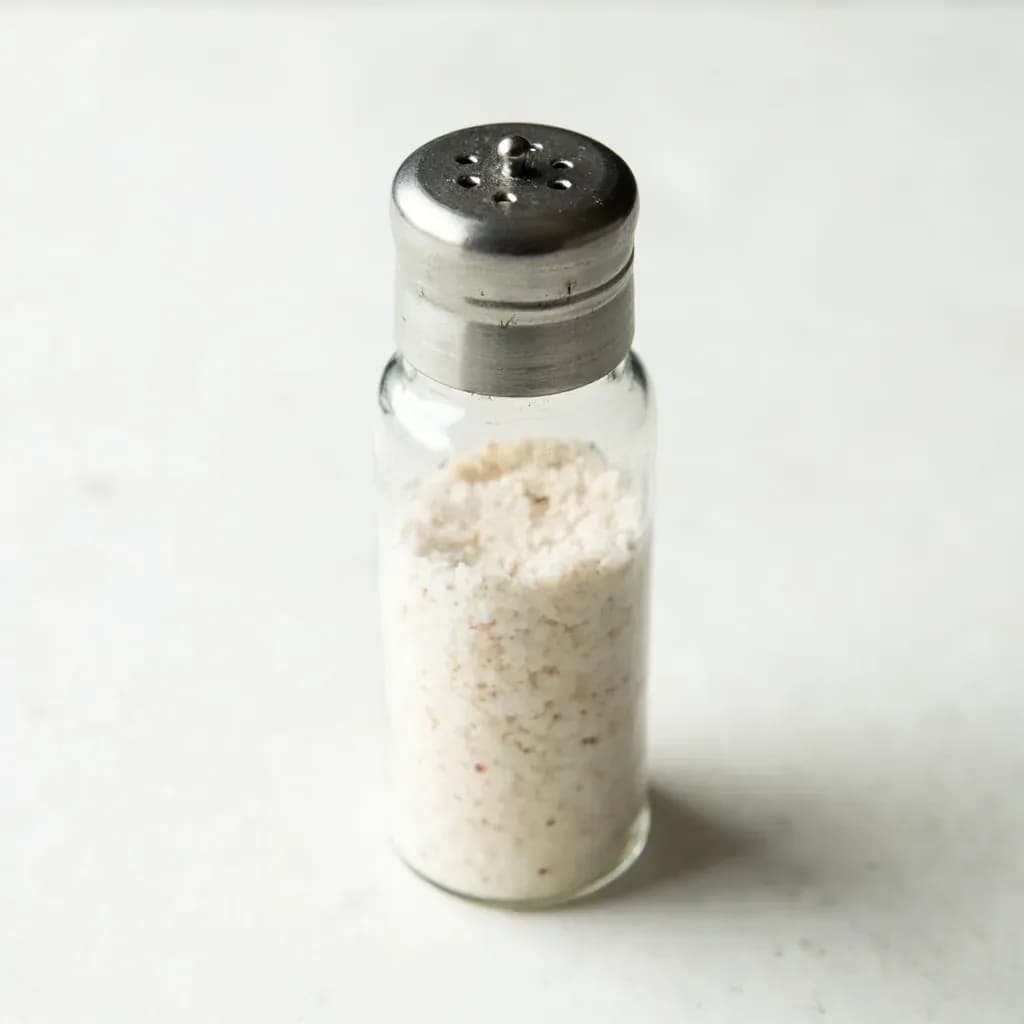
Coarse Salt Shaker
A perforated-lid bottle for evenly dispensing coarse salt, spice rubs, or seasoning blends over food.
A coarse salt shaker is a refillable bottle with a wide-hole perforated lid that distributes larger salt crystals, rubs, and seasoning blends without clumping. Cooks use it to season evenly from height while grilling or finishing dishes. The larger holes distinguish it from a fine table salt shaker and suit barbecue and dry-rub work.
A coarse salt shaker is a perforated-lid dispenser engineered around a single mechanical truth: hole diameter has to match grain diameter. Standard table-salt shakers were built for the fine, uniform ~0.3 mm crystals of refined iodized salt, so their tiny ~0.5–1 mm openings choke instantly on the 2–4 mm grains of kosher or coarse sea salt. The coarse salt shaker solves that by enlarging each perforation — usually to 2–3 mm — and clustering six to twelve of them in a stainless or chrome-plated cap that screws onto a glass, plastic, or stainless body. In practice it behaves less like a seasoning tool and more like a metering device: it does not grind, refine, or improve the salt, it simply releases an already-coarse product at a controlled, repeatable rate.
Where the coarse salt shaker earns its place in a kitchen is in the middle of the seasoning spectrum. A fine table shaker gives you a dusting, a salt mill or grinder gives you a fresh crush, and a salt cellar lets a cook pinch delicate finishing flakes between fingers. The coarse shaker fills the gap for high-volume, mid-coarseness work: salting roasting pans of vegetables, seasoning pasta water fast, distributing a dry rub evenly, or finishing fries and popcorn at the pass. It is the working cook's seasoning tool, not a finishing one.
The category itself is a late-20th-century home-kitchen development, tracking the rise of kosher salt in American cooking from the 1980s onward. Restaurant supply catalogs (Tablecraft, American Metalcraft, Vollrath, Carlisle) and housewares brands (OXO, RSVP, Kilner) now sell both the bottles and, crucially, replacement caps — because the cap is almost always the first component to rust, clog, or lose a hole.
Alternatives
Types & varieties
Small glass bottle, chrome-plated top, 6–8 medium holes; the classic American table shaker.
Larger 4–8 oz capacity, preferred in home kitchens; lids often sold separately so worn caps can be swapped.
More durable, rust-resistant cap; standard in restaurant back-of-house.
Lightweight and break-resistant; common for casual settings, outdoor dining, and kids' tables.
Single slot opens sideways, allowing larger flake salts to pass through the gap.
Modern takeout or take-home bottle with a peel-off seal and a small spout; not a true perforated shaker but often used as one.
Decorative tabletop version; cap is replaceable and usually dishwasher-safe.
Uses a coarse grinding disc instead of holes for very chunky crystals or salt-and-peppercorn blends.
Choosing the Right Hole Size
Hole diameter is the only specification that actually matters on a coarse salt shaker, and it is worth checking before you buy. Holes around 2 mm handle most kosher and coarse sea salt cleanly; under 1.5 mm and you get the same jamming problem a fine shaker has. Over 4 mm and the salt pours in clumps, not grains, which defeats the metering purpose entirely. If you cook across both kosher and coarse sea salt, aim for a cap in the 2–3 mm range — it is the sweet spot for the widest range of mid-coarse products.
When a Coarse Salt Shaker Is the Wrong Tool
The coarse shaker is a mid-coarseness workhorse, and using it outside that lane produces predictable failures. Flake salts (Maldon, Jacobsen, fleur de sel) shatter into dust inside any perforated cap and clog the holes within a few shakes — serve those from a salt cellar with a small spoon or pinch. A salt mill is the right tool when you want fresh-cut crystals and adjustable grind. And a fine table shaker is correct when seasoning to taste at the table, where guests want a quick, even dust rather than a coarse sprinkle.
- Flake and pyramid salts → use a salt cellar or pinch with fingers.
- Very chunky blends with peppercorns or large herbs → use a grinder-style cap or a spoon.
- Fine finishing on a plated dish → fine shaker or pinching from a cellar.
- Wet or oil-based rubs → spoon or rub by hand; they clog perforations.
Common uses
Tips & pitfalls
- Match hole size to grain: about 2 mm for kosher and coarse sea salt; under 1.5 mm causes jamming, over 4 mm pours in clumps.
- Never fill a coarse salt shaker with fine iodized table salt — it cakes in the larger openings and will not shake out evenly.
- Keep a few grains of dry rice or a silica packet in the shaker to absorb humidity; clumping is the single most common problem.
- Tap the side of the shaker over the food rather than shaking vertically for a more controlled, even sprinkle and to avoid dumping a clumped plug.
- If flow stops, clear individual holes with a pin or wooden skewer instead of banging the shaker, which can crack glass or deform the cap.
- Hand-wash and dry the cap immediately; chrome-plated caps will rust at the perforations if stored wet.
- Never refill while the cap is still damp — trapped moisture fuses the salt into a solid plug that no amount of tapping will dislodge.
- Reserve a dedicated shaker for flavored salts (smoked, herb, citrus zest blends) to prevent cross-contamination of plain salt.
Good to know
- Also called
- Kosher salt shaker, sea salt shaker, coarse-grind salt shaker
- Defining feature
- Perforated cap with enlarged holes (typically ~2–3 mm) sized for coarse-crystal salt
- Standard shaker hole size for comparison
- ~0.5–1 mm — too small for kosher or coarse sea salt
- Body material
- Glass, clear SAN/Tritan plastic, stainless steel, or ceramic
- Cap material
- Stainless steel or chrome-plated plastic with punched or drilled perforations
- Typical capacity
- 2–6 oz (60–180 ml) at home; 1–2 oz diner-style refillables
- Best salt pairing
- Kosher salt (Diamond Crystal, Morton), coarse sea salt, pickling salt, coarse grinder blends
- Not suitable for
- Fine table salt, finely ground iodized salt, flake salts like Maldon, or moisture-heavy blends
Also called
Rub Shaker Bottle · Shaker Bottle · Seasoning Shaker
Related

Peeler
Swift blade for stripping skin off fruit and vegetables

Grater
Sharp-toothed surface for shredding cheese and vegetables

Microplane
Ultra-fine rasp for citrus zest, garlic, and hard cheese

Mixing Bowl
All-purpose bowl for combining, whisking, and tossing

Whisk
Looped wires that beat air into eggs, cream, and sauces

Spatula
Flat blade for flipping, lifting, and scraping

Slotted Spoon
Pierced spoon that lifts solids and drains the liquid behind

Wooden Spoon
Gentle, heat-friendly spoon for stirring anything