Prep Tools
Sanitizer Test Strips
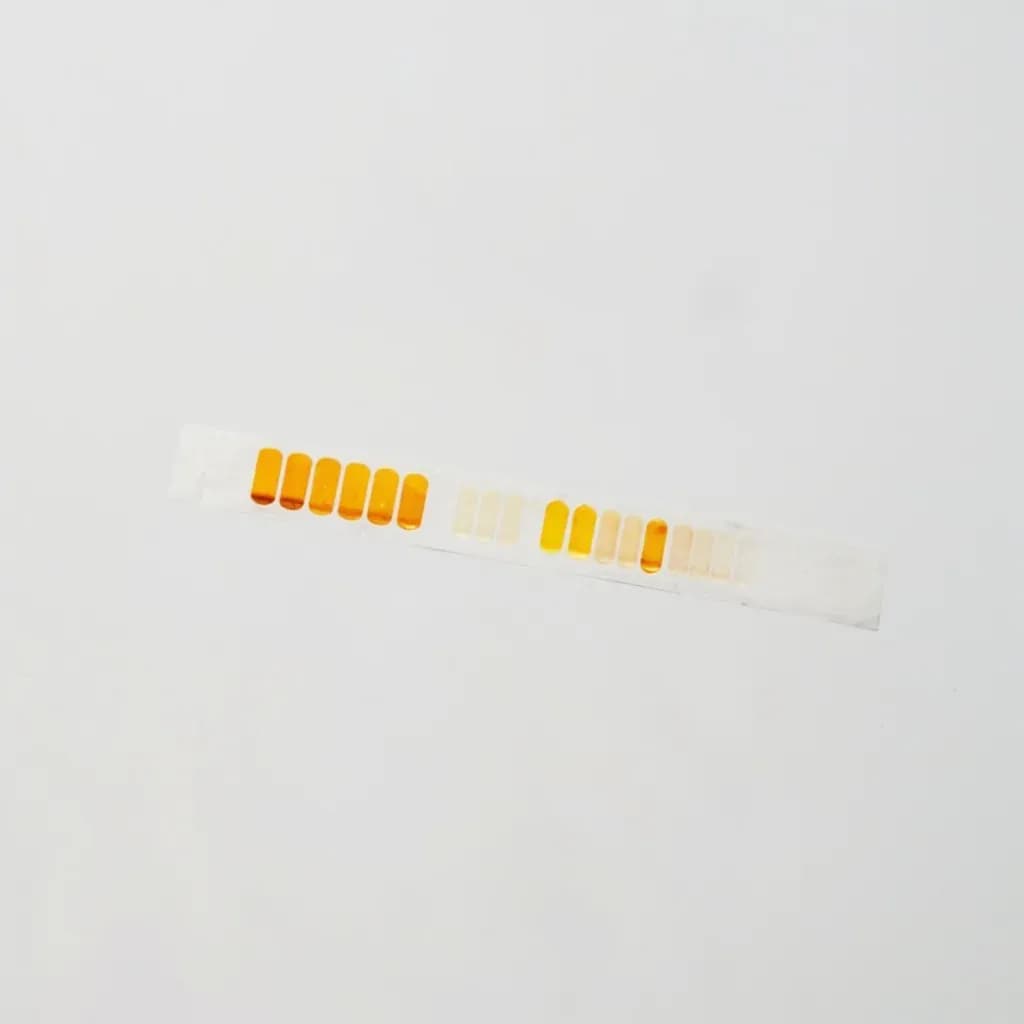
Color-changing paper strips that confirm a sanitizing solution is at the safe concentration.
Sanitizer test strips are treated paper that change color when dipped in a chlorine, quat or iodine solution, letting kitchens verify the sanitizer is mixed to a food-safe concentration. They are part of routine food-safety checks for the third sink, wiping cloths and surface buckets. Matching the strip against a color chart gives a quick parts-per-million reading.
A sanitizer test strip is a single-use paper or plastic strip with a chemically reactive pad at one end that changes color when dipped into a sanitizing solution. The resulting hue is matched against a printed color chart supplied with the strip vial, and the color block nearest to your pad tells you the active concentration in parts per million (ppm). Without that confirmation, you are guessing whether your chlorine, quat, or iodine bath is strong enough to kill pathogens — or so strong that it is corroding metal, off-gassing into the dining room, or leaving residues on food-contact surfaces.
Strips are not sanitizers; they are measuring instruments. The reactive pad contains reagents formulated to react with a specific active ingredient, so a chlorine strip and a quat strip are not interchangeable, and putting the wrong one into a bucket gives a meaningless (and often falsely reassuring) color. Used properly, they are the fastest, cheapest way for a cook, manager, or health inspector to verify that a three-compartment sink, spray bottle, or wiping-cloth bucket is doing the job the label on the sanitizer claims it is.
For a working kitchen, the discipline is the point. A strip in a log book at the start of every shift — and again after a heavy prep push — is the difference between a kitchen that passes inspection and one that gets cited, fined, or shut down. In the home, the same strip tells a fermenter, cheesemaker, or home brewer that the surface they are about to trust with a SCOBY or rennet is actually clean, rather than just rinsed.
Alternatives
Types & varieties
Used for bleach/sodium hypochlorite sanitizing baths; the most common strip in low-cost warewashing setups, targeting a 50–100 ppm band.
For QAC-based sanitizers such as alkyl dimethyl benzyl ammonium chloride; target 200–400 ppm. Standard in most commercial spray-and-wipe programs.
For iodophor sanitizers; more common in dairies, breweries, and cheesemaking operations than in general restaurant kitchens.
Used in produce wash water and some meat and poultry plants; more common in processing environments than on the line.
For peroxide-based sanitizers; niche in food service, more common in aseptic packaging and beverage facilities.
Combine sanitizer concentration with water hardness or alkalinity on a single strip; typical in food plants monitoring boiler and CIP water.
Matching the Strip to the Sanitizer
The single most common field error is reaching for whatever vial is closest to the sanitizer bucket. Each reactive pad is formulated to react with a specific active — chlorine, quat, iodine, PAA, or peroxide — and the color chart on the vial is calibrated to that chemistry. A chlorine strip dipped in a quat solution will not give a meaningful reading; it may drift to a color that looks plausible on the wrong scale, or stay flat, and either outcome tells you nothing about what is actually in the bucket. If your kitchen switches sanitizer brands or chemistries, the strip vial has to switch with it. Color the cap, or keep each vial in a zip bag with the matching product's SDS, so there is no ambiguity during a busy service.
- Chlorine strips: yellow-to-pink or yellow-to-purple scale for sodium hypochlorite, depending on manufacturer.
- Quat strips: yellow-to-blue scale for QAC sanitizers.
- Iodine strips: yellow-to-blue or yellow-to-dark-purple, calibrated for iodophors (not tincture of iodine) and based on the starch-iodine reaction.
- A strip that gives an off-scale color, or no color change where the chart expects one, is almost always the wrong strip in the wrong bucket — change vials, do not reinterpret the chart.
Why a Bucket That Read 200 ppm at 9 a.m. Reads 80 ppm at Noon
Sanitizers are consumed by the job they are asked to do. Every speck of food soil, fat, or detergent carryover that lands in the bucket neutralizes a portion of the active ingredient, and the strip is the only honest way to see that. A quat bath that reads 400 ppm at the start of service can drop below 200 ppm by lunch rush once cutting boards, knives, and sheet pans have been dunked and dragged through. Chlorine is even more reactive: it is consumed by organic load, off-gasses at warm temperatures, and is rapidly inactivated in the presence of detergents. The professional habit is to test at the start of shift, log the reading, then test again after the prep push and again at cleanup — three readings on a clipboard is the audit trail that satisfies a health inspector and keeps the line safe.
Common uses
Tips & pitfalls
- Dip the strip for exactly the time the manufacturer specifies; longer dips bleed the reactive dye and read falsely low.
- Never touch the reactive pad — skin oils and sweat will skew the color and give a meaningless result.
- Cap the vial immediately after pulling a strip; humidity is the fastest way to ruin a batch, and a steamy dish pit will kill a vial in days.
- Compare the wet strip to the color chart under the same lighting the staff will actually use; warm yellow kitchen lights and sodium-vapor bar lights both shift the color reading.
- Test at the start of service and again after the prep push — organic load drops ppm quickly, especially in a quat bucket.
- Log the time, the ppm reading, the sanitizer product, and the line item you sanitized; inspectors want the audit trail, not just the strip itself.
- Watch the expiration date; an expired chlorine strip tends to read as if the solution is stronger than it really is, which is the dangerous direction.
- Do not reuse a strip — once wet, the reaction is one-way and a re-dip gives garbage.
- Switch strip vials whenever you switch sanitizer chemistries; a chlorine strip in a quat solution is not a measurement, it is a guess.
- Store strips with other small, dry consumables (probe wipes, pH strips, thermometers), not in the wash area where steam and splashes get into the cap.
Good to know
- Purpose
- Verify that a chemical sanitizing solution is at the concentration required to kill pathogens on food-contact surfaces.
- Common chemistries tested
- Chlorine (sodium hypochlorite), quaternary ammonium compounds (quats), iodine, peracetic acid, and hydrogen peroxide.
- Target concentrations (FDA Food Code)
- Chlorine 50–100 ppm; quaternary ammonium 200–400 ppm; iodine 12.5–25 ppm; hot water immersion 171°F (77°C) for 30 seconds.
- Read time
- Typically 10–15 seconds after dipping; pad is then compared to the printed color chart on the vial.
- Format
- Small plastic strip about 2 x 8 cm with a reactive color pad at one end; single-use and disposable.
- Storage
- Tightly capped in the original vial, away from heat, light, and moisture; 12–24 month shelf life from manufacture when sealed.
- Regulatory role
- Required documentation during most U.S. health-department inspections of restaurants, commissaries, and food-processing operations.
- Cost
- Roughly $10–$25 per vial of 50–100 strips; bulk cases lower the per-strip cost.
- Related instruments
- Titration kits (more precise, slower), digital colorimeters, and ORP (oxidation-reduction potential) meters — strips are the lowest-cost, fastest option.
Also called
Chlorine Test Kit · Quat Test Strips · Sanitizer Strips
Related

Peeler
Swift blade for stripping skin off fruit and vegetables

Grater
Sharp-toothed surface for shredding cheese and vegetables

Microplane
Ultra-fine rasp for citrus zest, garlic, and hard cheese

Mixing Bowl
All-purpose bowl for combining, whisking, and tossing

Whisk
Looped wires that beat air into eggs, cream, and sauces

Spatula
Flat blade for flipping, lifting, and scraping

Slotted Spoon
Pierced spoon that lifts solids and drains the liquid behind

Wooden Spoon
Gentle, heat-friendly spoon for stirring anything