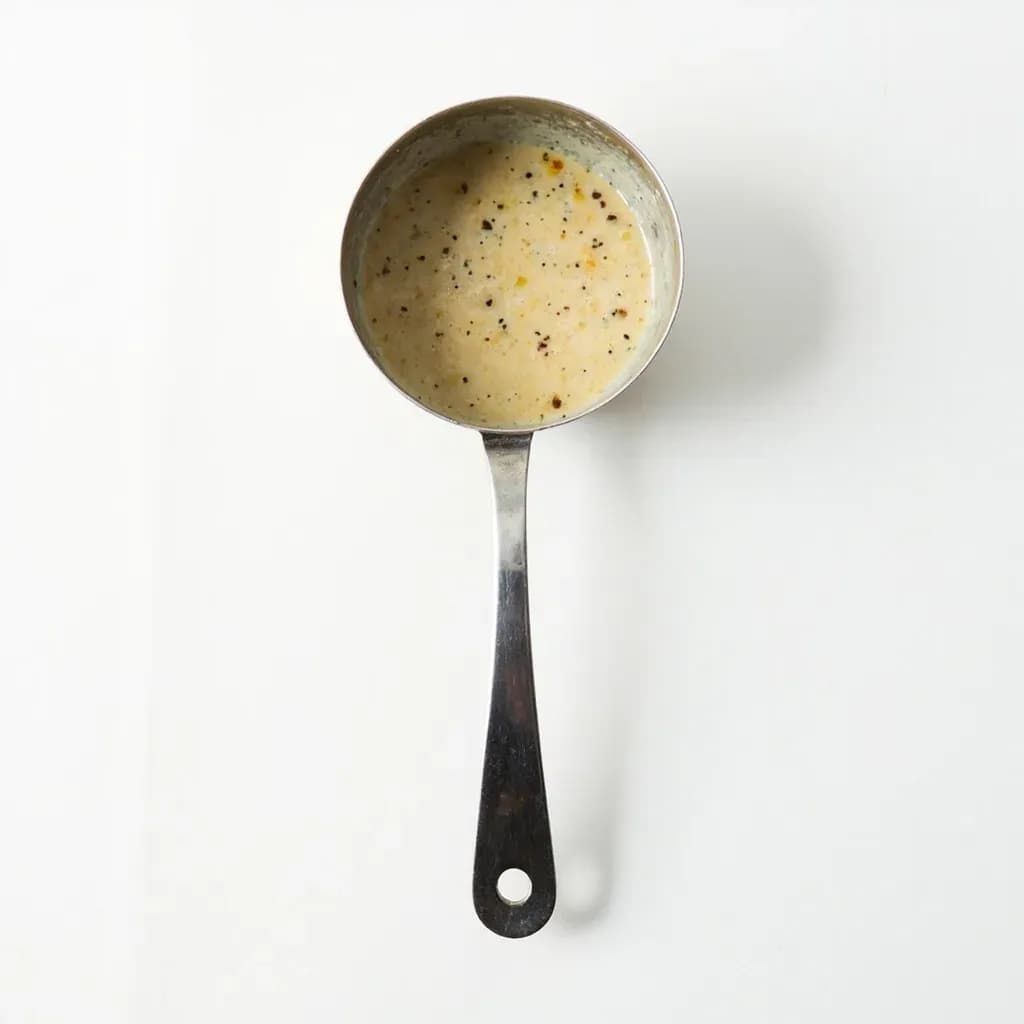
Prep Tools
Sauce Ladle
Small deep-bowled ladle for portioning sauces, dressings, and broths neatly.
A sauce ladle is a ladle with a relatively small, deep bowl and often a pouring spout, made for serving precise amounts of sauce, soup, or dressing. Cooks use it to nap plates with sauce, portion broth, and skim or degrease the surface of stocks. Measured versions hold a known volume for consistent portioning on a service line.
A sauce ladle is a small, deep-bowled ladle built for moving thin to medium-thick liquids — pan sauces, gravies, broths, dressings, purées — from pot to plate with control. Its hallmark is a compact, hemispherical bowl that holds a measured volume (most often 1 fl oz / 30 ml) and a handle long enough to reach the bottom of a 2-quart saucepan without tipping. Where a soup ladle scoops generous amounts of stew or broth, the sauce ladle is calibrated for precision: a single dip delivers exactly the right ribbon of jus around a piece of fish, the correct gravy portion onto a plate, or a tidy spoonful of consommé in a small cup.
The shape matters as much as the size. A deeper bowl than a sauce spoon gives the liquid enough body to pour in a clean stream rather than dribble; a slightly oval profile helps the ladle slip between aromatics in a simmering pan without disturbing the fond. In a working kitchen, the sauce ladle is one of the most-used hand tools on the pass — quietly responsible for the visual rhythm of sauced plates. A stainless 1-ounce model with a hooked handle is the default in most professional kitchens; home cooks benefit from the same tool whenever plating moves beyond spoon-and-hope.
Choosing one is mostly a matter of capacity, handle, and material. Most cooks only need a single 1 oz / 30 ml ladle for everyday saucing; larger 2–4 oz sizes are useful for gravies, buffet service, or portion-controlled catering. Stainless steel is the default for durability and dishwasher safety, while silicone wins for nonstick and enameled cookware. Color-coded commercial ladles add a layer of portion control and allergen separation that pays off fast on a busy line.
Alternatives
Types & varieties
1 oz / 30 ml deep-bowled stainless ladle; the everyday workhorse for plating reductions and pan sauces.
2 oz / 60 ml; used for bigger sauce portions or thicker gravies.
Bowl has a narrow pour spout for clean, controlled plating lines.
Commercial sizes from 1–8 oz; used in catering and cafeterias for exact portioning and allergen separation.
Handle notch rests on the pot rim; prevents the ladle from slipping into hot liquid.
Sits upright on the pass without rolling or dripping; popular on plating stations.
Sized to match hotel-pan depth so it doesn't sit in the food; usually plastic.
Slots or holes in the bowl; useful for lifting small solids (capers, pearl onions) from a sauce.
Heat-resistant, won't scratch nonstick or enamel; typically 1–2 oz capacity.
Sauce Ladle vs. Soup Ladle vs. Sauce Spoon
The three tools look similar but are built for different jobs. A soup ladle holds 4–8 oz in a wide, shallow bowl designed to scoop chunky stew, bisque, or chili — far too much volume for plating a sauce, and its broad bowl makes a controlled pour almost impossible. A sauce spoon has a flat, spouted bowl roughly the size of a small spade; it is meant for basting in a pan or spooning a single portion over food already in the pan, not for transferring measured amounts of liquid between vessels. The sauce ladle sits between the two: deep enough to pour cleanly, small enough to portion, and shaped to navigate a busy saucepan.
Plating Technique with a Sauce Ladle
A sauce ladle rewards a light hand and a dry bowl. The shape is doing half the work for you — let it.
- Dip the bowl at a shallow angle so you don't scrape up fond or break the surface of a clear broth or consommé.
- Lift and let the liquid settle for a heartbeat before pouring — this prevents drips between plate and ladle.
- Wipe the back of the bowl and the rim with a kitchen towel between dips for spotless plates.
- For a controlled pool, pour from a low height with the bowl tilted slowly; for a long stripe, raise the ladle 6–8 inches and let the sauce fall in a steady line.
- Rest a hooked-handle ladle on the pot rim between portions to keep the bowl out of the sauce and your hand free.
Capacity and Portion Control
The single biggest mistake cooks make with a sauce ladle is using one that is too large for the dish. A 1 oz ladle delivers roughly two tablespoons — usually the right amount of sauce to dress a plated protein without drowning it. Stepping up to 2 oz is appropriate for heartier gravies and starch service; 4–8 oz sizes exist mainly for institutional catering and buffet work where standardized portions matter. Color-coded commercial sets make that standardization automatic: a green handle always means 3 oz, a red handle always means 4 oz, and so on, which removes guesswork from a busy pass and helps separate allergen-specific sauces.
Common uses
Tips & pitfalls
- Match the ladle's capacity to your finished portion — many cooks unknowingly over-sauce when the ladle is too large.
- Dip the bowl at a shallow angle so you don't scrape the fond or break the surface of a clear broth.
- Use a hooked-handle ladle on tall, narrow pots; the rim notch keeps the bowl from sliding in and contaminating the sauce.
- Reserve dedicated, color-coded ladles for allergen-specific or vegetarian sauces to avoid cross-contamination on a busy line.
- Stainless steel is the most durable and dishwasher-safe choice; reserve silver-plate for service and hand-wash only.
- Don't substitute a soup ladle for a sauce ladle — the larger bowl makes plating precision nearly impossible.
- A flat-bottomed ladle is worth the small premium for plating stations: it sits upright without leaving a wet ring on the pass.
- Silicone ladles are gentler on enameled cast iron and nonstick pans, but their bowls are usually slightly larger than the equivalent stainless version.
Good to know
- Typical capacity
- 1 fl oz / ~30 ml for a small sauce ladle; larger sizes run 2 oz, 3 oz, 4 oz, 6 oz, and 8 oz
- Bowl shape
- Deep hemispherical bowl, slightly oval on most designs; flat-bottomed versions sit upright on the bench
- Common materials
- 18/10 stainless steel, nylon, polypropylene, silicone, silver-plate, copper
- Handle length
- Usually 8–11 in / 20–28 cm, long enough to reach the base of a 2-qt saucepan
- Also called
- Portion control ladle, dressing ladle, gravy ladle
- Commercial portion coding
- Color-coded handles map to specific ounce capacities (commonly black 1 oz, blue 2 oz, green 3 oz, red 4 oz, ivory 6 oz, gray 8 oz); standards vary by manufacturer
- Dishwasher safe
- Stainless steel and most high-heat plastics/silicones are; silver-plate is typically hand-wash only
- Distinguishing feature
- Much smaller bowl than a soup ladle (4–8 oz) but deeper bowl than a flat sauce spoon
- Hooked handle
- Many models include a notch or hook on the handle that catches a pot rim so the bowl doesn't slide in
Also called
Degreasing Ladle · Portion Ladle · Portion-Control Ladle · Steam-Table Ladle · Measuring Ladle
Related

Peeler
Swift blade for stripping skin off fruit and vegetables

Grater
Sharp-toothed surface for shredding cheese and vegetables

Microplane
Ultra-fine rasp for citrus zest, garlic, and hard cheese

Mixing Bowl
All-purpose bowl for combining, whisking, and tossing

Whisk
Looped wires that beat air into eggs, cream, and sauces

Spatula
Flat blade for flipping, lifting, and scraping

Slotted Spoon
Pierced spoon that lifts solids and drains the liquid behind

Wooden Spoon
Gentle, heat-friendly spoon for stirring anything