Cookware
Saucier
A wide pan with sloped, rounded sides for whisking, reducing, and stirring sauces.
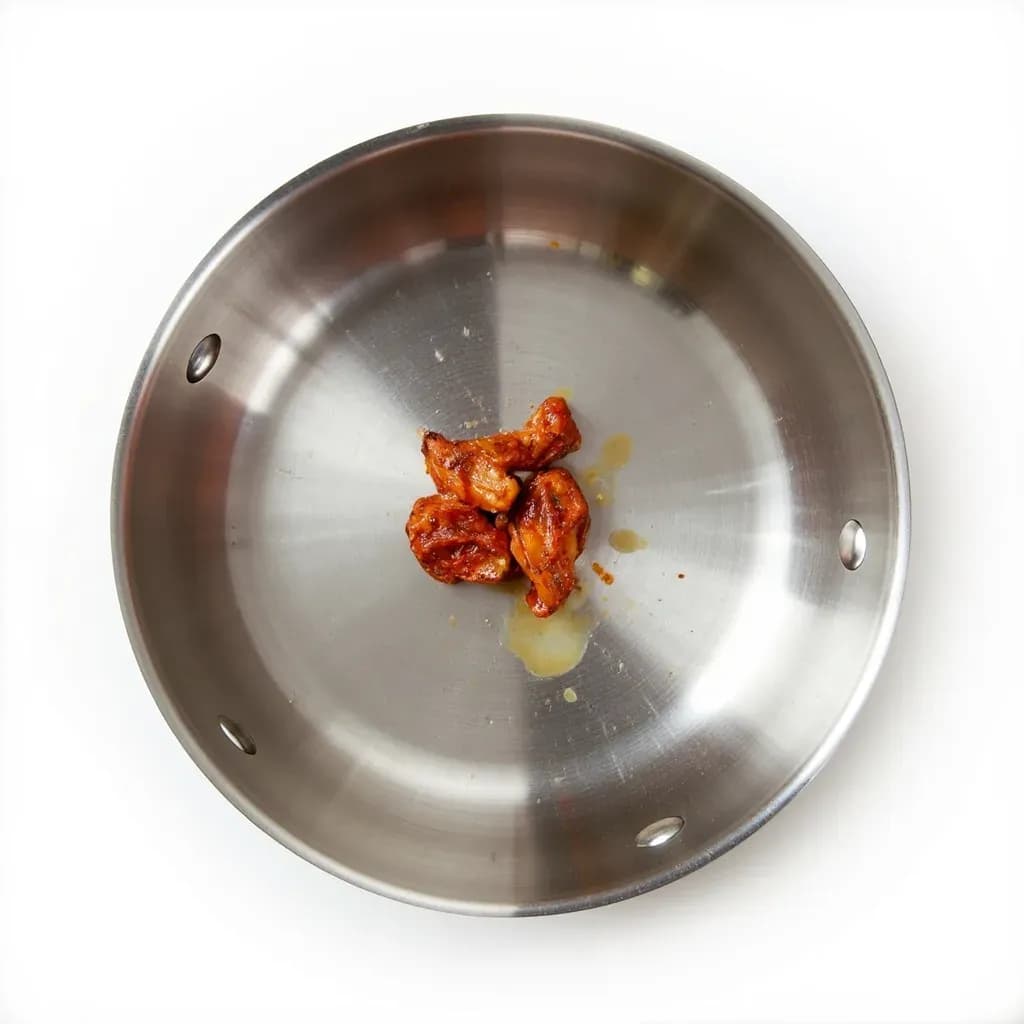
A saucier is a saucepan with curved, flaring sides and a rounded interior bottom that has no sharp corners for food to catch in. The sloped shape makes it easy to whisk continuously, reduce liquids, and stir risotto or custards without scorching. It bridges the gap between a saucepan and a sauté pan, prized for any preparation that needs constant motion and even reduction.
A saucier is the pan that serious sauce cooks reach for before anything else. Its defining feature is a continuously curved interior — the wall meets the base in a smooth arc with no sharp seam — which lets a whisk or spoon sweep the entire bottom in a single motion. That single design choice is what separates it from a straight-sided saucepan, where a corner always catches fond, holds unmixed flour, or hides a piece of butter that never quite melts in.
The shape also gives the saucier a wider evaporation profile than a saucepan of the same volume. Liquids reduce faster, and reductions are easier to monitor because the sloped sides expose more of the surface to view. A flat whisk, which struggles to reach the corners of a straight pot, becomes genuinely effective here, and a balloon whisk moves through the curved base without snagging. For anything that needs continuous agitation — béchamel, pan sauce, custard, risotto, caramel — the saucier simply behaves better than any other pan of comparable size.
A 3-quart clad stainless saucier is, for many home cooks, the single highest-value specialty pan to add beyond a good skillet. It is the workhorse of restaurant sauce stations, where cooks often refer to it as 'the pan' and use it all day for reductions, emulsions, and reheating.
Alternatives
Types & varieties
The modern default. Aluminum or copper core sandwiched between steel layers; durable, dishwasher-safe, and reasonably responsive.
The traditional professional choice. Best heat response of any material; requires polishing and, historically, periodic retinning if tin-lined.
Heavier and very durable, with a non-reactive surface. Often sold with a non-stick interior; heats more slowly than copper.
Best for egg- and dairy-based sauces, custards, and any reduction prone to scorch. Rules out high heat and metal utensils.
Ideal for caramel, dessert sauces, and reductions for two. Heats and drops in volume very quickly.
The everyday workhorse: risotto, large-batch reductions, custards, soups, braises. Almost always has a helper handle.
The closest French cousin — a slightly broader, sometimes shallower rounded pan. The line between 'sauteuse' and 'saucier' varies by maker and tradition.
Why the curved base matters
A straight-sided saucepan has a hard angle where the wall meets the bottom, and that angle is where cooking goes wrong. Flour clumps there during a béchamel. Butter hides there during a mount. Fond burns there during a reduction. A saucier's continuous arc eliminates the problem: the whisk, the spoon, the spatula, and the liquid all move through one smooth path, so nothing is stranded at a seam.
The same curve is what makes a flat whisk a real tool in this pan. In a straight pot, a flat whisk's flat profile can't reach into the corners where the wall meets the base. In a saucier, the tines follow the curve and contact the entire base on every stroke, which is exactly the kind of contact you need to pull butter into a sauce or to keep a custard from catching.
- No sharp seam means no hidden flour, butter, or scorched fond.
- A flat whisk becomes genuinely effective; a balloon whisk stops being a liability.
- The sloped sides expose more surface area, so reductions proceed faster and are easier to watch.
Choosing a material
Material choice is really a choice about responsiveness versus convenience. Copper heats and cools fastest, which matters most for emulsified sauces — hollandaise, beurre blanc — where a few seconds of overshoot can break the sauce. Clad stainless is the practical all-rounder: good response, easy to maintain, induction-ready, dishwasher-safe. Non-stick is best when scorch is the enemy, especially for custards, curd, and reheated cheese sauces.
- Copper: best for delicate emulsions and rapid response; needs hand care.
- Clad stainless: the everyday choice; works on every cooktop.
- Non-stick: best for dairy, egg, and sugar work; avoid high heat and metal tools.
- Hard-anodized aluminum: durable middle ground, often with a non-stick interior.
Common uses
Tips & pitfalls
- Use a flat whisk in a saucier; it is the only pan where it really pays for itself, and a balloon whisk loses much of its advantage here.
- Match material to the work — copper for emulsions, clad stainless as the default, non-stick for dairy and egg sauces that scorch easily.
- Heat the pan gradually, especially with copper and tri-ply; copper responds almost instantly, and an empty clad pan on high heat will overshoot your target before you add liquid.
- Do not fill above two-thirds capacity when reducing — the wide sloped sides drop volume fast and foamy liquids will climb right out.
- Deglaze with cold liquid after a sear. The curved base releases fond more readily than a flat sauté pan, and cold liquid keeps the fond loose rather than cementing it.
- Hand-wash and immediately dry copper and tin-lined saucier pans; the dishwasher will strip tin and dull copper quickly.
- Common mistake: using a saucier as a frying pan. It is built for liquid work with frequent agitation, not for dry, high-heat searing of large cuts — sear in a skillet, then finish the sauce in the saucier.
- Common mistake: assuming all saucier pans work on induction. Solid copper and bare aluminum will not; you need a bonded magnetic plate or full cladding.
Good to know
- Origin
- French kitchen tradition; the term overlaps with 'sauteuse,' a rounded sauté-style pan in French cookware.
- Defining shape
- Rounded interior with continuously sloped sides — no sharp corner where the wall meets the base.
- Primary materials
- Stainless steel (usually with an aluminum or copper core), solid copper, hard-anodized aluminum; non-stick interiors are common.
- Typical sizes
- 1.5 to 5 quarts at home; 3 to 4 quarts is the workhorse size in most kitchens.
- Handles
- One long main handle; sizes 3 quarts and up almost always carry a secondary helper handle on the opposite side.
- Lid
- Most come with a matching domed or flat lid, though sauce work is frequently done uncovered to encourage reduction.
- Compatibility
- Clad and induction-bonded versions work on induction, gas, and electric; solid copper and bare aluminum usually do not work on induction.
- Construction
- Tri-ply or multi-clad construction is standard in better models for even heat across the curved base.
Also called
Saucier Pan (Rounded Saute) · Windsor Pan · Reduction Pan · Saucier Pan
Related

Steamer
Gentle moist heat that keeps vegetables, fish, and dumplings tender

Frying Pan
Shallow sloped pan for frying, sautéing, and quick sears

Saucepan
Tall, straight-sided pot for sauces, grains, and small batches

Sauté Pan
Wide straight-sided pan with room to brown and braise

Dutch Oven
Heavy lidded pot that turns tough cuts tender over hours

Stock Pot
Tall, roomy pot for stocks, pasta, and big-batch cooking

Wok
High-sided bowl pan built for blistering-hot stir-fries

Griddle
Flat, broad surface for pancakes, smash burgers, and breakfast