Prep Tools
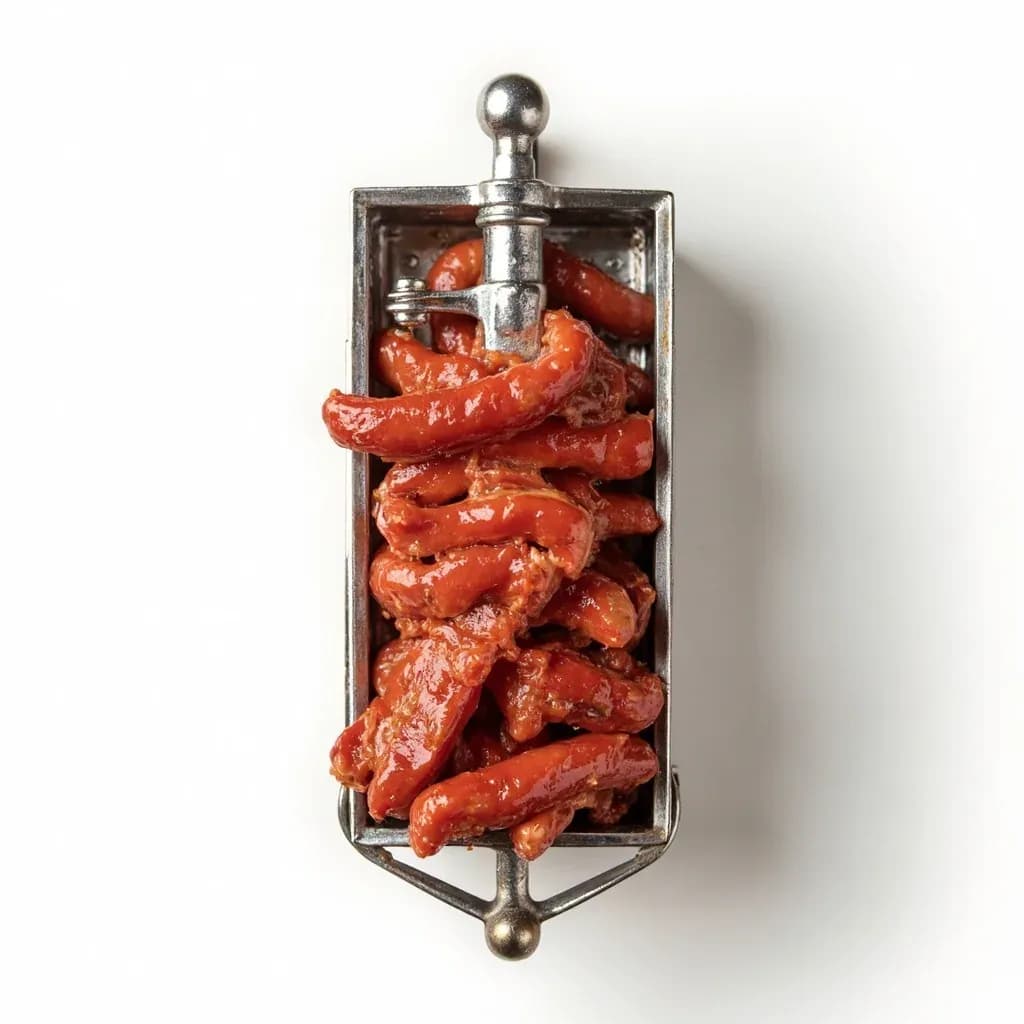
Sausage Stuffer
Cylinder-and-plunger device that forces ground meat into casings to form sausages.
A sausage stuffer is a vertical or horizontal cylinder with a piston that pushes seasoned ground meat through a nozzle into a casing slipped over the spout. Charcuterie makers use it to fill links evenly and tightly, controlling fill so the casings don't burst. A crank-driven plunger gives steady pressure for consistent links.
A sausage stuffer is the dedicated tool for filling casings with seasoned ground meat, and unlike a meat grinder's auger it pushes the mixture in a smooth, continuous column. That distinction matters more than it sounds: the gentle, even pressure of a plunger-style stuffer slides meat into natural or collagen casings without stretching them thin or bursting them, producing the tight, uniform link that defines a good fresh sausage. Without one, cooks fall back on improvised methods — piping bags, funnel-and-stick setups, even a stand-mixer grinder plate — none of which combine the right pressure, capacity, and control.
Mechanically, a stuffer is a cylinder that holds the meat, an interchangeable stuffing tube (or horn) sized to the casing, and a drive that pushes the mixture forward. The crucial detail is the drive. Plunger models — the traditional design — use a hand-pushed piston or a geared crank that drives the piston, so the meat moves only because pressure is applied. Auger-style attachments for stand mixers work differently: a screw both pushes and lightly shears, so they are faster but harsher on casings and harder to modulate. For most home and prosumer sausage making, a vertical geared plunger in the 5- to 15-pound range is the workhorse.
Used well, the stuffer also acts as a quality checkpoint. A properly chilled, properly mixed emulsion flows evenly; one with smearing fat or pockets of air fights you at the cylinder, and you learn to read the resistance. That feedback loop is part of why serious sausage makers consider the stuffer a non-negotiable rather than a luxury.
Alternatives
Types & varieties
Upright cylinder with a hand-pushed or geared plunger. The classic design; gravity helps the meat fall into the casing as pressure is applied from above.
Cylinder lies on its side with a side-mounted plunger. Smoother flow for long stuffing runs; common in small butcher shops.
Cylinder with a handle-and-gear mechanism that multiplies hand force. Easier on long sessions; most offer a fast speed for loading and a slow speed for stuffing.
Screw-auger attachment that fits a KitchenAid-type mixer. Convenient for small batches; pulsating flow and limited pressure control make it harsher on casings.
Small hand-pump units (also sold as jerky guns) built for snack sticks, jerky, and small-diameter casings of 12–19 mm. Limited pressure; not suitable for traditional fresh sausages.
Plunger vs. Auger: How the Mechanics Differ
Two distinct mechanisms live under the name "sausage stuffer," and they do not produce the same results. Plunger-style stuffers push the meat in one smooth, even column, which is gentler on casings and gives tighter, more uniform links. Auger-style attachments use a screw that both pushes and lightly shears, so they are faster but more likely to tear casings, and they cannot develop the same back-pressure as a real plunger — a real problem when stuffing tight sheep casings or dense cured sausages.
- Plunger: smooth continuous pressure, gentlest on natural casings, develops true back-pressure for tight links, slower per pound.
- Auger (mixer attachment): screw pushes and shears, faster for small batches, pulsating flow, limited back-pressure, more likely to tear collagen or sheep casings.
- For tight sheep-casing breakfast links, salami, or any cured sausage that needs to be dense and dry, a real plunger stuffer is essentially required.
- For snack sticks and pepperoni in fibrous casings, the mixer attachment is often sufficient because the casing itself is sturdy and small in diameter.
Common uses
Tips & pitfalls
- Chill the meat mixture to 32–38°F / 0–3°C before loading. Warm meat smears fat, sticks in the cylinder, and tears casings on the way out.
- Soak natural casings in lukewarm water for at least 30 minutes and flush them with water to soften them and wash out the salt; collagen casings need only a brief soak.
- Match the stuffing tube outside diameter to the casing: the casing should slip on snugly without stretching or bunching at the base of the horn.
- Tie a tight knot at the end of the casing before you begin, otherwise air and meat escape out the back of the tube.
- Load the cylinder no more than two-thirds to three-quarters full; overfilling traps air against the plunger and bursts casings from inside.
- Hold back-pressure on the casing with one hand so it slides on at the same rate the plunger advances — never let it stretch tight, and never let it balloon loose.
- Prick any visible air pockets with a sterile pin as the casing fills; trapped air expands during cooking and causes blowouts.
- Stop and clear a hang-up by reversing the crank or lifting the plunger; never force a jam or you can bend the gears or split a seal.
- Lubricate the rubber plunger seal lightly with vegetable oil so the air vent keeps working — the vent lets air pass through the seal so the plunger moves freely and the casing doesn't get sucked off the tube between strokes.
- Rinse and dry the unit immediately after use; salt and fat corrode chrome-plated steel and stain stainless parts if left overnight.
- Don't confuse a meat grinder with a stuffer: a grinder's auger shreds meat and shreds casings alike. A stuffer pushes gently under controlled pressure, which is the whole point.
Good to know
- Primary function
- Forces ground meat mixtures into casings to make linked or coiled sausages.
- Common capacities
- 5, 7, 11, 15, and 25 lb cylinders are standard for home and prosumer use; commercial units range from 30 lb to more than 60 lb.
- Typical materials
- Stainless steel cylinder and tubes (best); chrome-plated steel; plastic hoppers and end caps on entry models. Plunger seals are usually food-grade rubber or silicone.
- Drive styles
- Manual hand-plunger (push), geared two-speed hand crank, and stand-mixer auger attachments (KitchenAid-compatible).
- Stuffing tubes supplied
- Most include 4 or 5 interchangeable nozzles at roughly 10, 20, 30, 40, and 50 mm (about 1/2" to 2") outside diameter.
- Home price range
- About $60–$300 for hand-crank or plunger models; mixer attachments about $40–$100; pro-grade starts around $500.
- Required accessories
- Natural or collagen casings, soaking bowl, pricking pin, kitchen twine, and a meat mixture held at 32–38°F / 0–3°C.
Also called
Sausage Filler · Sausage Maker
Related

Peeler
Swift blade for stripping skin off fruit and vegetables

Grater
Sharp-toothed surface for shredding cheese and vegetables

Microplane
Ultra-fine rasp for citrus zest, garlic, and hard cheese

Mixing Bowl
All-purpose bowl for combining, whisking, and tossing

Whisk
Looped wires that beat air into eggs, cream, and sauces

Spatula
Flat blade for flipping, lifting, and scraping

Slotted Spoon
Pierced spoon that lifts solids and drains the liquid behind

Wooden Spoon
Gentle, heat-friendly spoon for stirring anything