Prep Tools
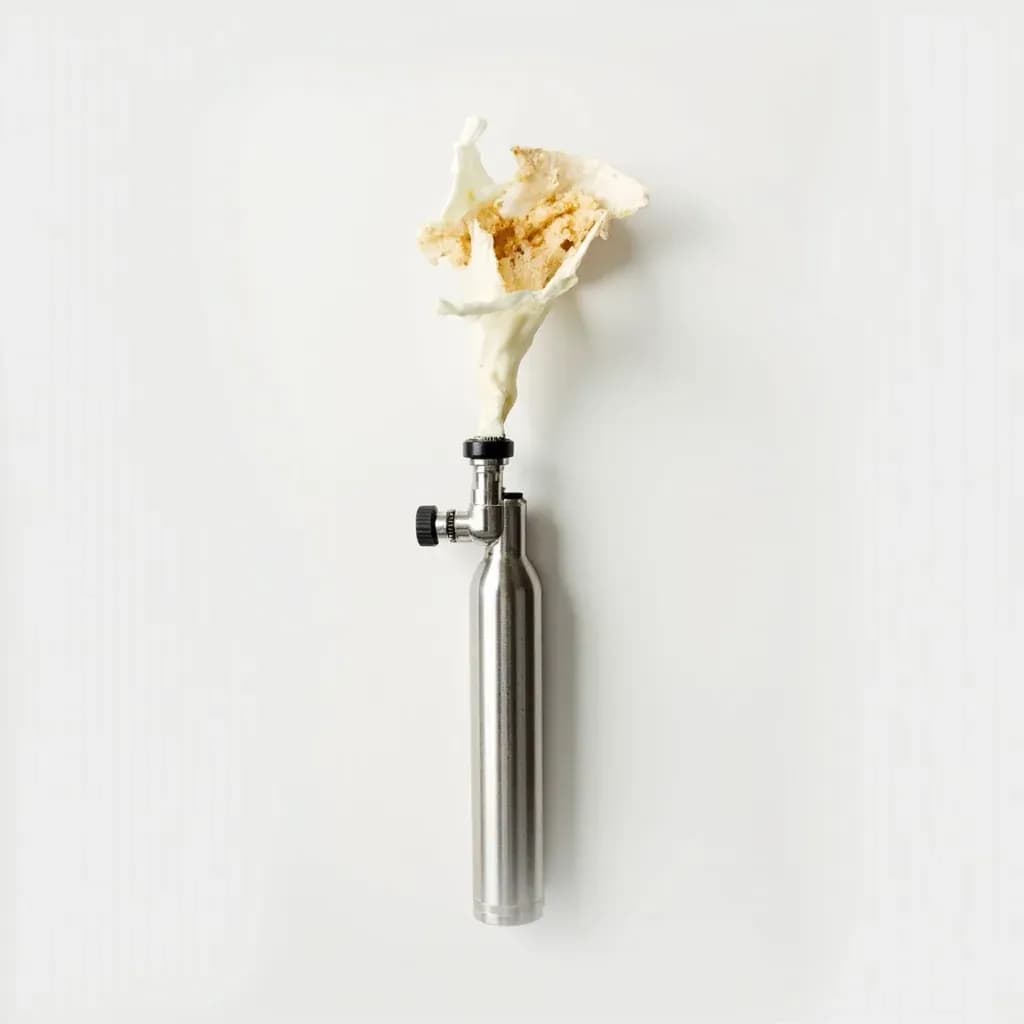
Cream Siphon (Sifó)
A pressurized canister charged with N2O that whips cream or aerates liquids into instant foams and espumas.
A cream siphon is a sealed canister charged with nitrous oxide cartridges that dispenses whipped cream and culinary foams under pressure. The gas dissolves into the liquid and expands on release, aerating it instantly. Beyond dessert cream it is a staple of modern cuisine for savory espumas, infusions, and rapid flavor extraction.
A cream siphon is a sealed stainless-steel canister fitted with a screw-on pressure head, a trigger lever, and a threaded port for a small gas cartridge. The cook loads it with cream, a purée, a sauce, or another liquid, screws in an 8 g nitrous oxide (N₂O) charger, and the cartridge punctures and dumps its gas into the headspace. Under roughly 6 bar of pressure (about 85 psi at room temperature) the N₂O dissolves into the contents; a pull of the lever forces the mixture through a fine nozzle, and the sudden pressure drop drives the gas out of solution on contact with the air, whipping the liquid into a stable foam as it emerges.
The choice of nitrous oxide is the heart of the tool, and the reason it cannot be swapped for a soda-style carbon dioxide charger. N₂O is fat-soluble, so it dissolves readily into cream, butter-rich purées, and egg-yolk emulsions, and leaves them stable once dispensed. CO₂, by contrast, is water-soluble and reacts with dairy to form carbonic acid, which curdles milk and cream within minutes. This single property is what the kitchen at elBulli exploited in the mid-1990s to build the modern espuma vocabulary — foams and airs that hold their shape on the plate without gelatin, egg white, or prolonged whipping. The technology itself is older (19th-century French seltzer siphons used the same screw-in cartridge principle), but the culinary application is essentially a modern invention.
In practice, a 0.5 L siphon charged with a single cartridge turns about half a litre of 36% cream into roughly 1.25–1.5 litres of softly set whipped cream in seconds, and the same device will aerate anything from a cold pea purée to a warm sabayon. It is now standard equipment in pastry stations for speed and consistency, in modernist kitchens for espumas and rapid infusions, in bar programs for cocktail foams, and in a great many home kitchens for the simple pleasure of instant, perfectly held whipped cream.
Alternatives
Types & varieties
The benchmark professional cream whipper; stainless steel, available in 0.25 L, 0.5 L, and 1 L
Double-walled stainless steel that holds temperature longer; favoured for fine-dining pass work and hot foams
Smaller 0.25 L unit aimed at home cooks and single-portion use
Entry-level plastic-head model for light-duty kitchen work
Common European alternative to iSi with the same charger thread and similar pressure rating
Modern competitor with a metal head and broad accessory line
0.5 L class with finer nozzles, marketed for savoury foams and bar programmes
Predecessor lever-operated style still found in some classic European kitchens
How it works
When an N₂O cartridge is pierced inside the head, the gas floods the space above the liquid and begins to dissolve into it. Nitrous oxide is soluble in fat (and reasonably so in water under pressure), so in cream it is absorbed into the butterfat phase. A few shakes accelerate this dissolution. Once the lever is pulled, the pressurised mixture is forced through a narrow nozzle; the instant the liquid exits into atmospheric pressure the gas comes back out of solution in tiny bubbles, and the fat and protein network of the cream traps them, producing a stable foam. The same mechanism aerates a vegetable purée or a sabayon — anything that contains enough fat, protein, or starch to trap the released gas. Venting the siphon quickly after charging (without shaking) reverses the process: the rapid pressure drop pulls air and aroma into the liquid, the basis of the rapid-infusion technique.
- N₂O dissolves into the fat phase of cream and is released as the foam exits the nozzle.
- One 8 g cartridge per 0.5 L load is standard; two cartridges pack more gas and yield a firmer, drier foam.
- Shaking after charging accelerates dissolution but is unnecessary for very thin liquids.
- Cold contents hold more dissolved gas — always chill both the canister and the liquid for stable foam.
Choosing a model
For a working pastry station, a 0.5 L stainless-steel iSi is the default: it is the size pastry cooks reach for, parts are widely available, and gaskets are cheap to replace. A 1 L model makes sense for banqueting volume, while 0.25 L units are pleasant for single portions and home use. Double-walled (Thermo) siphons are worth the premium if you dispense repeatedly across a long service, because the wall holds cold or heat that a single-walled body cannot. Plastic-headed models are cheaper but less durable and not recommended for daily professional use.
Common uses
Tips & pitfalls
- Chill the canister and the liquid to 2–4 °C before charging; warm cream under-pressurises and the foam collapses within minutes.
- Fill no more than two-thirds full — the headspace is where gas collects and dissolves, and overfilling produces thin, weeping foam.
- Use cream with at least 30% fat (36% is ideal); lower-fat dairy gives wet, unstable foam that bleeds almost immediately.
- Strain purées, stocks, and infusions through a fine chinois before loading — fibres and seeds are the most common cause of a clogged nozzle.
- Always vent the head fully (point the siphon into a container and pull the lever) before unscrewing the top; the residual gas is enough to launch the head across the room.
- Never substitute CO₂ chargers for cream work — they carbonate the liquid and curdle the proteins, producing a sour, broken foam.
- Hold the siphon completely inverted when dispensing; upright dispensing gives a thin, almost liquid output because the gas escapes before the foam forms.
- If foam fails to come out, the nozzle is clogged — clear it with a fine needle rather than forcing the lever, which can damage the head.
Good to know
- Operating gas
- Nitrous oxide (N₂O) in 8 g screw-in chargers; CO₂ is not suitable for dairy
- Working pressure
- Approximately 6 bar (85 psi) at room temperature
- Standard capacities
- 0.25 L, 0.5 L, 0.75 L, and 1 L
- Charging
- One 8 g cartridge per 0.5 L load; two for very dense or cold mixtures
- Ideal temperature
- Canister and contents chilled to 2–4 °C (35–40 °F) before charging
- Body and head
- Stainless steel body, metal or plastic head, silicone or rubber gaskets
- Origin
- Descended from 19th-century French seltzer siphons; culinary form popularised by Ferran Adrià at elBulli in the 1990s
- Leading manufacturer
- iSi GmbH of Vienna, founded 1964
Also called
Whipping Siphon · Cream Whipper · ISI Siphon · Sifó
Related

Peeler
Swift blade for stripping skin off fruit and vegetables

Grater
Sharp-toothed surface for shredding cheese and vegetables

Microplane
Ultra-fine rasp for citrus zest, garlic, and hard cheese

Mixing Bowl
All-purpose bowl for combining, whisking, and tossing

Whisk
Looped wires that beat air into eggs, cream, and sauces

Spatula
Flat blade for flipping, lifting, and scraping

Slotted Spoon
Pierced spoon that lifts solids and drains the liquid behind

Wooden Spoon
Gentle, heat-friendly spoon for stirring anything