Prep Tools
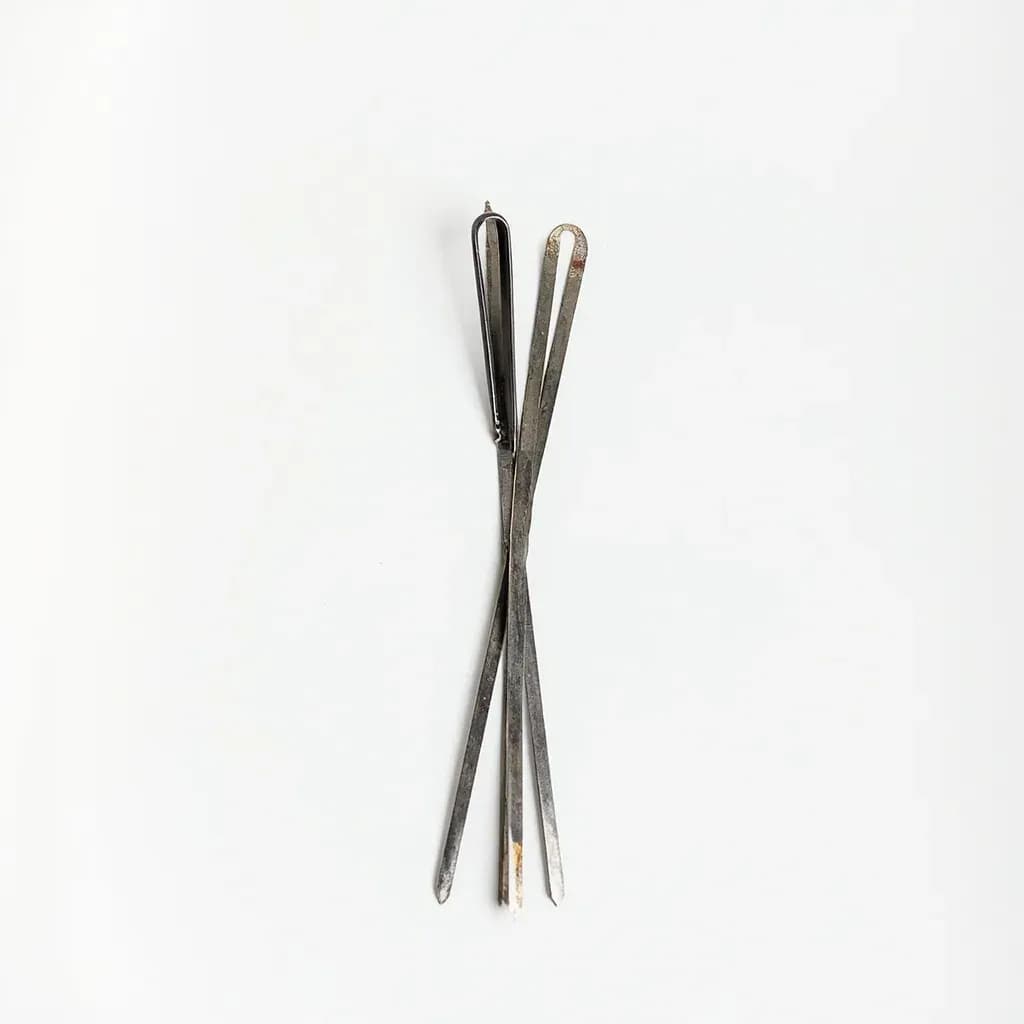
Metal Skewer
A long pointed rod that threads meat, fish, and vegetables for grilling over fire.
A skewer is a thin pointed rod, usually flat metal or bamboo, that spears chunks of meat, seafood, and vegetables so they cook evenly over coals or flame and turn as one. Flat metal şiş and souvla skewers grip food so it doesn't spin, while long espetos handle Brazilian churrasco cuts. Bamboo and banana-leaf skewers are cheap and disposable but should be soaked first so they don't burn through.
A metal skewer is a reusable, heat-conductive rod used to thread meat, fish, vegetables, and fruit for cooking over direct heat. Unlike disposable bamboo or wooden skewers, it does double duty: it holds food in place and it actively cooks it, conducting heat from the grill or coals into the center of whatever is threaded. That interior heat means a metal-skewered kebab will finish faster, and develop more pronounced browning along the contact line, than the same food laid on a bare grate.
A useful skewer is defined less by length than by cross-section. Round rods are the cheapest and most familiar, but they let food spin freely when you flip them. Flat, hexagonal, and double-pronged profiles were developed to grip food and keep it oriented; the choice matters most for single, large, or slippery items like fish fillets and scallops, which tear and flop on a round rod. Stainless steel is the workhorse material — dishwasher-safe, indifferent to marinade, and durable enough to outlast the cook who buys it.
Across the cuisines that lean hardest on skewer cookery — Turkish şiş, Persian kabab, Indian seekh, Indonesian satay, Japanese yakitori, Greek souvlaki, French brochette, Portuguese espetada — the metal skewer is treated as a real cooking tool rather than a serving aid. In Madeira, Iran, and parts of Turkey it is brought to the table still threaded, the rod stood upright on the plate or rested in bread and rice, both for drama and to keep the food warm through a long meal.
Alternatives
Types & varieties
Rectangular profile; resists spinning when food is turned and sears a clear flat edge against the food.
Classic pencil-thin rod; cheaper and traditional, but food tends to rotate when flipped unless tightly packed.
Two parallel prongs joined by a handle; locks in delicate or thinly sliced items so they do not flop or slip off.
Folding wire frame or hinged grill-basket design; holds small or fragile items (scallops, shrimp, diced vegetables) without threading them.
Six-sided rod that grips food firmly and minimizes rotation, popular in Japanese and Korean grills.
16–24+ inches, often flat; used in Levantine, Persian, and Madeiran grilling for whole fish, whole chickens, or layered meats.
How metal changes the cook
A metal skewer is not just a handle — it is a heat source. Stainless steel conducts heat rapidly from the grill into the center of whatever is threaded, so the food on a metal skewer cooks from the outside in (radiant and conductive heat from the fire) and from the inside out (heat traveling down the rod). The practical consequences are three: total cook time is shorter than for the same food on a bare grate, the contact line on each piece chars faster and deeper, and the interior continues to climb in temperature for a minute or two after the skewer leaves the fire. Pull the skewer a touch earlier than you would a basket of the same food, and rest it on a tray so carryover heat does not push the center past done.
- Preheat the rod on the grill for 30–60 seconds before loading; a hot skewer sears its first contact mark and keeps delicate proteins from sticking as you thread them on.
- Slide a strip of folded aluminum foil over the exposed handle end, or use a skewer with a ring or loop handle, so you can flip a long sword-style rod without burning your wrists.
- On a sword-length skewer (16–24 inches), rest the handle on the edge of the grill or across a tray so the heavy food end does not drag the rod into the coals.
- After the cook, deglaze the hot skewer in a small pan with stock, wine, or citrus juice to dissolve the fond stuck to the rod; that liquid is a free, intensely meaty base for a pan sauce.
Common uses
Tips & pitfalls
- Preheat the skewer on the grill for a minute before loading it; a hot rod sears the first contact mark and reduces sticking.
- Oil the metal, not just the food. Wipe the rod with a folded paper towel dipped in neutral oil before threading.
- Choose flat or double-pronged skewers over round ones for fish, scallops, or single pieces of chicken that will spin when flipped.
- Leave a small gap (about 1/8 inch) between pieces of food so heat circulates; packing tight causes steaming instead of charring.
- Cut food into uniform sizes so everything finishes at the same time — especially important because the metal core continues to cook interior meat after leaving the fire.
- Trim overhangs: nothing should extend past the tip or hang off the side, or it will burn and make turning awkward.
- Parboil or microwave dense vegetables (potato, carrot, sweet potato) for a few minutes before skewering so they finish in the same window as the meat.
- Common mistake: using a round skewer for one large piece of fish and then flipping — the fish spins and tears; switch to a flat or double-pronged rod.
Good to know
- Material
- Most commonly stainless steel; also nickel- or chrome-plated steel, with occasional brass or copper plating for faster heat transfer
- Typical home length
- 8 to 14 inches (20–35 cm); specialty and grill models run 16 to 24 inches
- Cross-section
- Round, flat/blade, hexagonal, or double-pronged (two parallel rods joined at one end)
- Reusability
- Reusable indefinitely; dishwasher-safe stainless steel; no pre-soaking required, unlike bamboo
- Heat behavior
- Metal conducts heat into the center of the food, accelerating cook time and encouraging browning on the contact line
- Origin of the tool
- Iron and bronze skewers appear in ancient Near Eastern, Persian, and Indian cookery; the modern stainless-steel version is a 20th-century evolution
- Cuisines most associated
- Turkish şiş kebab, Persian kabab, Indian seekh, Indonesian/Malaysian satay, Japanese yakitori, Greek souvlaki, French brochette, Portuguese espetada, Spanish pincho
Also called
Shampoor · Metal Skewer (Souvla Skewer) · Flat Kebab Skewer (Şiş) · Baku Skewer · Churrasco Skewer (Espeto) · Churrasco Skewer · Bamboo Skewer Stick (Tusuk Sate) · Banana Leaf Skewer · Kebab Skewer
Related

Peeler
Swift blade for stripping skin off fruit and vegetables

Grater
Sharp-toothed surface for shredding cheese and vegetables

Microplane
Ultra-fine rasp for citrus zest, garlic, and hard cheese

Mixing Bowl
All-purpose bowl for combining, whisking, and tossing

Whisk
Looped wires that beat air into eggs, cream, and sauces

Spatula
Flat blade for flipping, lifting, and scraping

Slotted Spoon
Pierced spoon that lifts solids and drains the liquid behind

Wooden Spoon
Gentle, heat-friendly spoon for stirring anything