Prep Tools
Spider Skimmer
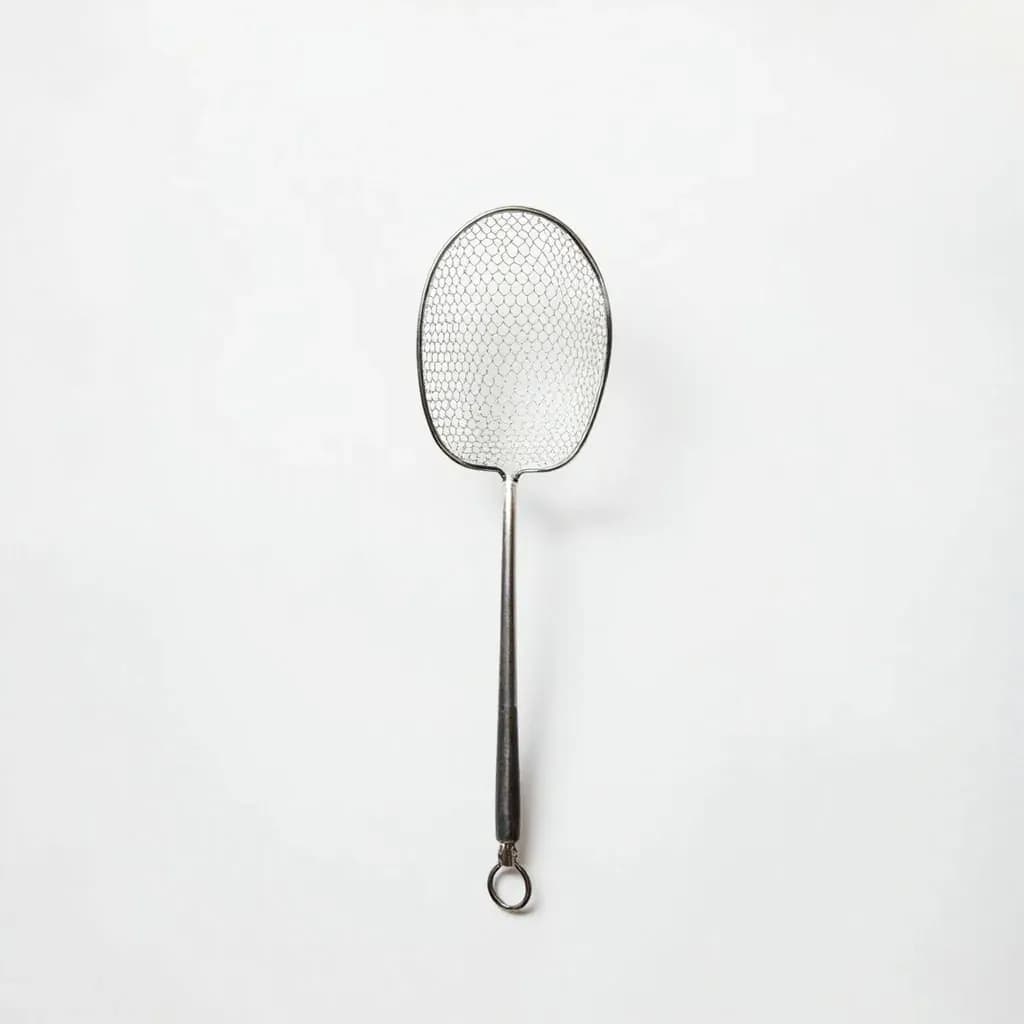
A wide wire-mesh basket on a handle for lifting fried foods and skimming scum from liquids.
A spider skimmer is a long-handled tool with a shallow wire-mesh or perforated basket used to scoop foods out of hot oil or boiling water while leaving the liquid behind. It is essential for deep-frying, blanching, and dumpling cooking, draining quickly through its open mesh. The same tool also skims foam and impurities off the surface of stocks and soups.
The spider skimmer is a long-handled basket or disc of open wire mesh used to lift food from hot oil or boiling water and to skim impurities from the surface of liquids. Its defining trait is drainage: the open mesh lets oil or water fall straight through while retaining what is solid, which is why it is preferred over a slotted spoon for fried foods (less carried-over grease) and over a ladle for blanching (the food drains in the basket as you lift, with no need to tip or pour through a colander). A good spider is fast — you can clear a Dutch oven of fritters in a single scoop — and safe, because the long handle keeps your hand well back from steam and spatter.
It is one of the few tools that earns a permanent hook in every cuisine that boils water or heats oil. In Chinese kitchens the coiled-wire spider (漏勺, lòu sháo) is as fundamental as a ladle, used to lift dumplings from boiling water and to blanch vegetables. In Western kitchens the deeper bowl-shaped mesh skimmer became the workhorse of shallow and deep frying. Despite the English nickname "spider," which some sources trace to early three-legged long-handled skillets, the basket-strainer form is Chinese in origin and predates its wider Western adoption by centuries.
A flat fine-mesh skimmer is a related but distinct tool, optimized for skimming foam from stocks rather than for lifting food. Choosing between the two is the single most common point of confusion in this category.
Alternatives
Types & varieties
Flat or shallow-bowled wire-mesh basket, often with a bamboo or looped-wire handle; the classic shape for blanching, deep-frying, and lifting dumplings.
Deeper bowl-shaped wire mesh on a long straight handle; the go-to for home and restaurant deep-frying.
Flat disc of fine woven or perforated metal on a long handle; designed to skim foam and impurities from stocks, consommés, and sauces.
Heat-resistant synthetic mesh on a metal or plastic handle; safe for non-stick, enameled cast iron, and seasoned carbon-steel surfaces.
Made from a single spiraled wire rather than woven mesh; lighter, drains very quickly, and is the traditional Cantonese shape for blanching noodles and vegetables.
Small 3–4 in handheld version for retrieving poached eggs, plating, or fishing items from a jar.
Choosing between a basket spider and a flat skimmer
These are two different tools that share a name, and using one for the other's job is the single most common mistake cooks make with this category. A basket spider — the bowl-shaped or coiled-wire type — is built to scoop and lift. A flat skimmer is built to graze the surface of a liquid and let water pass through while catching what floats on top.
- Use a basket spider to lift dumplings, fritters, blanched greens, and poached eggs from a pot or fryer.
- Use a flat fine-mesh skimmer to remove foam and fat from stocks, consommés, and simmering sauces; it loses far less liquid than a basket.
- A coarse-mesh basket spider is a poor substitute for a flat skimmer — it pulls too much stock through and only catches the largest debris.
- A flat skimmer is a poor substitute for a basket spider — it cannot scoop a serving of noodles or a batch of fritters in one motion.
Common uses
Tips & pitfalls
- Match mesh gauge to the job: coarse mesh for fries and fritters, fine mesh for skimming stocks or lifting peas and small pasta.
- For skimming stocks, angle the flat skimmer so only the surface water contacts the mesh — you want foam and fat, not the stock itself.
- Shake the spider gently over the pot to let oil or water fall back, then transfer to a rack or paper towels; do not drag it across the counter.
- Use a nylon-mesh skimmer on non-stick, enameled cast iron, or seasoned carbon-steel woks to avoid scratching the surface.
- Wooden or bamboo handles should never be soaked or run through the dishwasher — wipe, rinse briefly, and dry upright.
- After frying, soak the spider in hot water with a squirt of dish soap to loosen polymerized oil, then scrub the mesh with a brush to prevent rancid buildup.
- Do not overload the basket when deep-frying: oil surges and temperature drops, leading to greasy food and uneven cooking.
- Hang the spider from a pot hook or utensil rail rather than dropping it in a drawer, where the mesh can be bent out of shape.
- If the mesh dents, reshape it by hand while it is dry — a warped spider will not sit flat in the oil and will let food slip through.
Good to know
- Other names
- Spider, spider strainer, wire skimmer, mesh skimmer, Chinese skimmer; in Chinese, 漏勺 (lòu sháo) or 漏盆
- Origin
- Traditional Chinese kitchen tool with centuries of use; the bowl-shaped wire-mesh form predates its wider Western adoption
- Materials
- Stainless steel wire mesh is standard; handles are bamboo, wood, or stainless; nylon-mesh versions exist for non-stick cookware
- Handle length
- 12–16 in (30–40 cm) for stovetop work; shorter 6–8 in versions for small jobs
- Basket diameter
- Commonly 5–8 in (12–20 cm) for stovetop work; 3–4 in for mini spiders
- Heat tolerance
- All-metal spiders tolerate deep-fry temperatures (350 °F / 175 °C and above); nylon mesh is typically rated to ~400 °F / 200 °C
- Mesh types
- Coarse mesh for large foods; fine mesh for skimming scum and lifting small items like peas or gnocchi
- Care
- Hang by handle or store flat; wooden and bamboo handles should not be soaked or dishwashed
Also called
Spider Skimmer · Wire Skimmer · Frying Spider · Skimmer Ladle · Slotted Skimmer · Mesh Skimmer · Skimmer Spoon
Related

Peeler
Swift blade for stripping skin off fruit and vegetables

Grater
Sharp-toothed surface for shredding cheese and vegetables

Microplane
Ultra-fine rasp for citrus zest, garlic, and hard cheese

Mixing Bowl
All-purpose bowl for combining, whisking, and tossing

Whisk
Looped wires that beat air into eggs, cream, and sauces

Spatula
Flat blade for flipping, lifting, and scraping

Slotted Spoon
Pierced spoon that lifts solids and drains the liquid behind

Wooden Spoon
Gentle, heat-friendly spoon for stirring anything