Prep Tools
Smoking Bowl (Katori for Dhungar)
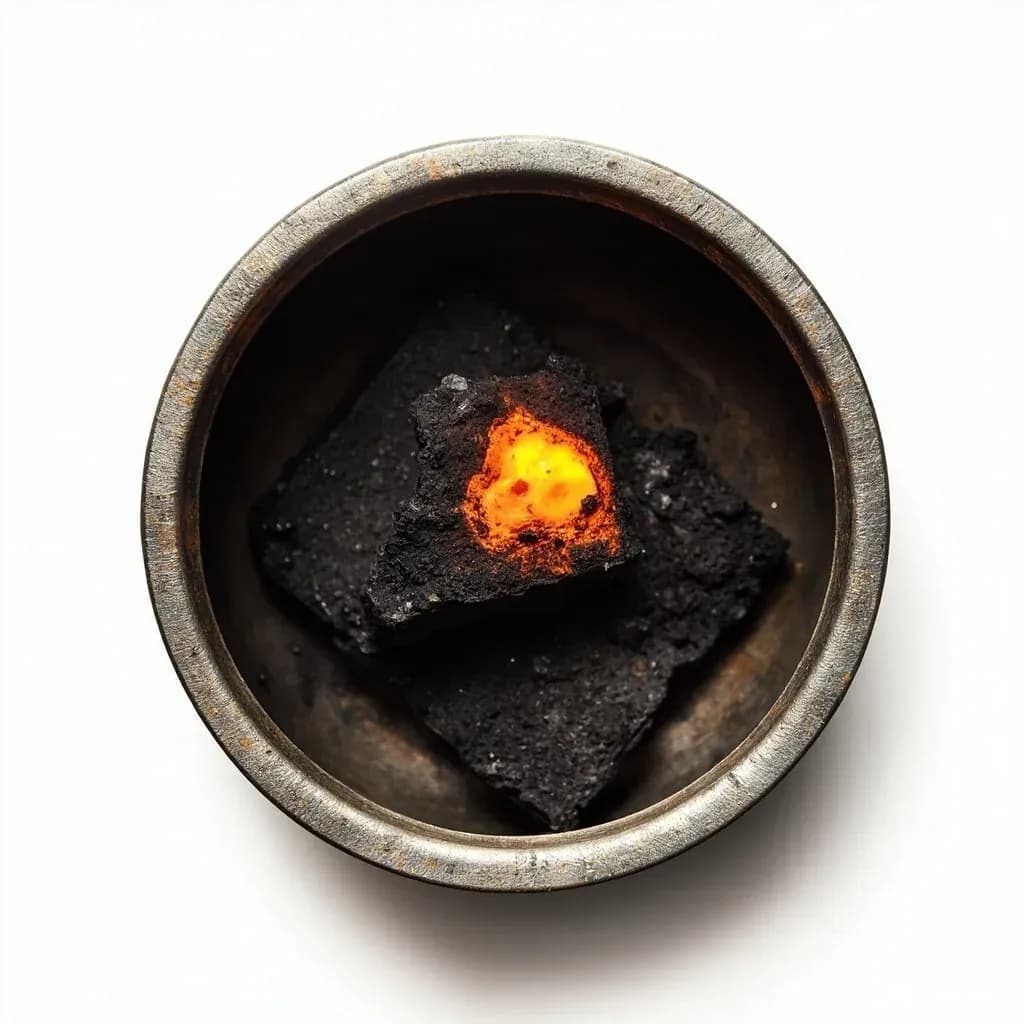
Small metal bowl that holds a smoldering coal to infuse food with smoke via the dhungar method.
A small metal bowl, often a steel katori, used in the Indian dhungar smoking technique to perfume dishes with smoke. A piece of glowing charcoal is placed in the bowl, set into the food (such as dal, biryani, or kebab marinade), topped with ghee, and covered so the rising smoke infuses the dish. It delivers a deep charcoal aroma without an open grill.
The smoking bowl — known across North Indian and Pakistani kitchens as a katori, or sometimes a dum ki katori — is the small, heatproof vessel that holds a single glowing piece of charcoal inside a covered pot so its smoke can perfume the food inside. Dhungar (also written dhuwan) is the broader technique of cold-smoking a finished or nearly finished dish by trapping that smoke, and the katori is simply the piece of equipment that makes it safe and practical: it cradles the coal, catches the dripping ghee that flares into smoke, and keeps the burning embers from touching the food directly. Without a small bowl, you'd be dropping live coals into a curry — disastrous and dangerous — so the katori's role is really about fire management more than flavoring.
What makes a katori work is its size and shape rather than any special construction. About two to three inches across and an inch deep, it nests comfortably in the center of a standard pot or handi, leaving room around it for the food to receive smoke evenly. The walls need to be thick enough to withstand a glowing coal for several minutes without warping, and the material must be non-reactive (stainless steel is the everyday choice; brass and copper are traditional but reactive over long contact). It is an inexpensive, almost disposable piece of equipment — a few dollars for a steel version — yet it unlocks one of the most distinctive finishing moves in South Asian cooking.
In practice, the katori is just one element of a dhungar setup. Equally important are a tight-fitting lid, a way to seal the rim (traditionally a rope of wheat dough pressed around the edge), and a small trivet or salt bed to keep the hot bowl off the surface of the food. Modern restaurants have borrowed the same kit to smoke cocktails, butter, and other ingredients, which speaks to how simple the apparatus really is: a bowl, a coal, a flame, a fat, and a sealed lid.
Alternatives
Types & varieties
The everyday workhorse: non-reactive, dishwasher-safe, cheap, and the default choice for most home cooks.
Traditional and attractive, with excellent heat conduction, but reactive with acidic or salty foods over time — best kept for short smoking sessions and prompt washing.
Heritage option tied to Mughal-era presentation; heats fast but also reactive, so it is used briefly and historically tinned on the inside.
A 1-oz stainless shot cup or 1/4-cup measuring cup doubles as a perfect modern stand-in and is easy to find in any kitchenware aisle.
Disposable one-off option molded from thick aluminum foil — zero cleanup, but flimsier under direct flame and less stable.
Heavier and more stable on a trivet; favored in some restaurant kitchens where the bowl must sit steady over a long smoke.
How a katori fits into dhungar
The katori is not the technique itself — dhungar is the broader practice of trapping smoke inside a covered pot — but it is the piece that makes the technique possible. The sequence runs like this: a dish is fully cooked, the katori is set on a small trivet, a salt bed, or a square of foil in the center of the pot, a walnut-sized piece of hardwood charcoal is heated until glowing red and lightly ashed, and the coal is dropped into the katori with long tongs. A thin film of ghee is spooned on top, which flashes into flame and then thick white smoke. The lid goes on, the rim is sealed with dough or a wet cloth, and the dish rests three to ten minutes while the trapped smoke settles onto the surface of the food. The katori's job ends the moment the lid is sealed; the smoke does the actual flavoring.
- Hold the coal, not the flavor — the katori just makes ignition safe.
- Trap and contain — a tight lid and a sealed rim do the real work of flavoring.
- Smoke lingers — leaving the pot sealed well past ten minutes can turn the flavor acrid and bitter.
Choosing and buying
Most cooks only ever need one stainless-steel katori, and a small steel shot cup from a barware shop makes an excellent substitute. Buy brass or copper versions for the look and the heat response, but treat them as display-and-short-task pieces rather than everyday drivers. The bowl should be wide enough to hold a thumb-sized coal with room to spare, but narrow enough to sit comfortably in your most-used pot or pressure cooker — measure across the inside of the lid if you can, because the katori must clear the lid when it goes on.
- Pick stainless for daily use; save brass and copper for show.
- A 1-oz stainless shot cup is the easiest Western stand-in.
- Match the katori to your pot — it should nest inside without touching the lid.
Common uses
Tips & pitfalls
- Use only natural lump hardwood charcoal — self-lighting briquettes release lighter-fluid vapors that taste chemical in the finished dish.
- Heat the coal over a gas flame, a small chimney, or with a chef's torch until the surface is glowing red and lightly ashed; cold or barely warm coal produces wispy, weak smoke.
- Keep the coal small — about walnut- or thumb-sized — so it fits inside the katori without touching the food and burns through a controlled amount of ghee.
- Spoon on just a thin film of ghee (around 1 teaspoon) once the coal is in the bowl; more fat makes the smoke acrid and the flare harder to control.
- Always rest the katori on a small trivet, a bed of salt, or a piece of foil inside the pot so the hot metal doesn't scorch the food or crack a clay handi.
- Seal the lid promptly — a rope of wheat dough pressed around the rim is traditional; a damp kitchen towel works in a pinch. The smoke needs to be trapped for 3–5 minutes to actually flavor the dish.
- Use long metal tongs to place and remove the katori, keep a metal snuffer or lid and a bowl of water nearby, and work under a range hood or near an open window — the initial flare produces a lot of smoke.
- Don't eat the coal or the spent ash; the flavor comes purely from the trapped smoke, and ash will taste exactly like ash.
Good to know
- Also called
- Katori (Hindi/Urdu for 'small bowl'); occasionally dum ki katori; the coal itself is sometimes called angithi
- Origin
- Indian subcontinent, rooted in Mughlai and North Indian / Pakistani home cooking
- Used in technique
- Dhungar (also dhuwan, dhungar) — cold-smoke finishing of an already cooked or nearly cooked dish
- Typical size
- Roughly 2–3 in (5–7.5 cm) across and about 1 in (2.5 cm) deep — small enough to sit in the center of a pot
- Traditional materials
- Stainless steel (most common), brass, and copper
- Fat traditionally used
- Ghee (clarified butter); sometimes mustard oil or a flavored oil in regional variants
- Sealing method
- Tight lid with a rope of wheat dough pressed around the rim to trap the smoke
- Infusion time
- Typically 3–10 minutes, depending on the dish and intensity desired
- Charcoal
- Natural lump hardwood only — never self-lighting briquettes, which taint the smoke with lighter-fluid flavors
- Smoke source
- A thumb-sized piece of glowing charcoal with a teaspoon of ghee (or flavored oil) dripped on top to flare and billow
- Cost
- A few dollars for basic steel; $10–30 for heritage brass or copper
Also called
Katori · Dhungar Bowl · Smoking Cup
Related

Peeler
Swift blade for stripping skin off fruit and vegetables

Grater
Sharp-toothed surface for shredding cheese and vegetables

Microplane
Ultra-fine rasp for citrus zest, garlic, and hard cheese

Mixing Bowl
All-purpose bowl for combining, whisking, and tossing

Whisk
Looped wires that beat air into eggs, cream, and sauces

Spatula
Flat blade for flipping, lifting, and scraping

Slotted Spoon
Pierced spoon that lifts solids and drains the liquid behind

Wooden Spoon
Gentle, heat-friendly spoon for stirring anything