Prep Tools
Snail Tongs
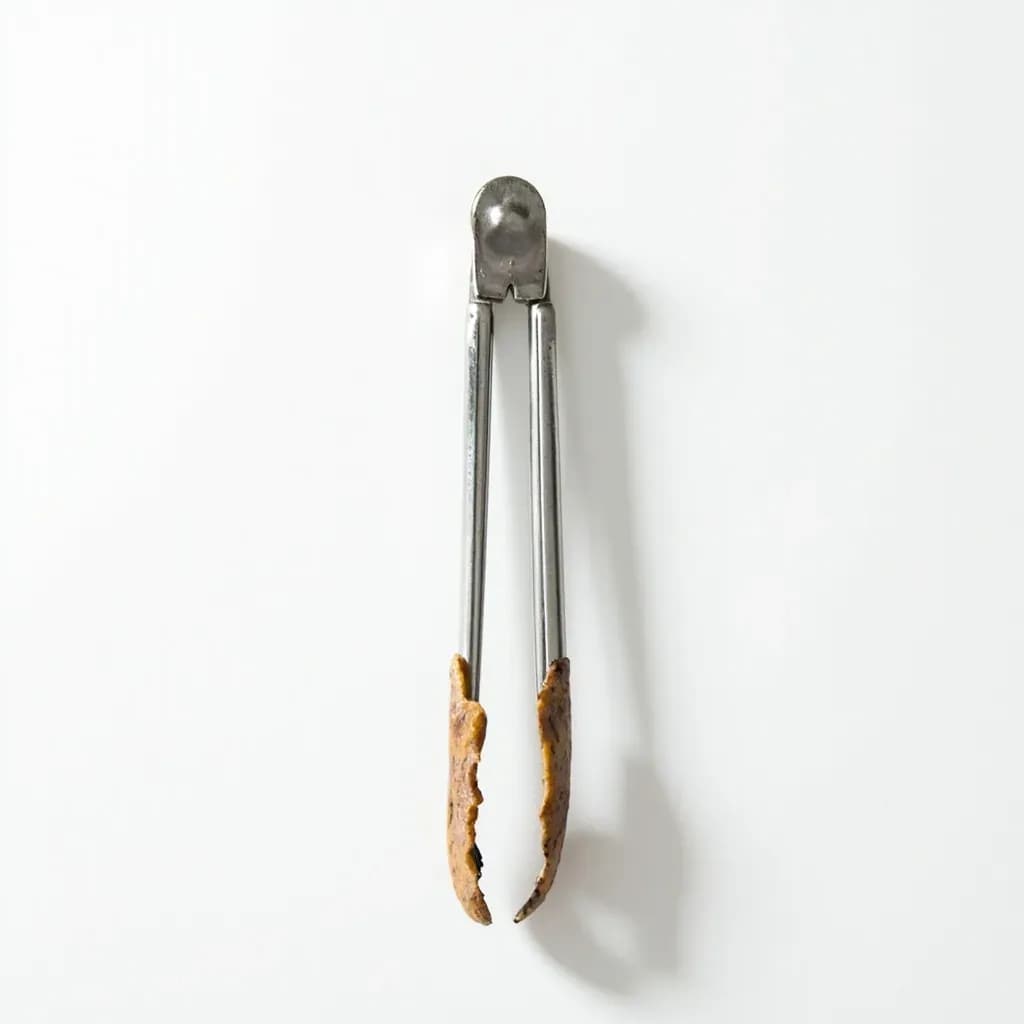
Spring-hinged scissor tongs that grip a hot escargot shell so the meat can be forked out.
Small spring-loaded tongs designed to hold a hot snail shell securely while you extract the meat with a narrow escargot fork. They're a tabletop tool for serving escargot, gripping the slippery, butter-soaked shell without burning fingers. The hinged jaws are shaped to cradle a round shell firmly.
Snail tongs — pince à escargot in French — are a small, spring-loaded scissor implement built for one job: holding a hot, butter-soaked escargot shell steady while the diner works the meat out with a tiny two-tined fork. They look like a miniature pair of scissors, but the arms end in shallow, spoon-shaped cups sized to cradle a single snail shell, and a leaf spring at the pivot keeps them open until you squeeze. That scissor action is what gives you a controlled grip without crushing the thin shell.
They earn their place at the table because escargot leaves the oven at roughly 200 °C / 400 °F, swimming in garlic-herb butter, and the shells are too small and too curved to hold safely with bare fingers, salad tongs, or a napkin. The tongs free one hand entirely so the other can work the fork, which matters when you are working through six or twelve shells in a sitting.
In classical French service they are part of a trio with the dimpled porcelain escargot plate and the small escargot fork (fourchette à escargot); all three are typically sold as a kit. Outside formal escargot service they see occasional use for other small, hot shell-on dishes such as individual baked clams, but they are essentially a single-purpose tool.
Alternatives
Types & varieties
Two crossed arms joined by a pivot with a leaf spring; the most common form found in escargot kits.
Straight plier shape with cupped ends; a simpler, less traditional alternative.
Heavier, polished finish used in classical French table service and special-occasion dining.
Lightweight stamped-steel versions sold in home escargot kits; dishwasher safe.
Holding the shell correctly
The trick with snail tongs is to think of them as a third hand, not as kitchen tongs. The cups are sized for one shell, and the shell needs to sit upright in them so the opening faces up and the butter does not spill.
- Hold the tongs in your non-dominant hand and the escargot fork in your dominant hand.
- Squeeze the tongs just enough to grip — squeezing harder does not give better hold, it just crushes the shell.
- Cup the shell by its widest part so it sits flat and the opening faces up for forking.
- Lower the tongs into the dimple of the escargot plate so the shell is supported from below as well.
Care and storage
Because the spring pivot traps butter and food residue, snail tongs are one of those small tools that go rancid quickly if neglected. A quick rinse and dry after each use keeps them serviceable for years.
- Rinse under hot water immediately after use to flush butter out of the pivot.
- Hand-wash silver-plated versions and dry them right away; the dishwasher will tarnish the finish.
- Stainless versions can go in the dishwasher, but a hand wash still extends the life of the spring.
- Store dry in a drawer or with the rest of the escargot kit so the cups do not get bent out of shape.
Common uses
Tips & pitfalls
- Escargot shells come out of the oven at roughly 200 °C / 400 °F swimming in garlic butter; bare fingers or a napkin will not save you — always use the tongs.
- Do not substitute salad or kitchen tongs: the ends are too wide and will either drop the shell or crush it. A folded linen napkin works in a pinch but soaks up butter and is far less stable.
- Rinse and dry the tongs promptly after use; the spring pivot traps butter that turns rancid if left overnight.
- Silver-plated versions tarnish in the dishwasher — hand-wash and dry them right away to keep the finish bright.
Good to know
- Also called
- Escargot tongs; French: pince à escargot
- Function
- Grips a single hot escargot shell steady so the meat can be forked out
- Mechanism
- Spring-hinged scissor action — open at rest, closed under hand pressure
- Typical material
- Stainless steel; silver-plated versions exist for traditional table service
- Typical length
- About 13–15 cm (5–6 in)
- End shape
- Curved, spoon-like or cupped pads sized to cradle one small snail shell
- Sold as
- Part of an escargot service set (tongs + two-tined fork + dimpled plate) or individually
- Dishwasher safe
- Stainless versions yes; silver-plated versions should be hand-washed to avoid tarnish
Also called
Escargot Tongs · Pince à Escargot
Related

Peeler
Swift blade for stripping skin off fruit and vegetables

Grater
Sharp-toothed surface for shredding cheese and vegetables

Microplane
Ultra-fine rasp for citrus zest, garlic, and hard cheese

Mixing Bowl
All-purpose bowl for combining, whisking, and tossing

Whisk
Looped wires that beat air into eggs, cream, and sauces

Spatula
Flat blade for flipping, lifting, and scraping

Slotted Spoon
Pierced spoon that lifts solids and drains the liquid behind

Wooden Spoon
Gentle, heat-friendly spoon for stirring anything