Prep Tools
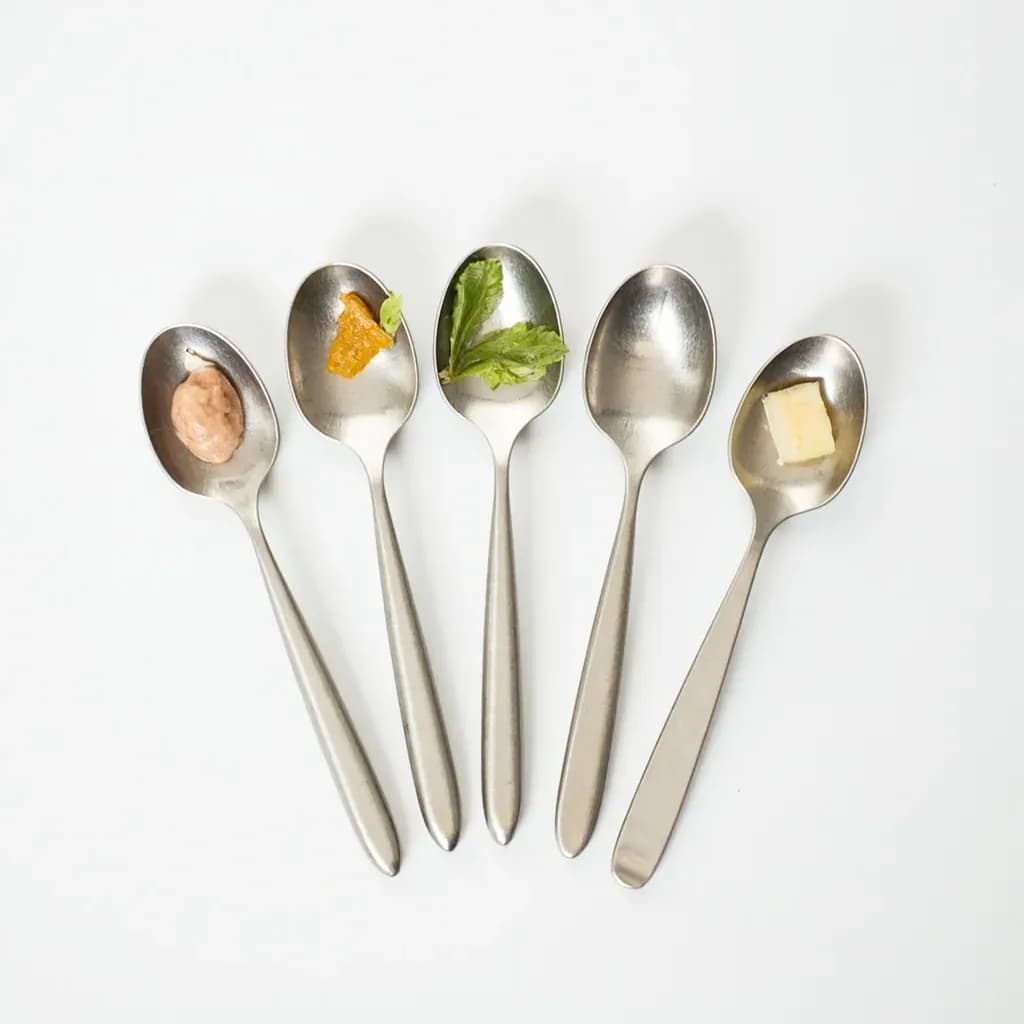
Spherification Spoon Set
Slotted and rounded spoons for forming, dosing, and draining spheres in molecular cuisine.
A set of specialized spoons used in spherification, the molecular-gastronomy technique that turns liquids into caviar-like or yolk-like spheres. The round-bowled spoon doses droplets into a setting bath, while the slotted spoon lifts and drains the finished spheres without breaking them. They're essential for plating gels and flavored pearls cleanly.
A spherification spoon set is a small family of shallow, rounded, and perforated spoons purpose-built for one job in modernist cuisine: dosing controlled drops of sodium alginate liquid into a calcium bath, then lifting the resulting spheres cleanly out. The tool matters because spherification is, at heart, a volume-and-contact-time problem — every sphere gels from the outside in, and the spoon is what fixes the size of the payload and the moment the chemistry starts. A regular teaspoon will technically drop a sphere, but its deeper bowl holds liquid with surface tension that drags and tails, and it cannot drain the bath liquid off in a single motion. A dedicated set solves both problems with shallower bowls, smaller capacities, and a slotted retrieval spoon sized to the spheres it forms.
The set typically centers on three tools: a tiny caviar or pearl spoon for sub-milliliter pearls, a demitasse-sized rounded spoon for 'olive' spheres of roughly half a teaspoon, and a larger tablespoon bowl for yolk- or ravioli-sized spheres. A slotted draining spoon rounds out the kit, used to lift finished spheres from the bath and to gently agitate the liquid so drops don't fuse or settle and stick. Mirror-polished stainless steel is the standard, both for hygiene and chemical resistance and because the smooth surface releases the drop without smearing it.
The spoon set works the same way for both branches of the technique. In basic spherification, the drop carries the alginate and lands in a calcium bath; in reverse spherification, the drop carries calcium lactate and lands in an alginate bath. Choosing the right method — basic for flavored waters and juices without calcium, reverse for dairy, alcohol, and anything already rich in calcium — matters far more than the spoon, but the set is what gives you reproducible sizing either way.
Alternatives
Types & varieties
Very small, shallow cup (½–1 ml); used with a squeeze bottle pointed into the bowl to form uniform tiny pearls, or dipped directly to make caviar-sized beads.
Rounded bowl holding roughly ½ teaspoon; the workhorse for olive-sized spheres and cocktail garnishes.
Tablespoon-capacity bowl; used for yolk- or ravioli-sized spheres and for reverse-spherified fillings.
Fine slits or perforations that lift spheres from the calcium bath while letting the liquid fall away; usually deeper and oval-bowled.
Hybrid tool with a small bulb or pipette behind the spoon for extra control over release; sold by some modernist suppliers.
Heat- and chemical-resistant silicone head on a rigid handle; favoured for non-stick release of thicker batters.
Basic vs Reverse Spherification
The spoon set is identical for both methods, but the chemistry is mirrored, and picking the wrong one will leave you with collapsed spheres no matter how good your spoon technique is. In basic spherification, the flavored liquid is blended with sodium alginate and dropped into a bath of calcium chloride or calcium lactate; a thin skin forms on contact and thickens inward. The catch is that the flavored liquid must contain no calcium and only modest acidity, so dairy, hard water, and most fresh-fruit juices are off-limits unless you adjust. In reverse spherification — developed later at elBulli — the flavored liquid is blended with calcium lactate and dropped into an alginate bath. Because the gelling happens in the bath rather than in the drop, the sphere can be rinsed and held for hours without collapsing, and dairy, alcohol, and high-acid liquids all work.
- Basic: drop carries alginate, bath carries calcium. Best for flavored waters, vinegars, and clarified juices without calcium.
- Reverse: drop carries calcium lactate, bath carries alginate. Required for dairy, alcohol, and anything with inherent calcium.
- Time in bath: 30 seconds to 3 minutes is the working window; pull earlier for a thin 'burst' membrane, later for a chewy skin.
- Rinse finished spheres in plain or distilled water to stop the gelling reaction and halt further membrane thickening.
Common uses
Tips & pitfalls
- Hold the spoon as close to the bath surface as possible — a 1–2 cm drop minimizes the tail or 'comet' that forms when liquid falls from height.
- Angle the spoon and tap the rim against the bath's edge to release the drop cleanly; pushing it off with a finger transfers skin oils and can rupture the membrane on the next drop.
- Pull spheres at 1–2 minutes for a thin, 'burst-in-the-mouth' membrane; longer baths thicken the wall and can leave the center hollow or cause collapse on rinse.
- After lifting, plunge the spheres into a bowl of plain (preferably distilled) water; any residual calcium chloride will continue gelling and ruin texture if left on.
- For basic spherification, the liquid must contain no calcium — avoid dairy, hard water, and many fresh-fruit juices. Switch to reverse spherification with calcium lactate inside the drop and an alginate bath instead.
- Acidic liquids above roughly 5% acid by weight inhibit gelling with sodium alginate; add a small amount of gellan or switch to the reverse method for citrus work.
- Work in small batches. The bath loses potency as calcium is depleted, and old baths produce soft, leaking spheres with uneven membranes.
- Rinse the slotted spoon between batches — calcium residue on the spoon can pre-set the next drop before it leaves the bowl, giving you a teardrop instead of a sphere.
- If a drop sticks to the spoon, dip the bowl into the bath first to wet it; a thin film of calcium water acts as a release agent for the next drop.
- Store the set dry; residual salt from baths will pit cheap stainless steel over time.
Good to know
- Origin of technique
- Developed in the early 2000s by Ferran Adrià and the elBulli team in Catalonia, Spain, as part of the molecular gastronomy movement.
- Primary function
- Dosing controlled volumes of sodium alginate or calcium lactate liquid into a reactive bath, and retrieving the formed spheres.
- Typical set composition
- Three or four spoons: a small caviar/pearl spoon, a medium rounded forming spoon, a large tablespoon spoon, and a slotted draining spoon.
- Material
- Usually mirror-polished stainless steel; some sets use food-grade silicone heads on rigid handles.
- Standard capacities
- Caviar spoon approx. 0.5–1 ml; medium spoon approx. 2.5–5 ml (½ tsp); large spoon approx. 15 ml (1 tbsp).
- Pairs with chemicals
- Sodium alginate and calcium chloride or calcium lactate — the two gelling agents that drive the reaction.
- Bath temperature
- Works at room temperature; chilled or iced baths slow the gelling slightly and help delicate flavors hold.
- Time in bath
- Typically 30 seconds to 3 minutes depending on desired membrane thickness.
Also called
Caviar Spoon Set · Molecular Gastronomy Spoons
Related

Peeler
Swift blade for stripping skin off fruit and vegetables

Grater
Sharp-toothed surface for shredding cheese and vegetables

Microplane
Ultra-fine rasp for citrus zest, garlic, and hard cheese

Mixing Bowl
All-purpose bowl for combining, whisking, and tossing

Whisk
Looped wires that beat air into eggs, cream, and sauces

Spatula
Flat blade for flipping, lifting, and scraping

Slotted Spoon
Pierced spoon that lifts solids and drains the liquid behind

Wooden Spoon
Gentle, heat-friendly spoon for stirring anything